What this friendship drift quiz measures
This am I losing my best friend quiz estimates how often friendship drift signals show up with your closest friend and how they may connect to adult closeness habits. Twenty original frequency items group into four drift domains inspired by friendship maintenance research: communication fade, priority shift, emotional withdrawal, and bond erosion. Each item also maps to a fear-of-intimacy stack layer so you can see whether vulnerability pull-back, trust hesitation, self-disclosure limits, or closeness anxiety feels strongest. Your friendship drift index averages these patterns into a 0 to 100 score with plain-language bands.
Communication fade
Slower replies, shallow threads, hesitation to reach out, and wondering if silence means pull-back.
Priority shift
Learning news secondhand, leftover schedule slots, and no longer being first for milestones.
Emotional withdrawal
Skipped follow-ups, dropped warmth, performative small talk, and holding back harder topics.
Bond erosion
Fading inside jokes, abandoned future plans, acquaintance-level closeness, and lost daily rhythm.
How it works
Three steps from first question to your friendship drift report with fear-of-intimacy stack. Click Start Quiz to open the interactive quiz in a full-screen modal.
Answer 20 frequency items
Rate how often each drift pattern and closeness habit shows up when you think about your best friend, from Never to Almost always. You click Next after each answer; nothing auto-advances.
Items map to drift domains and intimacy stack
Your answers accumulate percentages for communication fade, priority shift, emotional withdrawal, and bond erosion, plus four fear-of-intimacy stack layers.
View band and dual charts
Results show Lower, Mixed, or Higher Friendship Drift with drift domain bars and a fear-of-intimacy stack chart. Higher bands include crisis resources.
Take the am I losing my best friend quiz
Rate 20 statements about your best friend and how the friendship feels lately. Your answers produce a friendship drift index from 0 to 100, a fear-of-intimacy stack index, four domain scores, and a band label for reflection or therapy conversation.
Opens in a focused modal. No account required. Results stay on screen.
What your result means
Your friendship drift index is the normalized total across all 20 items on a 0 to 100 scale, with reverse scoring on protective items so higher scores mean more drift concern overall. The fear-of-intimacy stack index uses the same answers mapped to vulnerability, trust, disclosure, and closeness anxiety layers. Domain bars show endorsement rates so you can see whether communication fade, priority shift, emotional withdrawal, or bond erosion drives your result most.
| Band | Index range | Typical reading |
|---|---|---|
| Lower Friendship Drift | 0 to 35 | Fewer drift signals on this screener; normal busy seasons or new partners may still create brief distance |
| Mixed Friendship Drift | 36 to 65 | Blend of closeness history and growing distance; worth naming in conversation if persistent |
| Higher Friendship Drift | 66 to 100 | Frequent communication fade, deprioritization, or emotional distance; professional support may help |
What your friendship drift report looks like
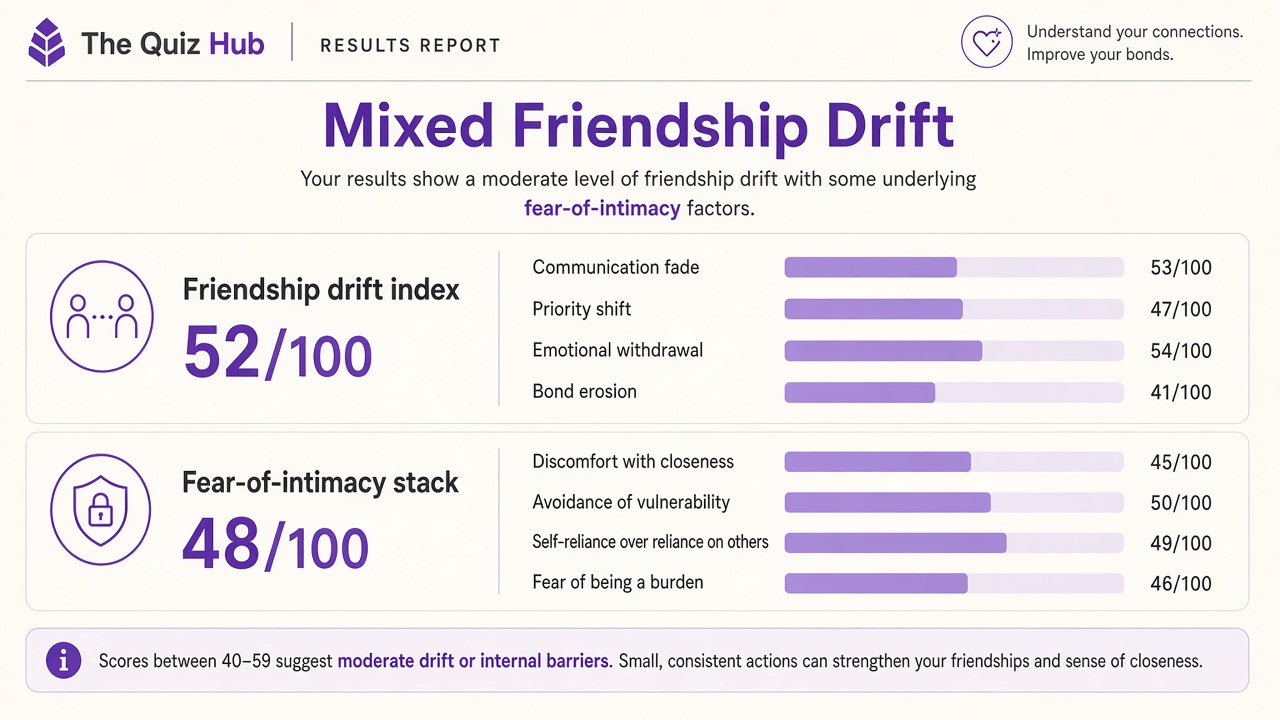
After all 20 items, you get a friendship drift index from 0 to 100, a band label, four drift domain bars, and a fear-of-intimacy stack chart with vulnerability pull-back, trust hesitation, self-disclosure limits, and closeness anxiety layers. Percentages reflect how you experience distance with your best friend and adult closeness habits, not proof they are leaving.
What this quiz can and cannot tell you
Can tell you
- How often friendship drift signals showed up for you with your best friend lately
- A friendship drift index and fear-of-intimacy stack index with domain bars
- Which drift domain or intimacy stack layer feels strongest in your current experience
- A starting point for therapy conversation about friendship grief and adult closeness patterns
Cannot tell you
- Whether your best friend is leaving or has already decided to end the friendship
- Whether distance means rejection without an honest conversation with your friend
- Whether the friendship can recover without mutual effort and clear communication
- What treatment you need without a licensed clinician's evaluation
Friendship drift, maintenance, and the fear-of-intimacy stack
Social psychologists Laura VanderDrift and Christopher Agnew (2012) studied how close friends maintain bonds through shared time, mutual disclosure, and coordinated future plans. When those maintenance behaviors drop, drift can feel like grief even before anyone says the friendship is over. Communication researchers also note that reply latency and news learned secondhand often signal shifting priority rather than malice, while emotional withdrawal may trace to unspoken hurt, envy, or life overload on either side.
The Quiz Hub built this am I losing my best friend quiz as an original self-report screener inspired by those themes, not a reproduction of any single published instrument. Readers often compare it to sibling tools on this site. Our is my friend toxic quiz screens drain, disrespect, and guilt pressure. The am I in the friend zone quiz maps romantic ambiguity with a close friend. The fear of intimacy quiz maps vulnerability avoidance in romantic bonds without a best-friend frame.
| The Quiz Hub test | What it adds |
|---|---|
| Is my friend toxic quiz | Emotional drain, disrespect, unreliability, and guilt pressure domains |
| Is my friend a narcissist quiz | Competitiveness, empathy gaps, possessiveness, conditional loyalty tied to status |
| Am I in the friend zone quiz | Romantic ambiguity signals, not communication fade or priority shift |
| Fear of intimacy quiz | FOIS-inspired avoidance index without friendship drift domains |
| Do I have trust issues quiz | Hypervigilance and repair doubt across relationships, not best-friend drift |
| This friendship drift quiz | Friendship drift index plus parallel fear-of-intimacy stack layers |
Sample item types include frequency ratings such as whether you learn big news about them from social media instead of directly, or whether inside jokes and shared references fade without replacement. High communication fade with high priority shift scores often lands in Mixed or Higher Friendship Drift. New partners, cross-country moves, and demanding jobs can spike scores temporarily without ending the bond. Read how we review quizzes in our editorial policy or browse more tools on our relationships and dating hub.
Am I losing my best friend quiz FAQ
What does friendship drift mean?
Friendship drift describes the slow widening of distance between close friends: slower replies, feeling deprioritized, shallow hangouts, and fading shared rituals even when affection may still exist. Life stages, new partners, moves, and unspoken hurt can all contribute. This am I losing my best friend quiz measures how often those drift signals show up with your best friend lately and how they may connect to your fear-of-intimacy stack in adult bonds. It is not proof the friendship is over.
What does this friendship drift quiz measure?
Twenty original frequency items ask how often you notice communication fade, priority shift, emotional withdrawal, and bond erosion when you think about your best friend. Each item also maps to a fear-of-intimacy stack layer: vulnerability pull-back, trust hesitation, self-disclosure limits, and closeness anxiety. You receive a friendship drift index from 0 to 100 and a band from Lower through Higher Friendship Drift.
What is the fear-of-intimacy stack on this quiz?
The fear-of-intimacy stack is a second results chart inspired by FOIS-style intimacy avoidance themes, adapted to friendship distance. Each of the 20 items maps to one of four stack layers showing how drift signals may connect to adult closeness habits: hiding vulnerability, testing trust, limiting disclosure, or panicking when bonds deepen. The stack index summarizes those layers alongside the friendship drift index.
How is this different from the is my friend toxic quiz?
The is my friend toxic quiz screens emotional drain, disrespect, flaky support, and guilt pressure patterns that wear you down. This am I losing my best friend quiz focuses on distance signals: slower contact, feeling like a backup friend, emotional withdrawal, and fading shared future talk. It uses a best-friend drift frequency frame plus a parallel fear-of-intimacy stack rather than toxic friendship domains.
Can this quiz tell me if my best friend is leaving?
No. The friendship drift index describes self-reported distance signals on this abbreviated screener. Busy seasons, new relationships, and geographic moves can raise scores without the bond ending. Only you and your friend can clarify intentions through honest conversation. Online quizzes cannot predict breakups, prove rejection, or replace your judgment about whether to reach out.
Who reviewed this content?
Dr. Priya Sharma, PhD, reviewed the test framing and result explanations. See our editorial policy for review standards.
Reviewed by