What this rebound relationship quiz measures
This rebound relationship quiz estimates how often post-breakup coping patterns show up in your current or recent romance. Twenty original frequency items group into four rebound domains inspired by breakup recovery research from Claudia Brumbaugh, R. Chris Fraley, and Stephanie Spielmann: post-breakup timing, ex comparison, distraction use, and genuine investment. Each item also maps to a fear-of-intimacy stack layer so you can see whether vulnerability pull-back, trust hesitation, self-disclosure limits, or closeness anxiety drives confusion most. Your rebound pattern index averages these signals into a 0 to 100 score where higher numbers mean more rebound pattern endorsement.
Post-breakup timing
Rushed dating, loneliness-driven jumps, faster-than-usual pace, and whirlwind romance after a split.
Ex comparison
Ranking new partners against an ex, social media checks, relief comparisons, and unfair ex mentions.
Distraction use
Using romance to numb grief, packed schedules, panic when alone, and choosing partners to quiet pain.
Genuine investment
Curiosity about the new person, future plans, present listening, and learning their world beyond honeymoon energy.
How it works
Three steps from first question to your rebound pattern report with fear-of-intimacy stack. Click Start Quiz to open the interactive quiz in a full-screen modal.
Answer 20 frequency items
Rate how often each rebound pattern shows up when you think about dating after a breakup, from Never to Almost always. You click Next after each answer; nothing auto-advances.
Items map to rebound domains and intimacy stack
Your answers accumulate percentages for post-breakup timing, ex comparison, distraction use, and genuine investment, plus four fear-of-intimacy stack layers.
View band, domain bars, and stack chart
Results show Lower Rebound Patterns, Mixed Rebound Signals, or Strong Rebound Patterns with domain bars, stack layers, and reflection prompts.
Take the rebound relationship quiz
Rate 20 statements about dating after a breakup. Your answers produce a rebound pattern index from 0 to 100, four domain scores, a fear-of-intimacy stack chart, and a band label for reflection or pacing talks.
Opens in a focused modal. No account required. Results stay on screen.
What your rebound pattern result means
Your rebound pattern index is the normalized total across all 20 items on a 0 to 100 scale. Higher scores mean more frequent endorsement of rushed timing, ex comparison, distraction use, and limited genuine investment items on this screener. Domain bars show endorsement rates so you can see whether speed, comparison, grief avoidance, or low investment drives your result most. The fear-of-intimacy stack chart shows parallel layers for vulnerability pull-back, trust hesitation, self-disclosure limits, and closeness anxiety while dating after a split.
| Band | Index range | Typical reading |
|---|---|---|
| Lower Rebound Patterns | 0 to 35 | Fewer rebound signals; grounded dating after healing time can still score here |
| Mixed Rebound Signals | 36 to 65 | Blend of real connection and post-breakup coping; worth slowing pace and naming grief |
| Strong Rebound Patterns | 66 to 100 | Frequent rushed timing, ex comparison, distraction use, or low investment; grief work or support may help |
What your rebound report looks like
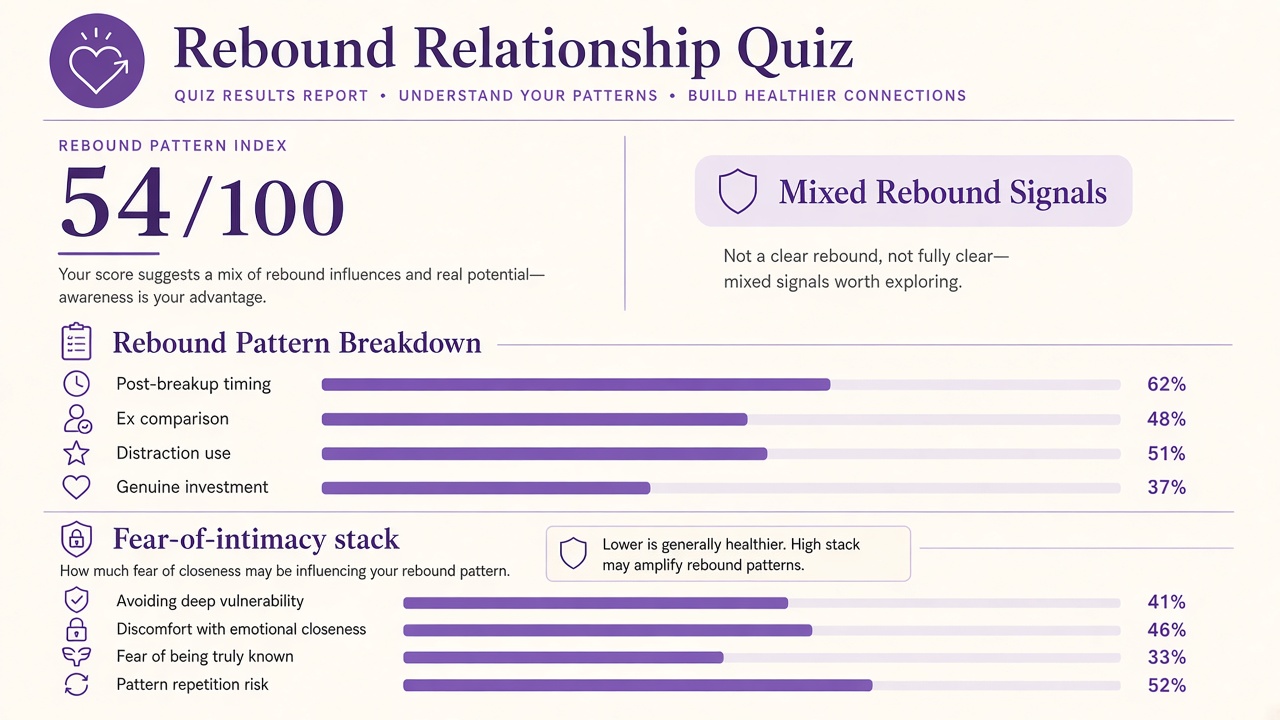
After all 20 items, you get a rebound pattern index from 0 to 100, a band label, four domain bars for post-breakup timing, ex comparison, distraction use, and genuine investment, plus a fear-of-intimacy stack chart with vulnerability, trust, disclosure, and closeness anxiety layers.
What this quiz can and cannot tell you
Can tell you
- How often rebound pattern signals showed up in your current or recent relationship on this screener
- A rebound pattern index and four domain bars for timing, comparison, distraction, and investment
- A fear-of-intimacy stack showing which closeness-avoidance layer feels strongest after a breakup
- A starting point for pacing talks, grief work, or therapy
Cannot tell you
- Whether you are officially in a rebound without your own judgment and honest reflection
- Whether your new partner is right or wrong for you in your specific context
- Whether you should stay or leave without dialogue, pacing, and self-trust
- What treatment you need without licensed professional guidance
Rebound timing, ex comparison, and grief avoidance
Rebound relationships entered everyday dating language as shorthand for starting someone new before the last breakup has settled. Psychologists Claudia Brumbaugh and R. Chris Fraley published work in 2015 on how people use new partners to regulate post-breakup distress, while Stephanie Spielmann and colleagues studied how fear of being single can push rushed attachment. Those findings help explain why rebound is not always fake love: sometimes chemistry is real while grief, comparison, and distraction still run underneath.
The Quiz Hub built this rebound relationship quiz as an original self-report screener inspired by those themes plus FOIS-style intimacy avoidance layers, not a reproduction of any single published instrument. Readers often compare it to sibling tools on this site. Our am I desperate for love quiz screens attachment urgency across dating in general. The fear of intimacy quiz measures vulnerability pull-back across closeness, not post-breakup timing frequency. The trauma bond quiz screens cycle intensity and loyalty isolation in high-conflict bonds rather than ex comparison after a split.
| The Quiz Hub test | What it adds |
|---|---|
| Am I desperate for love quiz | Attachment urgency index, not ex comparison or post-breakup timing |
| Fear of intimacy quiz | General intimacy avoidance across vulnerability and trust, not rebound-specific habits |
| Trauma bond quiz | Cycle intensity and hope pendulum in high-conflict bonds, not rebound timing |
| Am I afraid of love quiz | Love avoidance and romantic panic, not distraction use after a breakup |
| Attachment style test | Anxiety and avoidance quadrants, not ex comparison frequency |
| This rebound relationship quiz | Rebound pattern index plus fear-of-intimacy stack for timing, comparison, distraction, and investment |
Sample item types include frequency ratings such as whether you compare your new partner's traits to your ex, or whether you feel curious about them as their own person rather than a replacement. High post-breakup timing with high ex comparison often lands in Mixed or Strong Rebound Patterns. Dating months after a mutual split with honest grief work can score in Lower Rebound Patterns even when the new relationship moves quickly. Read how we review quizzes in our editorial policy or browse more tools on our relationships and dating hub.
Rebound relationship quiz FAQ
What is a rebound relationship?
A rebound relationship usually means starting a new romance soon after a breakup, sometimes to distract from grief, avoid loneliness, or prove you have moved on. Psychologists such as Claudia Brumbaugh and R. Chris Fraley (2015) and earlier work by Stephanie Spielmann and colleagues studied how people use new partners to regulate post-breakup distress. Rebound does not always mean the new relationship is fake, but timing, ex comparison, and distraction habits can signal you are not fully present yet. This rebound relationship quiz measures how often those patterns show up in your experience. It is not proof you are in a rebound or a clinical diagnosis.
What does this rebound relationship quiz measure?
Twenty original frequency items ask how often you notice rushed post-breakup timing, ex comparison, distraction use, and limited genuine investment in a current or recent relationship. Scores map to four rebound domains plus a parallel fear-of-intimacy stack with vulnerability pull-back, trust hesitation, self-disclosure limits, and closeness anxiety layers. You receive a rebound pattern index from 0 to 100 where higher scores mean more rebound signals, plus a band from Lower Rebound Patterns through Strong Rebound Patterns.
What is the fear-of-intimacy stack on this quiz?
The fear-of-intimacy stack is a second results chart inspired by FOIS-style intimacy avoidance themes, adapted to post-breakup dating. Each of the 20 items also maps to one of four stack layers: vulnerability pull-back, trust hesitation, self-disclosure limits, and closeness anxiety. The stack index summarizes how often you dodge grief talks, assume honesty will scare someone off, edit breakup history, or panic when alone while dating someone new.
How is this different from the am I desperate for love quiz?
The am I desperate for love quiz screens attachment urgency: pace rushing, standards bending, loneliness intolerance, and validation chasing across dating in general. This rebound relationship quiz focuses on post-breakup habits: how soon you started, whether you compare partners to an ex, and whether you use romance to numb grief. It adds a fear-of-intimacy stack layer that the desperation quiz does not include.
Can this quiz prove I am in a rebound?
No. The rebound pattern index describes self-reported pattern signals on this abbreviated screener. Fast-moving love after a clean break, long-distance pacing, or cultural differences can raise scores without dysfunction. Only you plus honest reflection and dialogue can define whether your pace fits your healing. Online quizzes cannot confirm or deny a rebound label.
Who reviewed this content?
Dr. Priya Sharma, PhD, reviewed the test framing and result explanations. See our editorial policy for review standards.
Reviewed by