What this toxic friendship quiz measures
This is my friend toxic quiz estimates how often toxic friendship pattern signals show up with someone in your circle and how they may connect to adult closeness habits. Twenty original frequency items group into four friend domains inspired by friendship psychology on emotional labor and boundary strain: emotional drain and one-sided support, disrespect and belittling, unreliability and fair-weather patterns, and manipulation with guilt pressure. Each item also maps to a fear-of-intimacy stack layer so you can see whether vulnerability pull-back, trust hesitation, self-disclosure limits, or closeness anxiety feels strongest. Your toxic friendship index averages these patterns into a 0 to 100 score with plain-language bands.
Emotional drain and one-sided support
Exhausting vent sessions, rare curiosity about your life, dreading their calls, and fear your stress becomes gossip.
Disrespect and belittling
Jokes at your expense, public corrections, sarcasm about your dreams, and downplaying your wins.
Unreliability and fair-weather patterns
Disappearing when you need help, last-minute cancellations, broken promises, and skipped check-ins.
Manipulation and guilt pressure
Guilt trips about limits, mood responsibility, passive aggression, and scorekeeping old favors.
How it works
Three steps from first question to your toxic friendship report with fear-of-intimacy stack. Click Start Quiz to open the interactive quiz in a full-screen modal.
Answer 20 frequency items
Rate how often each friendship pattern and closeness habit shows up when you think about this person, from Never to Almost always. You click Next after each answer; nothing auto-advances.
Items map to friendship domains and intimacy stack
Your answers accumulate percentages for emotional drain, disrespect, unreliability, and manipulation domains, plus four fear-of-intimacy stack layers.
View band and dual charts
Results show Lower, Mixed, or Higher Toxic Friendship Concern with friendship domain bars and a fear-of-intimacy stack chart. Higher bands include crisis resources.
Take the is my friend toxic quiz
Rate 20 statements about this friend and how the friendship feels. Your answers produce a toxic friendship index from 0 to 100, a fear-of-intimacy stack index, four domain scores, and a band label for reflection or therapy conversation.
Opens in a focused modal. No account required. Results stay on screen.
What your result means
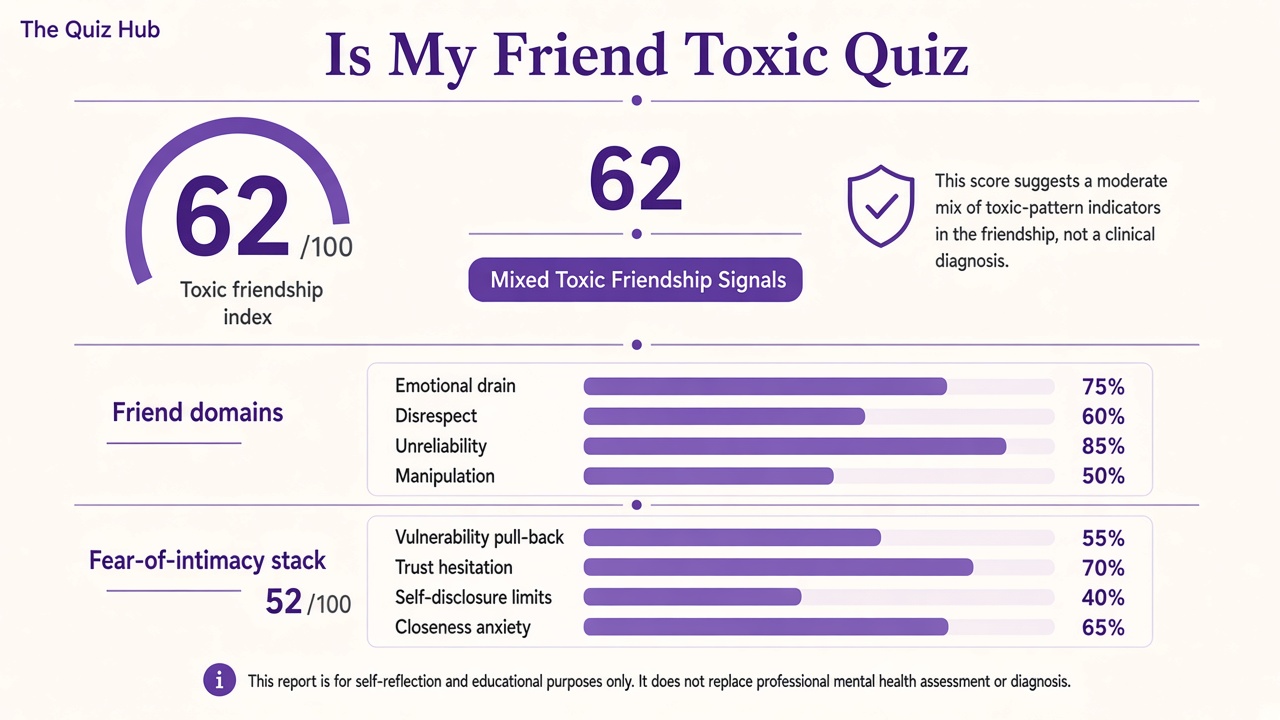
Your toxic friendship index is the normalized total across all 20 items on a 0 to 100 scale, with reverse scoring on protective items so higher scores mean more concern overall. The fear-of-intimacy stack index uses the same answers mapped to vulnerability, trust, disclosure, and closeness anxiety layers. Domain bars show endorsement rates so you can see whether emotional drain, disrespect, unreliability, or manipulation drives your result most.
| Band | Index range | Typical reading |
|---|---|---|
| Lower Toxic Friendship Concern | 0 to 35 | Fewer toxic friendship pattern signals on this screener; normal friction or group drama may still appear |
| Mixed Toxic Friendship Signals | 36 to 65 | Blend of good memories and strain; worth tracking if persistent across seasons |
| Higher Toxic Friendship Concern | 66 to 100 | Frequent drain, disrespect, unreliability, or guilt pressure; professional support may help |
What your toxic friendship report looks like
After all 20 items, you get a toxic friendship index from 0 to 100, a band label, four friendship domain bars, and a fear-of-intimacy stack chart with vulnerability pull-back, trust hesitation, self-disclosure limits, and closeness anxiety layers. Percentages reflect how you experience this friend and adult closeness habits, not a clinical verdict about their personality.
What this quiz can and cannot tell you
Can tell you
- How often toxic friendship pattern signals showed up for you with this person
- A toxic friendship index and fear-of-intimacy stack index with domain bars
- Which friendship domain or intimacy stack layer feels strongest in your current experience
- A starting point for therapy conversation about friendship wounds and adult closeness patterns
Cannot tell you
- Whether your friend has a personality disorder or any clinical diagnosis
- Whether the friendship is abusive without your own judgment and professional support
- Whether the friendship can heal without honest dialogue and mutual effort
- What treatment you need without a licensed clinician's evaluation
Toxic friendships, emotional labor, and the fear-of-intimacy stack
Clinical psychologist Andrea Bonior (2018) writes that unhealthy friendships often feature chronic one-sidedness, subtle put-downs, and guilt when you set limits, patterns that can leave you drained even when shared history runs deep. Friendship researchers also note that fair-weather friends may show up for parties but vanish during grief, illness, or moves, while manipulative friends may keep score of favors to win arguments. Those habits can raise fear-of-intimacy stack scores in romantic bonds years later when you learned to edit yourself or expect betrayal.
The Quiz Hub built this is my friend toxic quiz as an original self-report screener inspired by those themes, not a reproduction of any single published instrument. Readers often compare it to sibling tools on this site. Our is my friend a narcissist quiz screens competitiveness and status-based loyalty. The are your parents toxic quiz covers family-of-origin criticism and guilt pressure. The fear of intimacy quiz maps vulnerability avoidance in romantic bonds without a friendship frame.
| The Quiz Hub test | What it adds |
|---|---|
| Is my friend a narcissist quiz | Competitiveness, empathy gaps, possessiveness, conditional loyalty tied to status |
| Are your parents toxic quiz | Family-of-origin criticism, guilt trips, boundary violations with caregivers |
| Do I have trust issues quiz | Hypervigilance and repair doubt across relationships, not friend drain domains |
| Fear of intimacy quiz | FOIS-inspired avoidance index without toxic friendship domains |
| Am I a people pleaser quiz | Approval seeking and boundary strain you bring into relationships |
| This toxic friendship quiz | Toxic friendship index plus parallel fear-of-intimacy stack layers |
Sample item types include frequency ratings such as whether you dread their calls knowing you will spend hours listening without reciprocal care, or whether you get guilt-tripped for setting limits on time, money, or favors. High emotional drain with high manipulation scores often lands in Mixed or Higher Toxic Friendship Concern. Group trips, weddings, and career milestones can spike scores temporarily. Read how we review quizzes in our editorial policy or browse more tools on our relationships and dating hub.
Is my friend toxic quiz FAQ
What makes a friendship feel toxic?
In everyday language, a toxic friendship often describes recurring patterns that wear you down: one-sided emotional labor, put-downs disguised as jokes, disappearing when you need support, or guilt trips when you set limits. Clinical personality disorders require a formal evaluation and are not the same as a difficult friend during stress. This is my friend toxic quiz measures how often those pattern signals show up with someone in your circle and how they may shape your fear-of-intimacy stack in adult bonds. It is not proof your friend is irredeemably toxic.
What does this toxic friendship quiz measure?
Twenty original frequency items ask how often you notice emotional drain and one-sided support, disrespect and belittling, unreliability and fair-weather patterns, and manipulation with guilt pressure when you think about this friend. Each item also maps to a fear-of-intimacy stack layer: vulnerability pull-back, trust hesitation, self-disclosure limits, and closeness anxiety. You receive a toxic friendship index from 0 to 100 and a band from Lower through Higher Toxic Friendship Concern.
What is the fear-of-intimacy stack on this quiz?
The fear-of-intimacy stack is a second results chart inspired by FOIS-style intimacy avoidance themes, adapted to uneven friendship dynamics. Each of the 20 items maps to one of four stack layers showing how toxic friendship pattern signals may connect to adult closeness habits: hiding vulnerability, testing trust, limiting disclosure, or panicking when bonds deepen. The stack index summarizes those layers alongside the toxic friendship index.
How is this different from the is my friend a narcissist quiz?
The is my friend a narcissist quiz screens competitiveness, empathy gaps, possessiveness of your social circle, and loyalty tied to status. This is my friend toxic quiz focuses on drain, disrespect, flaky support, and guilt pressure patterns that wear you down over time. It uses a friendship frequency frame plus a parallel fear-of-intimacy stack rather than narcissism trait domains.
Can this quiz label my friend as toxic?
No. The toxic friendship index describes self-reported pattern signals on this abbreviated screener. Group drama, busy seasons, and mismatched communication can raise scores without a clinically toxic personality. Only a licensed clinician can evaluate personality disorders through structured interviews. Online quizzes cannot confirm abuse, prove toxicity, or replace your judgment about whether to stay or leave.
What should I do if I get a higher toxic friendship band?
Consider scheduling an evaluation with a licensed therapist who treats relational trauma and friendship wounds. Reflect on whether firmer boundaries, distance, or ending the friendship supports your peace. If you feel unsafe or in crisis, call or text 988 (US) or your local crisis line.
Who reviewed this content?
Dr. Priya Sharma, PhD, reviewed the test framing and result explanations. See our editorial policy for review standards.
Reviewed by