What this people pleaser quiz measures
This am I a people pleaser quiz estimates how often accommodation patterns show up when other people want something from you. Twenty-two original frequency items group into four domains drawn from people-pleasing and boundary research: approval seeking, conflict avoidance, self-neglect, and guilt about boundaries. Your people-pleasing index averages these patterns into a 0 to 100 score with plain-language bands. It reflects your self-report about expectations, not whether you are objectively "too nice."
Approval seeking
Saying yes when tired, adjusting views for likability, and feeling uneasy until others seem pleased.
Conflict avoidance
Avoiding arguments, nodding along, steering away from tension, and apologizing to restore calm.
Self-neglect
Skipping rest or goals for others, deferring preferences, and feeling selfish about solo time.
Guilt about boundaries
Guilt when declining requests, over-explaining no, and accepting extra work to avoid disappointment.
How it works
Three steps from first question to your people-pleasing report. Click Start Quiz to open the interactive quiz in a full-screen modal.
Answer 22 frequency items
Rate how often each accommodation pattern shows up when you think about other people's expectations, from Never to Almost always. You click Next after each answer; nothing auto-advances.
Items map to four domains
Your answers accumulate percentages for approval seeking, conflict avoidance, self-neglect, and guilt about boundaries, plus an overall people-pleasing index.
View band and domain bars
Results show Lower, Mixed, or Higher People-Pleasing with domain bars and reflection prompts. Higher bands include crisis resources.
Take the am I a people pleaser quiz
Rate 22 statements about how you handle other people's expectations. Your answers produce a people-pleasing index from 0 to 100, four domain scores, and a band label for reflection or therapy conversation.
Opens in a focused modal. No account required. Results stay on screen.
What your result means
Your people-pleasing index is the normalized total across all 22 items on a 0 to 100 scale, with reverse scoring on healthy-boundary items so higher scores mean more people-pleasing overall. Domain bars show endorsement rates so you can see whether approval seeking, conflict avoidance, self-neglect, or guilt about boundaries drives your result most.
| Band | Index range | Typical reading |
|---|---|---|
| Lower People-Pleasing | 0 to 35 | Fewer over-accommodation patterns on this screener; occasional yes-saying during busy weeks may still appear |
| Mixed People-Pleasing | 36 to 65 | Blend of kindness and putting others' comfort first; worth tracking if resentment builds |
| Higher People-Pleasing | 66 to 100 | Frequent approval seeking, conflict avoidance, or guilt about boundaries; professional support may help |
What your people pleaser report looks like
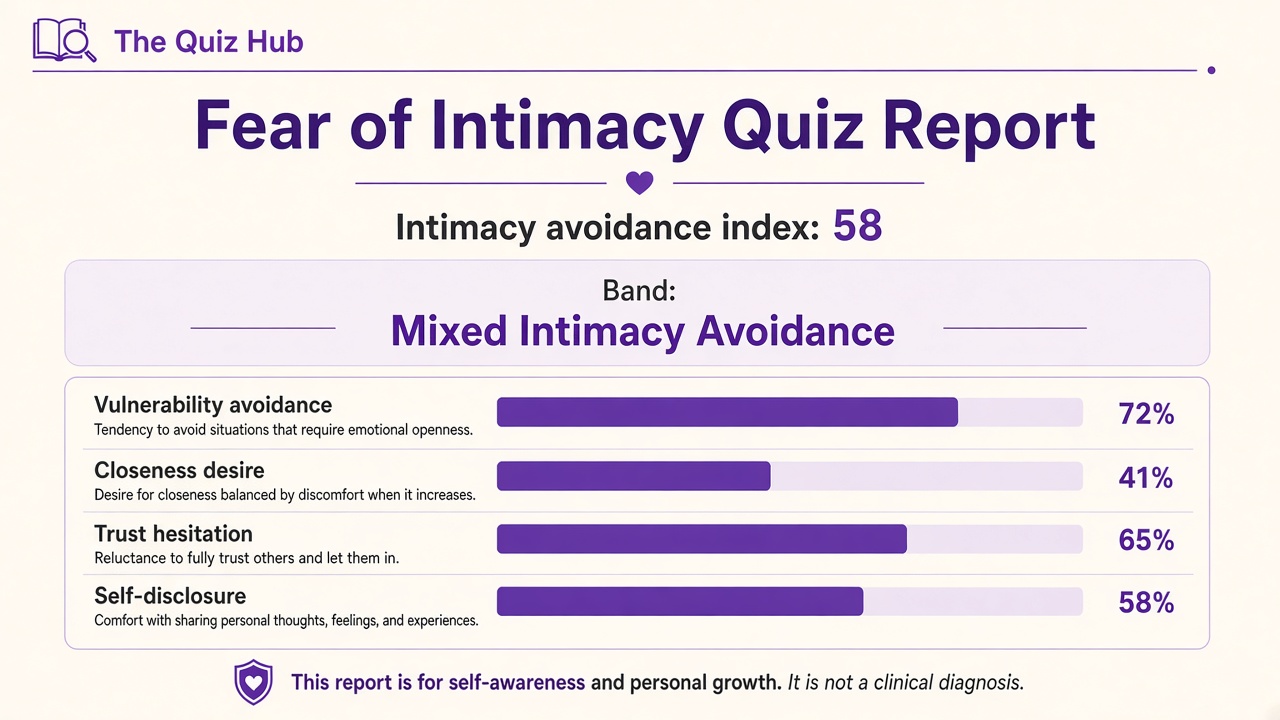
After all 22 items, you get a people-pleasing index from 0 to 100, a band label, and four domain bars for approval seeking, conflict avoidance, self-neglect, and guilt about boundaries. Percentages reflect how you handle other people's expectations, not a clinical verdict about your personality.
What this quiz can and cannot tell you
Can tell you
- How often people-pleasing patterns showed up for you around other people's expectations
- A people-pleasing index and four domain bars for approval, conflict avoidance, self-neglect, and guilt
- Which domain pattern feels strongest in your current accommodation habits
- A starting point for therapy conversation or retaking after boundary work
Cannot tell you
- Whether you have a personality disorder, anxiety disorder, or any clinical diagnosis
- Whether you are "too nice" or whether others will respect your limits without dialogue
- Whether your relationship can improve without honest conversation and mutual effort
- What treatment you need without a licensed clinician's evaluation
People pleasing, boundaries, and approval seeking
Psychologist Harriet Braiker described chronic people pleasing in her 2001 book "The Disease to Please" as a pattern of over-accommodation driven by fear of rejection, anger, or guilt. Therapist and author Harriet Lerner wrote in "The Dance of Anger" (1985) about how many adults learn early that keeping the peace protects connection, even when it costs self-respect. People pleasing in everyday language often maps to those habits: saying yes when exhausted, smoothing conflict at your own expense, and feeling selfish when you decline a reasonable request.
The Quiz Hub built this am I a people pleaser quiz as an original self-report screener inspired by boundary and accommodation themes, not a reproduction of any single published instrument. Readers often compare it to sibling tools on this site. Our codependency level test screens caretaking overload and self-worth through usefulness. The fear of intimacy quiz measures vulnerability avoidance and trust hesitation, not over-yes-ing to requests. The relationship anxiety quiz maps reassurance seeking and jealousy scan worry rather than guilt about saying no.
| The Quiz Hub test | What it adds |
|---|---|
| Codependency level test | Caretaking overload and boundary blur across relationships, not accommodation frequency alone |
| Fear of intimacy quiz | Vulnerability pull-back and trust hesitation, not approval seeking around daily requests |
| Relationship anxiety quiz | Reassurance loops and partner doubt, not guilt when declining favors |
| Attachment style test | Anxiety and avoidance dimensions across closeness, not people-pleasing frequency items |
| Bird test relationship | Partner bid responsiveness, not self-neglect when others ask for time |
| This am I a people pleaser quiz | Four-domain people-pleasing index for approval seeking, conflict avoidance, self-neglect, and guilt about boundaries |
Sample item types include frequency ratings such as whether you say yes when already tired because you do not want to disappoint someone, or whether you feel guilty declining a reasonable request. High approval seeking with high guilt about boundaries often lands in Mixed or Higher People-Pleasing. Family roles, workplace culture, and trauma responses such as fawning can spike scores temporarily. Read how we review quizzes in our editorial policy or browse more tools on our relationships and dating hub.
Am I a people pleaser quiz FAQ
What is a people pleaser?
A people pleaser is someone who often puts other people's comfort, approval, or expectations ahead of their own needs. Common signs include saying yes when exhausted, avoiding conflict, feeling guilty about boundaries, and measuring self-worth by whether others seem pleased. This am I a people pleaser quiz measures how often those patterns show up when you handle other people's expectations. It is not a clinical diagnosis.
What does this people pleaser quiz measure?
Twenty-two original frequency items ask how often you seek approval, avoid conflict, neglect personal needs, or feel guilty when you set limits. Scores map to four domains inspired by people-pleasing and boundary research, including Harriet Braiker's work on the disease to please. You receive a people-pleasing index from 0 to 100 and a band from Lower through Higher People-Pleasing.
How is this different from the codependency level test?
The codependency level test screens caretaking overload, self-worth through usefulness, and boundary blur across relationships. This am I a people pleaser quiz focuses on over-accommodation habits: approval seeking, peacekeeping at your own expense, and guilt when you decline requests. It uses a frequency frame about other people's expectations rather than broad caretaking identity items.
Can this quiz diagnose a personality disorder?
No. The people-pleasing index describes self-reported accommodation patterns on this abbreviated screener. Only a licensed clinician can evaluate personality traits or related conditions through structured interviews. Online quizzes cannot confirm or deny a diagnosis.
What should I do if I get a higher people-pleasing band?
Consider scheduling an evaluation with a licensed therapist who treats boundaries, assertiveness, or relationship stress. Bring your result summary and describe which domain feels hardest. If you feel unsafe or in crisis, call or text 988 (US) or your local crisis line.
Is people pleasing the same as being kind?
No. Kindness includes mutual care and honest limits. People pleasing often means over-yes-ing, hiding disagreement, or skipping your own needs to prevent disappointment. This quiz separates accommodation frequency from general agreeableness. Many kind people score in the Mixed band during stressful seasons.
Who reviewed this content?
Dr. Priya Sharma, PhD, reviewed the test framing and result explanations. See our editorial policy for review standards.
Reviewed by