What this am I dyslexic quiz measures
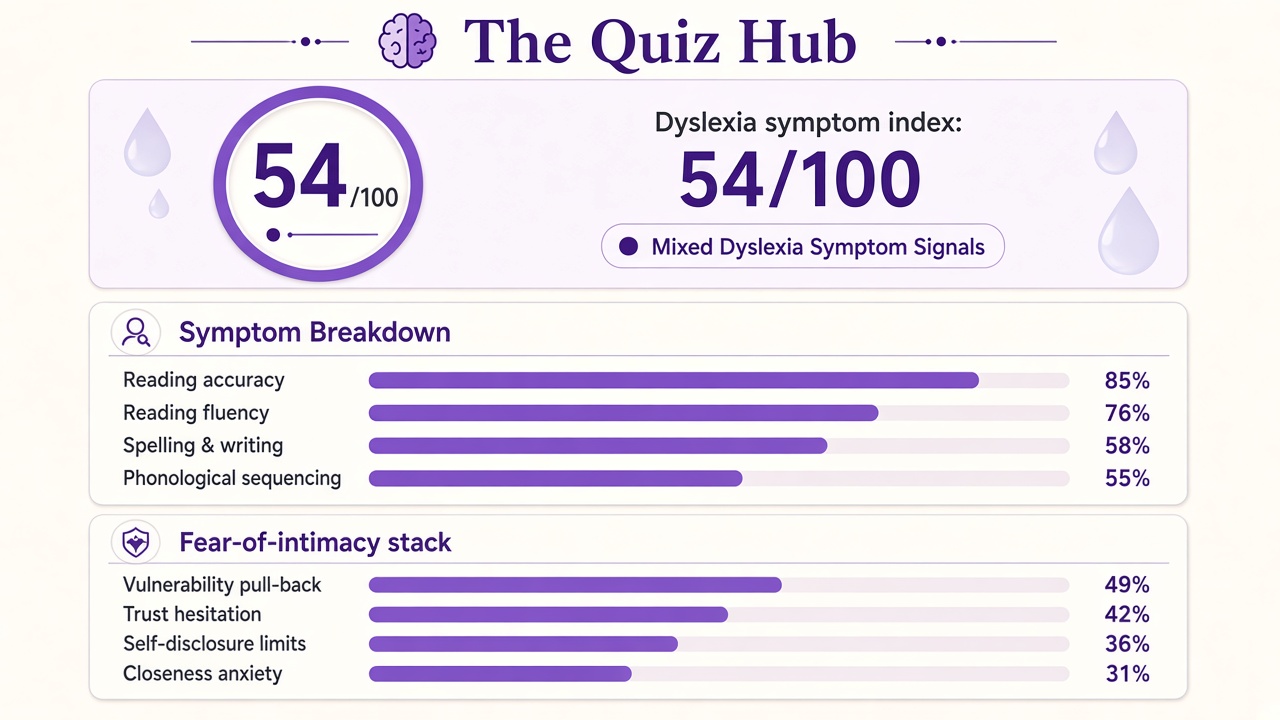
This am I dyslexic quiz estimates how often reading and language-processing strain showed up for you in the past two weeks. Twenty-two original frequency items group into four domains drawn from common adult dyslexia presentations: reading accuracy, reading fluency, spelling and writing output, and phonological sequencing. Your dyslexia symptom index averages these patterns into a 0 to 100 score with plain-language bands. A parallel fear-of-intimacy stack shows how guarded closeness or shame about reading difficulty may layer with decoding strain. It reflects your self-report, not a clinician's evaluation.
Reading accuracy
Word confusion, letter tracking, line skipping, and trouble recognizing familiar words on sight.
Reading fluency
Slow pace, rereading paragraphs, reading aloud avoidance, and eye strain during sustained text.
Spelling & writing
Inconsistent spelling, missing syllables, messy sentence organization, and reliance on spell-check.
Phonological sequencing
Sound blending trouble, rhyme confusion, sound-order slips, and difficulty holding ordered lists from text.
How it works
Three steps from first question to your dyslexia symptom report. Click Start Quiz to open the interactive quiz in a full-screen modal.
Answer 22 frequency items
Rate how often each reading or language-processing symptom showed up in the past two weeks, from Never to Very often. You click Next after each answer; nothing auto-advances.
Items map to four dyslexia domains
Your answers accumulate percentages for reading accuracy, fluency, spelling and writing, and phonological sequencing, plus a fear-of-intimacy stack index.
View band and domain bars
Results show Lower, Mixed, or Higher Dyslexia Symptom Signals with dyslexia domain bars and intimacy stack layers. Elevated bands include specialist referral guidance.
Take the am I dyslexic quiz
Rate 22 statements about reading and language-processing strain from the past two weeks. Your answers produce a dyslexia symptom index from 0 to 100, four dyslexia domain scores, a fear-of-intimacy stack chart, and a band label for reflection or a specialist visit.
Opens in a focused modal. No account required. Results stay on screen.
What your result means
Your dyslexia symptom index is the normalized total across all 22 items on a 0 to 100 scale, with reverse scoring on protective items so higher scores mean more reading and language-processing strain overall. Domain bars show endorsement rates so you can see whether word confusion, slow fluency, spelling output, or phonological sequencing drives your result most. The fear-of-intimacy stack chart shows how guarded closeness layers alongside decoding difficulty.
| Band | Index range | Typical reading |
|---|---|---|
| Lower Dyslexia Symptom Signals | 0 to 35 | Fewer decoding strain patterns on this screener; brief slips may still appear when tired |
| Mixed Dyslexia Symptom Signals | 36 to 65 | Blend of accuracy, fluency, and spelling strain; worth tracking and seeking support if persistent |
| Higher Dyslexia Symptom Signals | 66 to 100 | Frequent reading, spelling, or sequencing strain; formal evaluation may help |
What your am I dyslexic report looks like
After all 22 items, you get a dyslexia symptom index from 0 to 100, a band label, four dyslexia domain bars, and a fear-of-intimacy stack chart with vulnerability pull-back, trust hesitation, self-disclosure limits, and closeness anxiety layers. Percentages reflect how you handle reading and written tasks, not a clinical verdict about dyslexia.
What this quiz can and cannot tell you
Can tell you
- How often reading, spelling, and language-processing strain showed up for you in the past two weeks
- A dyslexia symptom index and four domain bars for accuracy, fluency, spelling, and phonological sequencing
- A fear-of-intimacy stack chart showing how guarded closeness layers with learning strain patterns
- A starting point for a specialist visit or retaking after tutoring or accommodations
Cannot tell you
- Whether you have dyslexia or any specific learning disorder
- Whether vision problems, ADHD, anxiety, or IQ explain your reading profile
- Which accommodations you qualify for without formal psychoeducational testing
- What treatment or tutoring plan you need without evaluation by a licensed specialist
Dyslexia symptoms, adult reading strain, and when to seek evaluation
The International Dyslexia Association describes dyslexia as a language-based learning difference that affects accurate and fluent word recognition, spelling, and decoding. The American Psychiatric Association lists specific learning disorder with impairment in reading in the DSM-5-TR (2022), noting that symptoms must persist despite targeted instruction and cause meaningful difficulty in school, work, or daily activities. In everyday language, am I dyslexic searches often map to slow reading, word confusion, unreliable spelling, and fatigue after dense text.
The Quiz Hub built this am I dyslexic quiz as an original self-report screener inspired by common adult dyslexia presentation themes from Lyon, Shaywitz, and Shaywitz (2003) on reading development, not a reproduction of any published clinical instrument such as the Adult Reading History Questionnaire. Readers often compare it to sibling tools on this site. Our dyslexia test uses 24 items with a core screening flag across phonology and sequencing memory. The do I have ADHD quiz screens attention, restlessness, and organization rather than decoding accuracy. The focus test maps concentration drift without spelling-specific items.
| The Quiz Hub test | What it adds |
|---|---|
| Dyslexia test | 24 items with core screening flag across reading accuracy, fluency, phonology, and sequencing memory |
| Do I have ADHD quiz | Attention, hyperactivity, and organization domains without spelling output bars |
| Focus test | Concentration and distraction patterns, not word confusion or phonological sequencing |
| Fear of intimacy quiz | FOIS-inspired intimacy avoidance only, without dyslexia domain bars |
| Am I a hypochondriac quiz | Health anxiety and body scanning patterns, not reading strain frequency |
| This am I dyslexic quiz | Four-domain dyslexia symptom index plus fear-of-intimacy stack for past-two-weeks frequency |
Sample item types include frequency ratings such as whether you read so slowly that you finish long assignments after classmates, or whether you spell the same word differently each time you write it. High fluency strain with high spelling output bars often land in Mixed or Higher Dyslexia Symptom Signals. Stress, sleep loss, and untreated vision changes can spike scores temporarily without meaning you need emergency care. Read how we review quizzes in our editorial policy or browse more tools on our mental health and clinical hub.
Am I dyslexic quiz FAQ
What are common signs of dyslexia in adults?
Adult dyslexia signs often include slow or exhausting reading, mixing up similar-looking words, inconsistent spelling, trouble sounding out new words, and difficulty holding ordered information from text. Vision problems, ADHD, and anxiety can overlap with some of the same complaints. This am I dyslexic quiz measures how often those patterns showed up for you in the past two weeks. It is not a formal reading assessment or diagnosis.
What does this am I dyslexic quiz measure?
Twenty-two original frequency items ask how often you experienced reading accuracy strain, slow fluency, spelling and writing difficulty, and phonological sequencing problems inspired by common dyslexia presentations. You receive a dyslexia symptom index from 0 to 100, four domain bars, and a parallel fear-of-intimacy stack chart. Only licensed specialists can confirm dyslexia through formal testing.
What is the fear-of-intimacy stack on this quiz?
The fear-of-intimacy stack is a second results chart inspired by FOIS-style intimacy avoidance themes, adapted to learning-strain framing. Each of the 22 items also maps to one of four stack layers: vulnerability pull-back, trust hesitation, self-disclosure limits, and closeness anxiety. The stack index summarizes how often guarded closeness habits appear alongside reading difficulty.
How is this different from the dyslexia test on The Quiz Hub?
The dyslexia test uses 24 items with a core screening flag across reading accuracy, fluency, phonological processing, and sequencing memory. This am I dyslexic quiz uses 22 past-two-weeks frequency items with spelling and writing output as a separate domain plus a fear-of-intimacy stack chart. Both are self-report screeners, not replacements for psychoeducational evaluation.
Can this quiz diagnose dyslexia?
No. The dyslexia symptom index describes self-reported pattern frequency on this abbreviated screener. Only a licensed psychologist, learning specialist, or speech-language pathologist can evaluate dyslexia through structured reading tests, history, and sometimes vision screening. Online quizzes cannot confirm or rule out dyslexia or any learning disorder.
What should I do if I get a higher dyslexia symptom band?
Consider scheduling an evaluation with a licensed psychologist or learning specialist who conducts formal reading assessments. Bring your result summary and describe when decoding difficulty began. Ask about tutoring, workplace accommodations, or coordinated vision screening. If you feel unsafe or in crisis, call or text 988 (US) or your local crisis line.
Who reviewed this content?
Dr. Elena Vasquez, PhD, reviewed the test framing and result explanations. See our editorial policy for review standards.
Reviewed by