What this sexual harassment quiz measures
This am I being sexually harassed quiz estimates how often sexual boundary violation pattern signals show up in your situation with this person. Twenty-two original frequency items group into four domains drawn from EEOC harassment themes and trauma-informed advocacy research: unwanted touch, sexual comments, pressure after refusal, and boundary disregard tied to power. Each item also maps to a fear-of-intimacy stack layer so you can see whether vulnerability pull-back, trust hesitation, self-disclosure limits, or closeness anxiety feels strongest. Your harassment exposure index averages these patterns into a 0 to 100 score with plain-language bands.
Unwanted touch
Intrusive closeness, unwelcome contact, dodging touch, and pressure to accept physical contact to keep peace.
Sexual comments
Sexual jokes, body comments, explicit messages, ratings, and embarrassment after remarks treated as banter.
Pressure after refusal
Repeated asks after no, guilt trips, quid-pro-quo hints, and fear that refusal will cost you something.
Boundary disregard
Ignored limits, dismissal of your reaction, power gaps, avoidance, and doubting whether discomfort counts.
How it works
Three steps from first question to your harassment exposure report with fear-of-intimacy stack. Click Start Quiz to open the interactive quiz in a full-screen modal.
Answer 22 frequency items
Rate how often each harassment pattern shows up, from Never to Almost always. You click Next after each answer; nothing auto-advances.
Items map to harassment domains and intimacy stack
Your answers accumulate percentages for unwanted touch, sexual comments, pressure after refusal, and boundary disregard, plus four fear-of-intimacy stack layers.
View band and dual charts
Results show Lower, Mixed, or Higher Harassment Exposure with domain bars, intimacy stack chart, and reflection prompts. Higher bands include crisis resources.
Take the sexual harassment quiz
Rate 22 statements about sexual boundary patterns with this person. Your answers produce a harassment exposure index from 0 to 100, four domain scores, a fear-of-intimacy stack chart, and a band label for reflection or advocacy conversation.
Opens in a focused modal. No account required. Results stay on screen.
What your result means
Your harassment exposure index is the normalized total across all 22 items on a 0 to 100 scale, with reverse scoring on protective items so higher scores mean more concern overall. The fear-of-intimacy stack index uses the same answers mapped to vulnerability, trust, disclosure, and closeness anxiety layers. Domain bars show endorsement rates so you can see whether unwanted touch, sexual comments, pressure after refusal, or boundary disregard drives your result most.
| Band | Index range | Typical reading |
|---|---|---|
| Lower Harassment Exposure | 0 to 35 | Fewer sexual harassment pattern signals; awkward moments may still appear |
| Mixed Harassment Signals | 36 to 65 | Blend of ordinary friction and boundary violation patterns; worth tracking if persistent |
| Higher Harassment Exposure | 66 to 100 | Frequent unwanted touch, sexual remarks, or pressure after refusal; advocate or HR support may help |
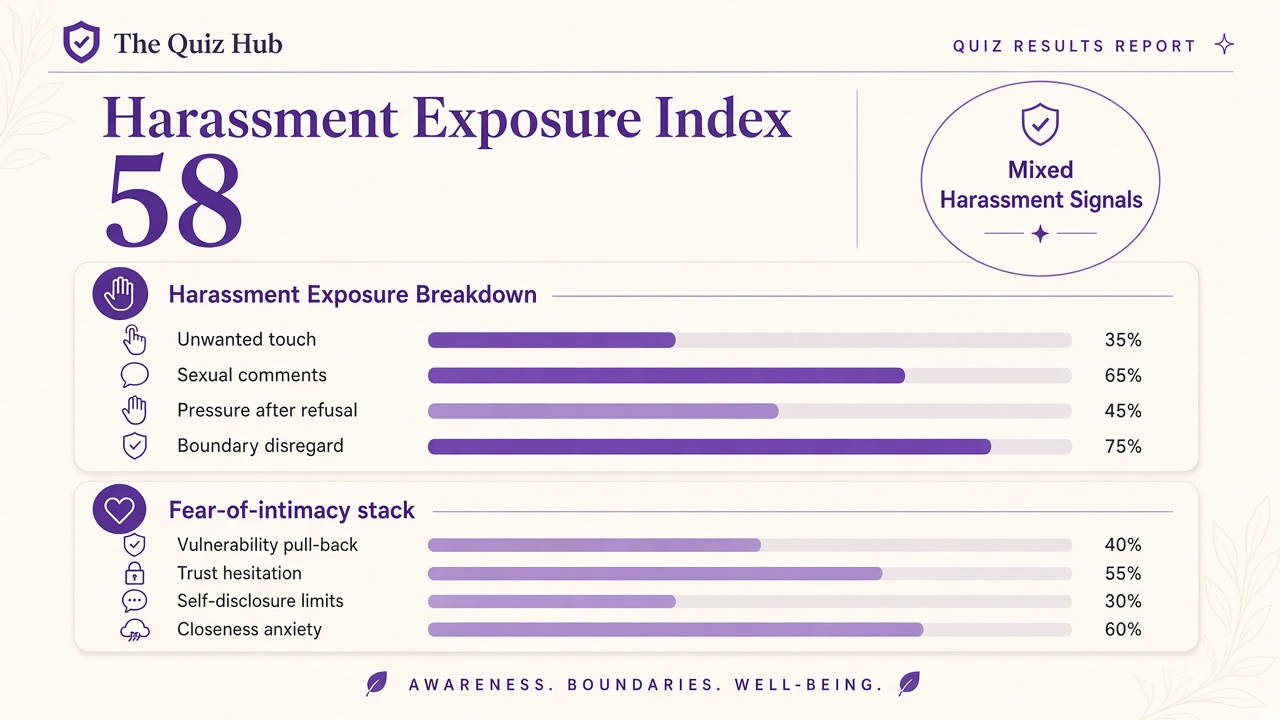
What your harassment exposure report looks like
After all 22 items, you get a harassment exposure index from 0 to 100, a band label, four harassment domain bars, and a fear-of-intimacy stack chart. Percentages reflect boundary patterns you notice, not a legal verdict about guilt or formal misconduct.
What this quiz can and cannot tell you
Can tell you
- How often sexual harassment pattern signals showed up for you in this situation
- A harassment exposure index and four domain bars for touch, comments, pressure, and boundary disregard
- A fear-of-intimacy stack showing which closeness-guarding layer feels strongest
- A starting point for documentation, HR, advocacy, or retaking after a safety plan step
Cannot tell you
- Whether conduct meets a legal definition of sexual harassment
- Whether you should file a complaint or who is at fault
- Whether your workplace, school, or relationship can be fixed without professional help
- What safety plan or legal strategy you need without an advocate, attorney, or clinician
Sexual harassment, power gaps, and the fear-of-intimacy stack
The U.S. Equal Employment Opportunity Commission defines sexual harassment as unwelcome sexual conduct that affects working conditions or creates a hostile environment. Legal scholar Catharine MacKinnon argued in the 1970s that harassment is less about desire than about power and exclusion. Trauma researcher Judith Herman's work on recovery also describes how survivors may freeze, minimize harm, or doubt their own reactions when someone with status crosses a line. In dating and roommate situations, similar patterns can appear without a formal employer involved.
The Quiz Hub built this am I being sexually harassed quiz as an original self-report screener inspired by those themes, not a reproduction of any single published clinical instrument. Readers often compare it to sibling tools on this site. Our gaslighting quiz screens reality distortion and blame reversal during conflict. The narcissistic abuse quiz measures broader coercion across an ongoing relationship. The fear of intimacy quiz maps closeness-limiting habits without harassment framing.
| The Quiz Hub test | What it adds |
|---|---|
| Gaslighting quiz | Reality distortion and blame reversal during conflict, not sexual boundary violations |
| Narcissistic abuse quiz | Broader coercion inventory across gaslighting, isolation, and control, not sexual touch frequency |
| Trauma bond quiz | Bond-after-harm relief cycles and loyalty isolation, not quid-pro-quo sexual pressure |
| Love-bombed quiz | Early intensity pace and future faking, not ongoing sexual comment frequency |
| Fear of intimacy quiz | Four-domain intimacy avoidance index without harassment exposure items |
| This sexual harassment quiz | Harassment exposure index plus fear-of-intimacy stack for touch, comments, pressure, and boundary disregard |
Sample item types include frequency ratings such as whether you receive sexual touches you did not invite, or whether you hear sexual jokes treated as harmless banter. High unwanted touch with high pressure after refusal often lands in Mixed or Higher Harassment Exposure. Power gaps at work or school can raise boundary disregard scores even when no force is used. Read how we review quizzes in our editorial policy or browse more tools on our relationships and dating hub.
Sexual harassment quiz FAQ
What counts as sexual harassment?
Sexual harassment includes unwelcome sexual advances, requests for sexual favors, and other verbal or physical conduct of a sexual nature when it affects employment, education, or creates a hostile environment. The U.S. Equal Employment Opportunity Commission (EEOC) defines it this way under Title VII. This am I being sexually harassed quiz measures how often unwanted touch, sexual comments, pressure after refusal, and boundary disregard signals show up in your situation. It is not a legal finding or formal complaint.
What does this sexual harassment quiz measure?
Twenty-two original frequency items ask how often you notice unwanted touch, sexual remarks, pressure after you said no, or boundary disregard tied to someone's power over you. Scores map to four harassment domains plus a parallel fear-of-intimacy stack with vulnerability pull-back, trust hesitation, self-disclosure limits, and closeness anxiety layers. You receive a harassment exposure index from 0 to 100 and a band from Lower through Higher Harassment Exposure.
What is the fear-of-intimacy stack on this quiz?
The fear-of-intimacy stack is a second results chart inspired by FOIS-style intimacy avoidance themes, adapted to harassment framing. Each of the 22 items also maps to one of four stack layers showing how boundary violations may connect to closeness habits: hiding vulnerability, testing trust, limiting disclosure, or panicking when bonds feel unsafe. The stack index summarizes those layers alongside the harassment exposure index.
How is this different from the gaslighting quiz?
The am I being gaslighted quiz screens reality distortion, blame reversal, memory doubt, and isolation tactics during conflict. This sexual harassment quiz focuses on sexual boundary violations: intrusive touch, sexual remarks, pressure after refusal, and power-based dismissal of limits. It adds a fear-of-intimacy stack chart that the gaslighting quiz does not include.
Can this quiz prove I am being sexually harassed?
No. The harassment exposure index describes self-reported pattern signals on this abbreviated screener. Awkward flirting, cultural differences, and trauma history can raise scores without meeting a legal definition. Only you plus HR, advocates, attorneys, or investigators can assess whether conduct meets formal standards. Online quizzes cannot file complaints or confirm guilt.
What should I do if I get a higher harassment exposure band?
Consider contacting RAINN at 1-800-656-4673 or rainn.org for confidential support. If the situation is work- or school-related, speak with HR, a campus Title IX office, or an employment attorney. Document incidents with dates and witnesses. If you feel unsafe or in crisis, call or text 988 (US) or your local crisis line.
Who reviewed this content?
Dr. Elena Vasquez, PhD, reviewed the test framing and result explanations. See our editorial policy for review standards.
Reviewed by