What this am I being cheated on quiz measures
This am I being cheated on quiz estimates how often partner behaviors that commonly raise infidelity concern show up in your relationship. Twenty-two original frequency items group into four domains drawn from betrayal and trust research: secrecy shifts, emotional withdrawal, story inconsistency, and trust erosion when you ask for clarity. Your infidelity suspicion index averages these patterns into a 0 to 100 score with plain-language bands. It reflects behaviors you notice, not hidden proof or a partner diagnosis.
Secrecy shifts
Phone privacy changes, guarded screens, deleted chats, and irritation when you ask who contacted them.
Emotional withdrawal
Less affection, shorter answers, canceled rituals, and pulling away from relationship talks.
Story inconsistency
Conflicting accounts of time, unexplained schedule gaps, and details that do not match later.
Trust erosion
Defensive reactions, blame for asking, abrupt exits from talks, and broken transparency promises.
How it works
Three steps from first question to your infidelity suspicion report. Click Start Quiz to open the interactive quiz in a full-screen modal.
Answer 22 frequency items
Rate how often each partner behavior shows up in your relationship lately, from Never to Almost always. You click Next after each answer; nothing auto-advances.
Items map to four behavior domains
Your answers accumulate percentages for secrecy shifts, emotional withdrawal, story inconsistency, and trust erosion, plus an overall infidelity suspicion index.
View band and domain bars
Results show Lower, Mixed, or Higher Suspicion Signals with domain bars and reflection prompts. Higher bands include safety and crisis resources.
Take the am I being cheated on quiz
Rate 22 statements about partner behaviors that often raise infidelity concern. Your answers produce an infidelity suspicion index from 0 to 100, four domain scores, and a band label for reflection or counseling conversation.
Opens in a focused modal. No account required. Results stay on screen.
What your result means
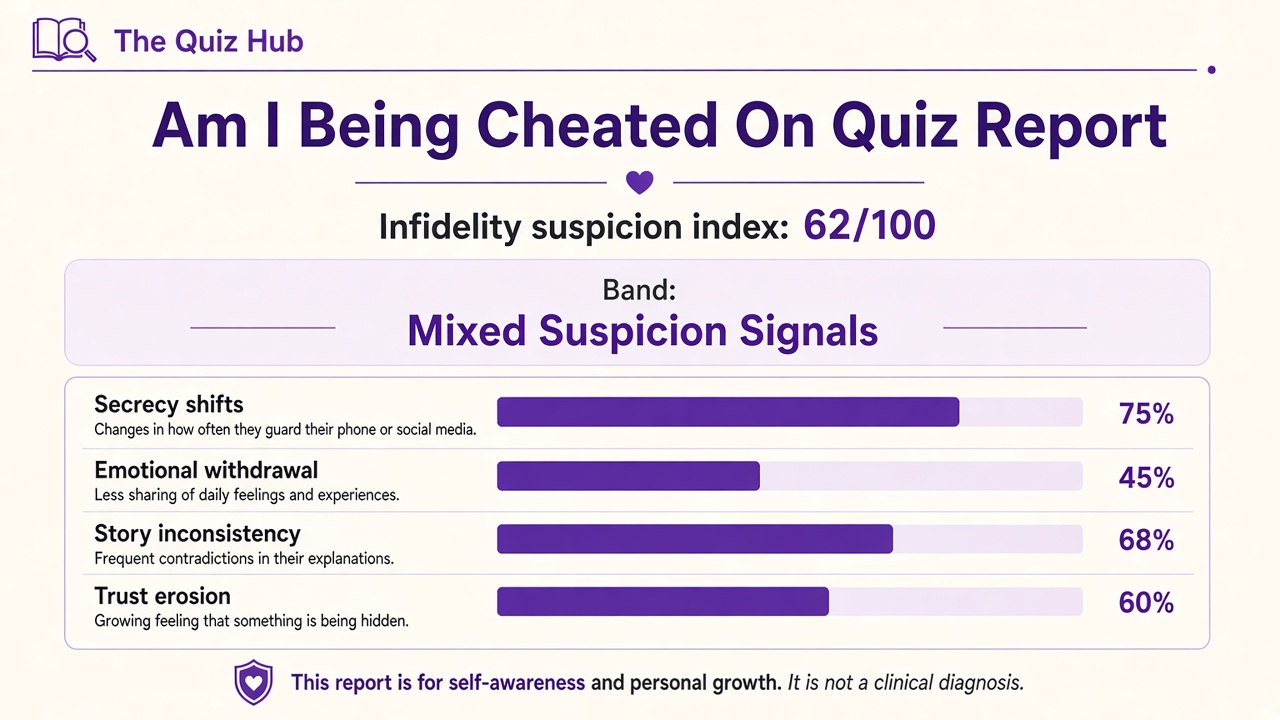
Your infidelity suspicion index is the normalized total across all 22 items on a 0 to 100 scale, with reverse scoring on transparency and warmth items so higher scores mean more concerning patterns overall. Domain bars show endorsement rates so you can see whether phone secrecy, emotional distance, inconsistent stories, or defensive blame drives your result most.
| Band | Index range | Typical reading |
|---|---|---|
| Lower Suspicion Signals | 0 to 35 | Fewer partner patterns that raise cheating concern on this screener; stress may still create temporary distance |
| Mixed Suspicion Signals | 36 to 65 | Blend of trustworthy moments and concerning habits; worth naming calmly in conversation |
| Higher Suspicion Signals | 66 to 100 | Frequent secrecy, withdrawal, inconsistency, or defensiveness; counseling or safety planning may help |
What your infidelity suspicion report looks like
After all 22 items, you get an infidelity suspicion index from 0 to 100, a band label, and four domain bars for secrecy shifts, emotional withdrawal, story inconsistency, and trust erosion. Percentages reflect partner behaviors you notice, not proof of cheating or a clinical verdict about your partner.
What this quiz can and cannot tell you
Can tell you
- How often concerning partner behavior patterns showed up in your ratings
- An infidelity suspicion index and four domain bars for secrecy, withdrawal, stories, and defensiveness
- Which domain pattern feels strongest in your current worry
- A starting point for calm conversation or couples counseling
Cannot tell you
- Whether your partner is cheating without direct evidence and honest dialogue
- Whether your partner has a personality disorder or any clinical diagnosis
- Whether surveillance, phone checks, or accusation will repair trust
- What legal or safety steps you need without your own judgment and support
Betrayal signals, trust erosion, and partner behavior
Psychologist Shirley Glass outlined in Not Just Friends (2003) how emotional and physical affairs often begin with secrecy, new grooming habits, and defensive distance long before a confrontation. John Gottman and colleagues studied trust as a balance of turning toward bids for connection versus turning away. When partners hide phones, shorten answers, or blame you for asking, many people search "am I being cheated on" before they have proof. That search is understandable, but self-report screeners cannot replace evidence or direct questions.
The Quiz Hub built this am I being cheated on quiz as an original partner-behavior screener inspired by betrayal research themes, not a reproduction of any single clinical infidelity inventory. Readers often compare it to sibling tools on this site. Our trust issues quiz screens your worry and reassurance habits. The gaslighting quiz focuses on reality-doubt and blame when you raise concerns. The relationship anxiety quiz maps jealousy scanning and reassurance seeking rather than partner secrecy patterns.
| The Quiz Hub test | What it adds |
|---|---|
| Trust issues quiz | Your jealousy and reassurance habits, not partner phone secrecy frequency |
| Gaslighting quiz | Reality-doubt and blame reversal when you raise concerns, not schedule inconsistency alone |
| Ghosting quiz | Contact drop-off and breadcrumbing patterns, not in-person secrecy shifts |
| Trauma bond quiz | Cycle intensity and loyalty under harm, not infidelity suspicion domains |
| Love-bombed quiz | Intensity and idealization spikes, not guarded devices or story gaps |
| This am I being cheated on quiz | Four-domain infidelity suspicion index for secrecy, withdrawal, inconsistency, and trust erosion |
Sample item types include frequency ratings such as whether your partner steps into another room for calls they used to take openly, or whether they volunteer honest details without you probing. High secrecy with high story inconsistency often lands in Mixed or Higher Suspicion Signals. Work travel, depression, or a prior affair you already know about can also spike scores. Read how we review quizzes in our editorial policy or browse more tools on our relationships and dating hub.
Am I being cheated on quiz FAQ
Can this quiz prove my partner is cheating?
No. This am I being cheated on quiz measures how often you notice partner behaviors that commonly raise infidelity concern, such as secrecy shifts, emotional withdrawal, story inconsistency, and defensive trust erosion. It produces an infidelity suspicion index from 0 to 100 for self-reflection. Only direct evidence and honest conversation can confirm or rule out cheating. This tool is not proof.
What does the infidelity suspicion index measure?
Twenty-two original frequency items ask how often your partner shows patterns linked to infidelity concern in relationship research: guarded devices, emotional distance, conflicting accounts of time, and blame when you seek reassurance. Scores map to four domains and an overall index from 0 to 100 with Lower, Mixed, or Higher Suspicion Signal bands.
How is this different from the trust issues quiz?
The trust issues quiz screens your own worry habits, jealousy scanning, and difficulty believing reassurance. This am I being cheated on quiz focuses on observable partner behaviors you rate, such as phone secrecy and schedule gaps. Many people take both when fear feels high but they are unsure whether the signal is internal or behavioral.
Could stress or depression explain a high score?
Yes. Work burnout, grief, postpartum exhaustion, health problems, or depression can create distance, irritability, and privacy without infidelity. Past betrayal can also leave you scanning harder. Treat higher bands as a prompt for calm conversation or counseling, not automatic guilt assignment.
What should I do if I get a higher suspicion band?
Consider scheduling a session with a licensed couples therapist or individual counselor. Bring your result summary and describe specific behaviors rather than accusations. If you feel unsafe, controlled, or threatened, contact the National Domestic Violence Hotline at 800-799-7233 or call/text 988 (US).
Who reviewed this content?
Dr. Priya Sharma, PhD, reviewed the test framing and result explanations. See our editorial policy for review standards.
Reviewed by