What this am I a negative person quiz measures
This am I a negative person quiz estimates how heavy negative thinking and reactivity have felt during the past two weeks. Twenty-two original frequency items group into four domains: negative self-talk, pessimistic outlook, irritable reactivity, and social negativity. Your negativity load index averages these patterns into a 0 to 100 score with plain-language bands. A parallel fear-of-intimacy stack chart shows whether guarded closeness habits ride alongside negative mood. It reflects your self-report, not how others secretly label you.
Negative self-talk
Harsh inner labels, assuming compliments will fade, replaying mistakes, and avoiding mirrors or photos.
Pessimistic outlook
Expecting plans to slip, bracing after good streaks, dreading tomorrow, and reading neutral cues as rejection.
Irritable reactivity
Snapping over small annoyances, staying irritated for hours, staying on edge, and avoiding repair after conflict.
Social negativity
Focusing on what people do wrong, complaint loops, expecting awkward events, and steering talk toward problems.
How it works
Three steps from first question to your negativity load report. Click Start Quiz to open the interactive quiz in a full-screen modal.
Answer 22 frequency items
Rate how often each negativity pattern showed up in the past two weeks, from Never to Very often. You click Next after each answer; nothing auto-advances.
Items map to four domains plus stack layers
Your answers accumulate percentages for negative self-talk, pessimistic outlook, irritable reactivity, and social negativity, plus fear-of-intimacy stack layers and an overall negativity load index.
View band, domain bars, and stack chart
Results show Lower, Mixed, or Higher Negativity Load with domain bars, stack chart, and reflection prompts. Higher bands include crisis resources.
Take the am I a negative person quiz
Rate 22 statements about negative thinking and reactivity in the past two weeks. Your answers produce a negativity load index from 0 to 100, four domain scores, a fear-of-intimacy stack chart, and a band label for reflection or therapy conversation.
Opens in a focused modal. No account required. Results stay on screen.
What your result means
Your negativity load index is the normalized total across all 22 items on a 0 to 100 scale. Domain bars show endorsement rates so you can see whether harsh self-talk, pessimistic outlook, irritable reactivity, or social negativity drives your result most. The fear-of-intimacy stack index summarizes parallel closeness-guard patterns mapped from the same items.
| Band | Index range | Typical reading |
|---|---|---|
| Lower Negativity Load | 0 to 35 | Fewer chronic negative thinking patterns on this screener; stress spikes may still appear |
| Mixed Negativity Load | 36 to 65 | Blend of realistic stress reactions and negative mood habits; worth tracking if persistent |
| Higher Negativity Load | 66 to 100 | Frequent harsh self-talk, pessimism, irritability, or draining social tone; professional support may help |
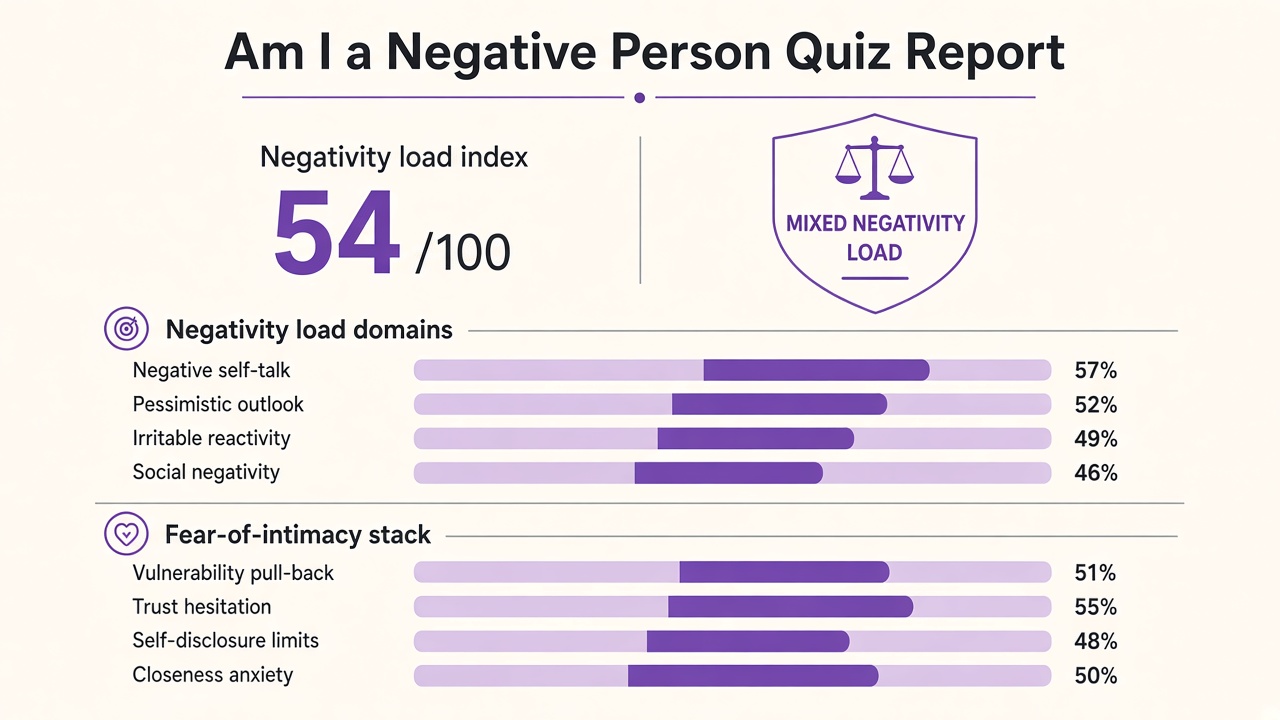
What your negativity load report looks like
After all 22 items, you get a negativity load index from 0 to 100, a band label, four domain bars, and a fear-of-intimacy stack chart with vulnerability pull-back, trust hesitation, self-disclosure limits, and closeness anxiety layers. Percentages reflect how the past two weeks have felt, not a clinical verdict about your personality.
What this quiz can and cannot tell you
Can tell you
- How often negativity patterns showed up for you in the past two weeks
- A negativity load index and four domain bars for self-talk, outlook, irritability, and social tone
- A fear-of-intimacy stack chart showing guarded closeness layers alongside negative mood
- A starting point for therapy conversation or retaking after rest, conflict repair, or treatment
Cannot tell you
- Whether you have depression, personality disorder, or any clinical diagnosis
- Whether you are objectively a bad friend or partner without your full relationship context
- Whether your mood will improve without sleep, support, therapy, or lifestyle change
- What treatment you need without a licensed clinician's evaluation
Negative thinking, cognitive bias, and closeness habits
Psychologist Aaron Beck's cognitive theory of depression (Beck, 1967) described how automatic negative thoughts about self, world, and future can maintain low mood. Later work on negativity bias in attention and memory (Baumeister and colleagues, 2001) showed that unpleasant events often stick harder than neutral or positive ones, which can make negative self-talk feel truthful even when it is distorted. Psychologists Karen M. Descutner and Mark H. Thelen published the Fear-of-Intimacy Scale in 1991, linking guarded closeness to vulnerability avoidance and trust hesitation that can amplify how harsh or pessimistic someone feels in relationships.
The Quiz Hub built this am I a negative person quiz as an original self-report screener inspired by those research themes, not a reproduction of any single published instrument. Readers often compare it to sibling tools on this site. Our depression test screens PHQ-style mood and energy symptoms. The do I hate myself quiz focuses on shame and self-directed hostility. The am I cynical quiz maps motive skepticism and disillusionment with a parallel fear-of-intimacy stack.
| The Quiz Hub test | What it adds |
|---|---|
| Depression test | PHQ-style mood, sleep, energy, and anhedonia screening, not negativity load domains |
| Do I hate myself quiz | Shame and self-directed hostility focus, not pessimistic outlook or social negativity |
| Am I cynical quiz | Motive skepticism and ideal disillusionment, not irritable reactivity or social tone |
| Self-sabotage quiz | Procrastination and success avoidance loops, not daily negative self-talk frequency |
| Fear of intimacy quiz | Romantic closeness avoidance frequency, not general negativity load across life |
| This am I a negative person quiz | Four-domain negativity load index plus fear-of-intimacy stack for guarded closeness habits |
Sample item types include frequency ratings such as whether you called yourself stupid in your head, or whether you stayed annoyed for hours after a minor comment. High negative self-talk with high pessimistic outlook often lands in Mixed or Higher Negativity Load. Sleep loss, grief, conflict, and burnout can spike scores temporarily. Read how we review quizzes in our editorial policy or browse more tools on our mental health and clinical hub.
Am I a negative person quiz FAQ
What does negative person mean on this quiz?
Negative person here means your self-reported answers lean toward harsh inner commentary, expecting disappointment, staying irritated, or steering social talk toward problems more than toward balanced or hopeful habits. It does not mean you are a bad person, permanently toxic, or incapable of change. This am I a negative person quiz maps those patterns to a negativity load index from 0 to 100 for reflection, not a personality verdict.
What does this am I a negative person quiz measure?
Twenty-two original frequency items ask how often negative self-talk, pessimistic outlook, irritable reactivity, and social negativity showed up in the past two weeks. Each item also feeds a parallel fear-of-intimacy stack with vulnerability pull-back, trust hesitation, self-disclosure limits, and closeness anxiety layers. You receive a negativity load index from 0 to 100 and a band from Lower through Higher Negativity Load.
What is the fear-of-intimacy stack on this quiz?
The fear-of-intimacy stack is a second results chart inspired by FOIS-style intimacy avoidance themes, adapted to negative mood framing. Each of the 22 items also maps to one of four stack layers: vulnerability pull-back, trust hesitation, self-disclosure limits, and closeness anxiety. The stack index summarizes how often guarded closeness rides alongside negative thinking or reactivity.
How is this different from the depression test?
The depression test screens PHQ-style mood, energy, sleep, and anhedonia symptoms over the past two weeks. This am I a negative person quiz uses a negativity load frame focused on harsh self-talk, pessimistic expectations, irritability, and draining social tone, plus the fear-of-intimacy stack chart rather than core depression symptom facets alone.
Can this quiz diagnose depression or a personality disorder?
No. The negativity load index describes self-reported pattern signals on this abbreviated screener. It cannot diagnose depression, personality disorder, or any clinical condition. Burnout, grief, sleep loss, and conflict can all raise scores without meaning you are stuck forever.
Who reviewed this content?
Dr. Elena Vasquez, PhD, reviewed the test framing and result explanations. See our editorial policy for review standards.
Reviewed by