What this am I a bully quiz measures
This am I a bully quiz estimates how often bullying behaviors showed up for you in the past month. Twenty-two original frequency items group into four domains drawn from bullying and relational aggression research: verbal aggression, social exclusion, dominance intimidation, and accountability gaps. Your bullying behavior index averages these patterns into a 0 to 100 score with plain-language bands. A parallel fear-of-intimacy stack shows how shame or closeness fear may fuel control and harm denial. It reflects your honest self-report, not how others secretly rate you.
Verbal aggression
Insults, humiliating sarcasm, mocking sensitive topics, and attacking character instead of one behavior.
Social exclusion
Leaving people out to punish, exposing private details, encouraging freeze-outs, and reputation harm.
Dominance intimidation
Threats, ultimatums, invading space, making others feel small, and using secrets to control behavior.
Accountability gaps
Blaming victims, dismissing pain, refusing apologies, and minimizing harm as jokes.
How it works
Three steps from first question to your bullying behavior report. Click Start Quiz to open the interactive quiz in a full-screen modal.
Answer 22 frequency items
Rate how often each bullying behavior showed up in the past month, from Never to Very often. You click Next after each answer; nothing auto-advances.
Items map to four bullying domains
Your answers accumulate percentages for verbal aggression, social exclusion, dominance intimidation, and accountability gaps, plus a fear-of-intimacy stack index.
View band and domain bars
Results show Lower, Mixed, or Higher Bullying Behavior with domain bars and intimacy stack layers. Higher bands include crisis resources and accountability prompts.
Take the am I a bully quiz
Rate 22 statements about bullying behaviors from the past month. Your answers produce a bullying behavior index from 0 to 100, four domain scores, a fear-of-intimacy stack chart, and a band label for reflection or therapy conversation.
Opens in a focused modal. No account required. Results stay on screen.
What your result means
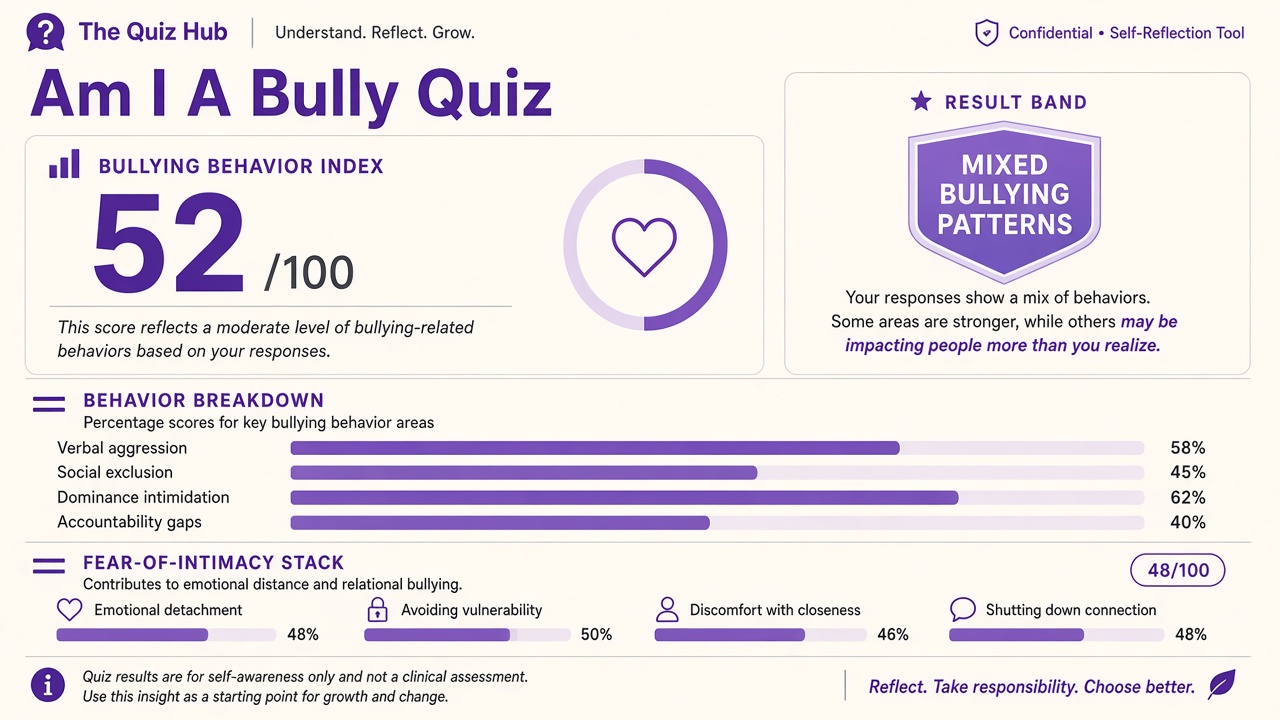
Your bullying behavior index is the normalized total across all 22 items on a 0 to 100 scale, with reverse scoring on protective items so higher scores mean more bullying behavior signals overall. Domain bars show endorsement rates so you can see whether verbal aggression, social exclusion, intimidation, or accountability gaps drives your result most. The fear-of-intimacy stack chart shows how closeness guarding layers alongside harmful conflict habits.
| Band | Index range | Typical reading |
|---|---|---|
| Lower Bullying Behavior | 0 to 35 | Fewer bullying patterns on this screener; ordinary conflict mistakes may still appear |
| Mixed Bullying Patterns | 36 to 65 | Blend of stress conflict and more frequent harm habits; worth tracking and repairing |
| Higher Bullying Behavior | 66 to 100 | Frequent hostility, exclusion, intimidation, or harm denial; accountability and support may help |
What your am I a bully report looks like
After all 22 items, you get a bullying behavior index from 0 to 100, a band label, four bullying domain bars, and a fear-of-intimacy stack chart with vulnerability pull-back, trust hesitation, self-disclosure limits, and closeness anxiety layers. Percentages reflect how you handle conflict and closeness, not a permanent label about your character.
What this quiz can and cannot tell you
Can tell you
- How often bullying behaviors showed up for you in the past month
- A bullying behavior index and four domain bars for verbal, exclusion, intimidation, and accountability patterns
- A fear-of-intimacy stack chart showing how closeness fear may fuel control and harm denial
- A starting point for accountability, repair, or therapy conversation
Cannot tell you
- Whether you are permanently a bully or a bad person
- Whether you have conduct disorder, narcissistic traits, or any clinical diagnosis
- Whether others experienced you as harmful without their own account
- What consequences or treatment you need without professional evaluation
Bullying behavior, power, and accountability
Psychologist Dan Olweus pioneered school bullying research in the 1970s, defining bullying as intentional harm with a power imbalance and repetition over time. Later work on relational aggression by Nicki Crick and Jennifer Grotpeter (1995) highlighted social exclusion, gossip, and reputation damage as bullying patterns that adults also use in friendships, workplaces, and families. In everyday language, am I a bully searches often map to those behaviors: hostile words when hurt, leaving people out to punish, intimidating until someone backs down, and refusing repair with phrases like it was just a joke.
The Quiz Hub built this am I a bully quiz as an original self-report screener inspired by Olweus bullying domains and relational aggression themes, not a reproduction of any published clinical instrument. Readers often compare it to sibling tools on this site. Our am I toxic quiz screens broader relationship harm across criticism, jealousy, control, and negativity. The am I intimidating quiz maps presence impact rather than exclusion or gossip frequency. The am I manipulative quiz focuses on covert control tactics rather than open hostility or social freeze-outs.
| The Quiz Hub test | What it adds |
|---|---|
| Am I toxic quiz | Broader criticism, jealousy, control, and negativity inventory, not bullying-specific exclusion items |
| Am I intimidating quiz | Presence and dominance impact frequency, not gossip or accountability gap patterns |
| Am I manipulative quiz | Covert control and guilt tactics, not open insults or social exclusion |
| Is my friend toxic quiz | Observes a friend's behavior toward you, not your own bullying habits |
| Am I a control freak quiz | Micromanagement and rigidity frequency, not humiliation or freeze-out patterns |
| This am I a bully quiz | Four-domain bullying behavior index plus fear-of-intimacy stack for harm and accountability frequency |
Sample item types include frequency ratings such as whether you insulted someone when angry, or whether you left someone out of plans to punish them. High verbal aggression with high accountability gaps often lands in Mixed or Higher Bullying Behavior. Stress, shame, and unprocessed hurt can spike scores temporarily without meaning change is impossible. The U.S. Department of Health and Human Services StopBullying.gov resource hub describes how repeated harm and power imbalance define bullying in schools and communities. Read how we review quizzes in our editorial policy or browse more tools on our mental health and clinical hub.
Am I a bully quiz FAQ
What counts as bullying behavior in relationships?
Bullying behavior includes repeated harm meant to dominate, humiliate, or exclude someone: hostile words, social freeze-outs, intimidation, and refusing accountability when you hurt others. Psychologist Dan Olweus defined bullying as intentional harm with a power imbalance, often repeated over time. This am I a bully quiz measures how often those patterns showed up for you in the past month. It is not a legal finding or clinical diagnosis.
What does this am I a bully quiz measure?
Twenty-two original frequency items ask how often you notice verbal aggression, social exclusion, dominance intimidation, and accountability gaps in your conflict habits. Scores map to four bullying behavior domains plus a parallel fear-of-intimacy stack with vulnerability pull-back, trust hesitation, self-disclosure limits, and closeness anxiety layers. You receive a bullying behavior index from 0 to 100 and a band from Lower through Higher Bullying Behavior.
What is the fear-of-intimacy stack on this quiz?
The fear-of-intimacy stack is a second results chart inspired by FOIS-style intimacy avoidance themes, adapted to bullying behavior framing. Each of the 22 items also maps to one of four stack layers. The stack index summarizes how often shame, fear, or closeness anxiety may fuel control, exclusion, or harm denial alongside bullying items.
How is this different from the am I toxic quiz?
The am I toxic quiz screens broader relationship harm across criticism, jealousy, control, and negativity with a longer item bank. This am I a bully quiz focuses on bullying-specific patterns: hostile words, social exclusion, intimidation, and refusing repair. Both are self-report screeners, not diagnoses of personality or conduct disorders.
Can this quiz tell me if I am a bad person?
No. The bullying behavior index describes self-reported pattern frequency on this abbreviated screener. People can change harmful habits with accountability, empathy skills, and support. Only a licensed clinician can evaluate conduct, anger, or personality concerns through structured interviews. Online quizzes cannot label you permanently as a bully.
Who reviewed this content?
Dr. Elena Vasquez, PhD, reviewed the test framing and result explanations. See our editorial policy for review standards.
Reviewed by