What this emotionally unstable quiz measures
This emotional instability test estimates how often you experience rapid mood shifts, impulsive reactions when upset, relationship fallout from strong feelings, and difficulty calming down over the past two weeks. Twenty-four self-report items group into four domains inspired by the Difficulties in Emotion Regulation Scale and dialectical behavior therapy emotion dysregulation themes, written in original plain language for daily life and relationships. Your emotional instability index averages all item scores on a 0 to 100 scale.
Mood reactivity
Rapid mood shifts, intense feelings that spike fast, and feeling fine one hour then wrecked the next.
Impulse dysregulation
Acting on strong emotions before thinking, regret afterward, and difficulty pausing when upset.
Relationship strain
Arguments, push-pull cycles, fear of abandonment, and fallout when emotions run high.
Emotional regulation
How quickly you calm down, recover after conflict, and return to a steadier baseline.
How it works
Three steps from first question to your emotional instability screening band. Click Start Test to open the interactive quiz in a full-screen modal.
Answer 24 frequency items
Rate each statement from Never to Very often. There is no timer and no auto-advance between items.
Items map to four domains
Your answers accumulate percentages for mood reactivity, impulse dysregulation, relationship strain, and emotional regulation, plus an overall instability index.
View screening band and next steps
Results show Lower Instability Signals, Mixed Instability Signals, or Higher Instability Signals with domain bars and professional referral guidance when appropriate.
Take the am I emotionally unstable quiz
Rate 24 emotional instability statements on a five-point frequency scale. Your answers produce an overall instability index, four domain scores, and plain-language next steps based on your screening band.
Opens in a focused modal. No account required. Results stay on screen.
What your result means
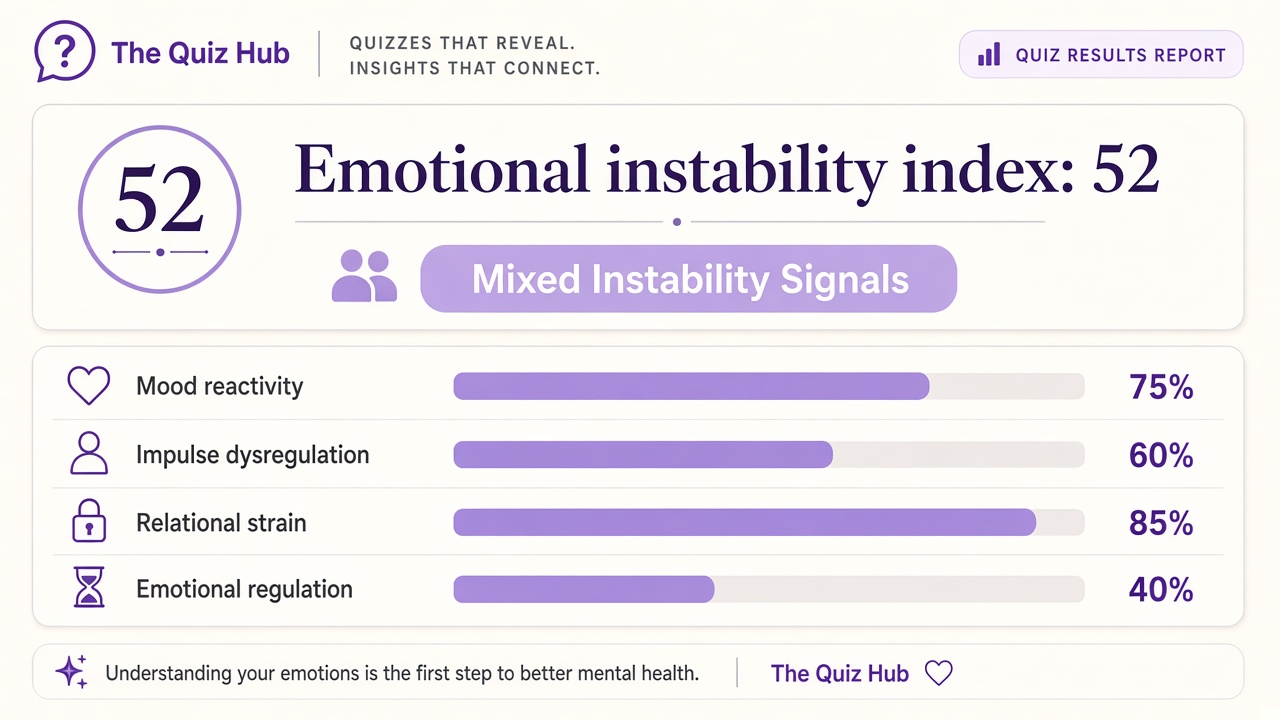
Your overall emotional instability index normalizes all 24 item scores to 0 through 100. The band groups that index into plain-language screening signals. Domain bars show whether mood swings, impulses, relationship strain, or poor regulation drives your result.
| Screening band | Score range | Typical reading |
|---|---|---|
| Lower Instability Signals | 0 to 35% | Fewer frequent volatility items; short stress spikes may still occur |
| Mixed Instability Signals | 36 to 65% | Some frequent reactivity worth monitoring, especially if persistent across settings |
| Higher Instability Signals | 66 to 100% | Frequent volatility that may warrant professional evaluation and skills support |
What your emotional instability report looks like
After you finish all 24 items, your report shows an emotional instability index score, a screening band badge, and four domain bars for mood reactivity, impulse dysregulation, relationship strain, and poor emotional regulation. The highest bar highlights which theme drove your result. Copy results to save a plain-text summary for a doctor or therapist. This is not medical clearance or a personality verdict.
What this test can and cannot tell you
Can tell you
- Whether your self-reported emotional volatility leans lower, moderate, or higher on this screener
- An emotional instability index and four domain scores for mood, impulse, relationship, and regulation themes
- Which domain bar scored highest when patterns are uneven across themes
- A starting point for conversations with a clinician about emotion regulation skills
Cannot tell you
- Whether you have borderline personality disorder, bipolar disorder, or any other clinical condition
- Official DERS scores comparable to published research norms
- Whether mood swings are caused by hormones, trauma, sleep loss, or substance use
- Whether you are a bad partner, parent, or friend
Emotion dysregulation and the DERS framework
In 2004, Kimberly Gratz and Lizabeth Roemer published the Difficulties in Emotion Regulation Scale (DERS), a self-report measure of how people identify, accept, and manage emotions. Their work helped separate everyday stress reactions from persistent dysregulation patterns that show up in mood disorders and borderline personality research. Marsha Linehan's dialectical behavior therapy (DBT) treats emotion dysregulation as a core skill deficit that can improve with structured practice, regardless of diagnosis.
The Quiz Hub built this am I emotionally unstable quiz as a focused screener on volatility rather than full personality assessment. It uses 24 original items with a two-week recall window on a five-point frequency scale. That trade-off favors readable domain feedback for casual users while naming the Gratz and Roemer (2004) source honestly. The National Institute of Mental Health notes that borderline personality disorder involves intense emotions and impulsive actions, but only structured clinical evaluation can determine whether those criteria apply to you.
| The Quiz Hub test | What it adds |
|---|---|
| Am I bipolar quiz | Manic and depressive episode screening over 12 months, not day-to-day mood reactivity |
| Am I emotionally numb quiz | Flat affect, anhedonia, and dissociative numbing domains, not mood swings or impulses |
| Am I emotionally exhausted quiz | Depletion drain and empathic overload domains, not impulsive reactions or relationship strain |
| Abandonment issues quiz | Fear of rejection and attachment anxiety themes, not impulse dysregulation broadly |
| Depression test | PHQ-inspired low mood and anhedonia screening, not rapid mood shifts specifically |
| This emotionally unstable quiz | Mood reactivity, impulse dysregulation, relationship strain, and regulation domains with a two-week recall window |
Sample item: rating Often on feeling fine one moment then suddenly overwhelmed raises your mood reactivity domain score. Rating Very often on saying something hurtful in the heat of the moment raises impulse dysregulation. Rating Rarely on calming yourself within a reasonable time raises your instability index because that regulation item is reverse-coded. Sleep loss, hormones, trauma, and untreated mood symptoms can overlap with volatility patterns, so clinicians rule out other causes during evaluation. Browse more screeners on our mental health and clinical hub or read how we review quizzes in our editorial policy.
Am I emotionally unstable quiz FAQ
What does emotionally unstable mean?
Emotionally unstable usually describes rapid mood shifts, intense reactions, impulsive behavior when upset, and difficulty calming down after conflict. In clinical language, emotion dysregulation overlaps with borderline personality traits and mood disorder symptoms, though many people use the phrase casually during stressful seasons. This am I emotionally unstable quiz measures how often those patterns showed up over the past two weeks. It is not a diagnosis.
What does this emotionally unstable quiz measure?
Twenty-four original frequency items ask how often you experience mood reactivity, impulse dysregulation, relationship strain, and poor emotional regulation. Scores map to four domains inspired by the Difficulties in Emotion Regulation Scale (Gratz and Roemer, 2004) and dialectical behavior therapy emotion dysregulation themes. You receive an emotional instability index from 0 to 100 and a band from Lower through Higher Instability Signals.
How is this different from the am I bipolar quiz?
The am I bipolar quiz screens manic and depressive episode patterns over 12 months using MDQ-inspired items. This emotionally unstable quiz focuses on day-to-day mood swings, impulsive reactions, relationship fallout, and regulation skills over two weeks. Both are screeners, but they measure different time frames and symptom clusters.
Can this quiz diagnose borderline personality disorder?
No. The emotional instability index describes self-reported volatility patterns on this abbreviated screener. Only a licensed clinician can evaluate borderline personality disorder, bipolar disorder, or related conditions through structured interviews. Online quizzes cannot confirm or deny a diagnosis.
What should I do if I get a higher instability band?
Consider scheduling an evaluation with your primary care doctor or a licensed therapist who treats emotion regulation and mood concerns. Bring your result summary and describe when patterns began and which domain feels hardest. If you feel unsafe or in crisis, call or text 988 (US) or your local crisis line.
Who reviewed this content?
Dr. Elena Vasquez, PhD, reviewed the test framing and result explanations. See our editorial policy for review standards.
Reviewed by