What this VVIQ test measures
This VVIQ test estimates how vividly you can picture scenes in your mind's eye. It groups 16 self-report items into four imagery scenarios that mirror David Marks' 1973 Vividness of Visual Imagery Questionnaire without using the published item text.
People and faces
Facial shape, expression, movement, and full appearance of someone you know well.
Natural light and sky
Sunrise colour, horizon sun, water reflection, and the whole dawn scene together.
Architecture and objects
Building proportions, window details, entrance features, and street outside.
Outdoor scenery
Sky above fields, a brook, tree detail, and plants moving in breeze.
How it works
Three steps from first question to your vividness band. Click Start Test to open the interactive quiz in a full-screen modal.
Picture each scene
Rate how vivid the mental image is on a five-point scale from no image at all to perfectly vivid. There is no timer and no auto-advance between items.
Items map to four scenarios
Your answers accumulate a vividness percentage across people, light, buildings, and outdoor scenery domains.
View band and scenario chart
Results show a Low, Moderate, or High Visual Imagery label, a spectrum marker, scenario bars, and practical notes.
Take the VVIQ test
Rate 16 imagery prompts on a five-point vividness scale. Your answers produce a vividness percentage and one of three imagery bands with a scenario breakdown chart.
Opens in a focused modal. No account required. Results stay on screen.
What your result means
Your vividness percentage is the sum of item ratings normalized to 0 through 100, where higher scores mean clearer mental pictures. The imagery band groups that score into plain-language labels. Scenario bars show whether faces or outdoor scenes drive your overall result.
| Imagery band | Vividness range | Typical reading |
|---|---|---|
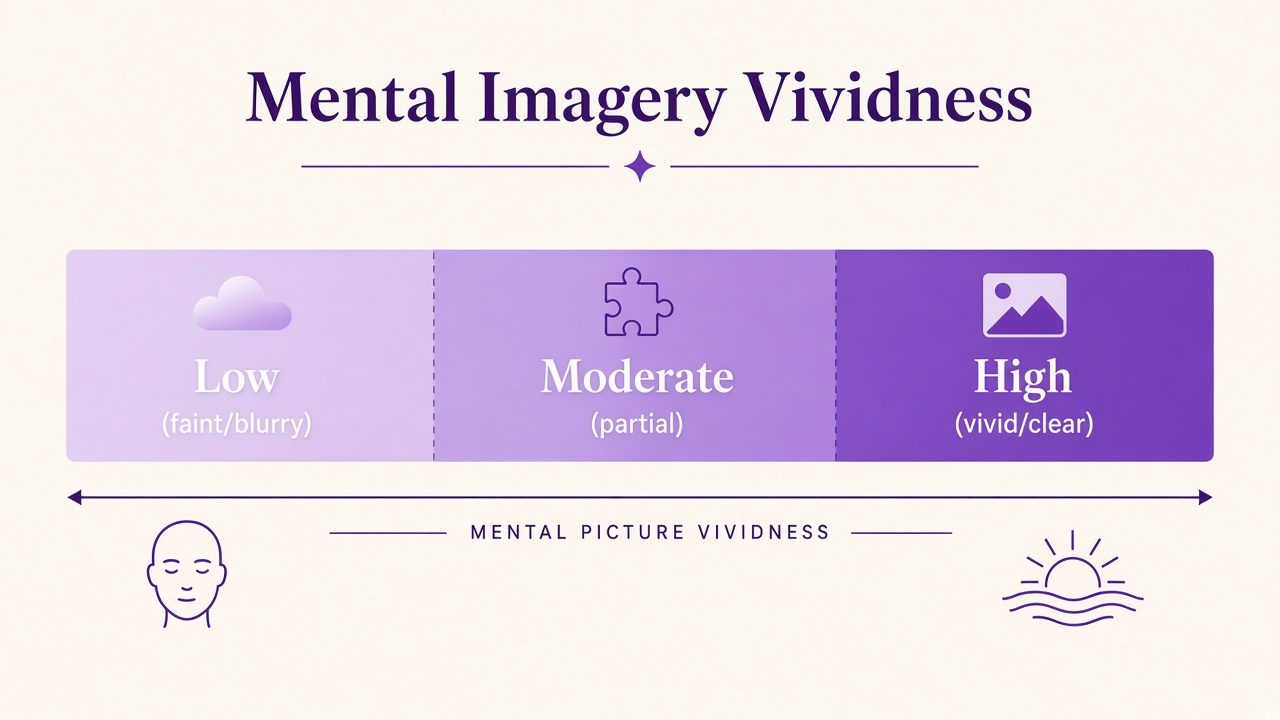
| Low Visual Imagery | 0 to 37% | Faint or absent mental pictures; knowing what something looks like without seeing it |
| Moderate Visual Imagery | 38 to 61% | Mixed clarity that strengthens with focus and weakens under distraction |
| High Visual Imagery | 62 to 100% | Clear, detailed, picture-like imagery when reading, remembering, or daydreaming |
Low to high imagery spectrum
The diagram below shows how vividness scores map across the three bands. A high score on people and faces with a low score on outdoor scenery might still land you in Moderate if your sunrise and building ratings sit in the middle.
What this test can and cannot tell you
Can tell you
- Whether your self-reported imagery leans faint, mixed, or vivid
- A vividness percentage and three-band label for self-reflection
- Which of four scenario types score highest or lowest for you
- A starting point for conversations about memory style or visualization practice
Cannot tell you
- Whether you have aphantasia, hyperphantasia, or any neurological condition
- Official VVIQ scores comparable to published research norms
- Whether you should be hired, treated, or medicated based on imagery style
- A fixed trait that never shifts with mood, practice, or fatigue
Marks 1973 visual imagery research
In 1973, David Marks published the Vividness of Visual Imagery Questionnaire (VVIQ) in the British Journal of Psychology. His 16-item scale asked participants to picture familiar scenes and rate how clearly each detail appeared in the mind's eye. The VVIQ became one of the most cited self-report tools in imagery research, though full validation requires the published instrument and norms, not a shortened web quiz.
The Quiz Hub built this VVIQ test as an abbreviated, plain-language screener inspired by Marks (1973) themes. It uses 16 original items and three result bands (Low, Moderate, High Visual Imagery) rather than the full published scoring tables. That trade-off favors readability for casual users while naming the Marks (1973) source honestly.
| The Quiz Hub test | What it adds |
|---|---|
| Big Five personality test | Trait percentiles across openness and four other domains, not mental picture vividness |
| Chronotype test (MEQ) | Morning-evening rhythm preference, not visual imagery strength |
| MBTI type test | Cognitive preference types, not imagery vividness |
| This VVIQ test | Vividness score with people, light, building, and scenery scenario bars |
Sample item: picturing the exact shape of a friend's face and rating it a 1 means no image at all, while a 5 means perfectly vivid. Fatigue or rushing can flatten ratings toward the middle, so retake after a quiet moment if results feel off. Browse more options on our personality psychology hub or read how we review quizzes in our editorial policy.
VVIQ test FAQ
What is the VVIQ test?
The Vividness of Visual Imagery Questionnaire (VVIQ) estimates how clearly you can picture scenes in your mind. The Quiz Hub version uses 16 self-report items across four imagery scenarios. Results sort into Low Visual Imagery, Moderate Visual Imagery, or High Visual Imagery bands with per-scenario bars.
How is this related to Marks 1973?
David Marks published the original VVIQ in 1973 in the British Journal of Psychology. His scale asked people to rate mental image vividness for faces, sunrise, shop fronts, and country scenes on a five-point scale. Our online screener is abbreviated and uses original plain-language items inspired by those themes. It is not the published VVIQ and is not validated for research or clinical use.
What do low, moderate, and high vividness mean?
Low Visual Imagery (0 to 37%) suggests faint or absent mental pictures, sometimes discussed as aphantasia in research. Moderate Visual Imagery (38 to 61%) means mixed clarity that varies by scene and effort. High Visual Imagery (62 to 100%) suggests clear, picture-like mental images. Bands describe self-reported preference, not intelligence or creativity.
Can visual imagery change over time?
Imagery vividness can shift with mood, fatigue, meditation practice, and age. Some people report stronger pictures after visualization training; others notice fading imagery under stress. Treat any result as a snapshot and retake after a quiet moment if answers felt rushed.
Is this VVIQ test a diagnosis of aphantasia?
No. Results are educational self-report only. They cannot diagnose aphantasia, hyperphantasia, or any neurological condition. See a qualified clinician or neuropsychologist if imagery differences affect daily life, memory, or mental health.
How long does the VVIQ test take?
Most people finish in about 4 minutes. There are 16 items on a five-point vividness scale from no image at all to perfectly vivid. You can pause and return in the same browser session.
Who reviewed this content?
Dr. James Whitfield, PhD, reviewed the test framing and result explanations. See our editorial policy for review standards.
Reviewed by