What this left brain right brain test measures
This right brain vs left brain test screens six thinking style preference domains using original agree-disagree statements. Each domain captures how you like to approach problems, not which hemisphere literally runs your mind. Neuroscience shows both sides collaborate on language, logic, and creativity.
Analytical and logical
Preference for evidence, rules, and stepwise reasoning before acting on a vague hunch.
Verbal and linguistic
Comfort explaining ideas in words, lists, and precise language rather than silent mental pictures alone.
Creative and big-picture
Enjoyment of open-ended ideas, metaphor, and seeing how separate parts connect into a whole.
Intuitive and visual
Trust in mental imagery, spatial sense, and gut impressions when information is still incomplete.
Sequential processing
Habit of tackling tasks in order, checking details, and finishing one step before jumping ahead.
Gestalt and big picture
Pull toward overall themes and forest-level patterns before fine-grained detail work.
How it works
Three steps from first statement to your thinking style band. Click Start Test to open the interactive quiz in a full-screen modal.
Answer 24 statements
Rate how much you agree with each item on a five-point scale from strongly disagree to strongly agree. There is no timer and no auto-advance between items.
Items map to six domains
Your answers accumulate scores across analytical, verbal, creative, visual, sequential, and gestalt domains. Some items are reverse-coded so that agreeing with big-picture behavior lowers your left-leaning score.
View percentages and band
Results show left-leaning and right-leaning percentages, a band label from right-leaning through integrated middle to left-leaning, per-domain bars, and notes that pop science hemisphere labels oversimplify real brain teamwork.
Take the left brain right brain test
Rate 24 thinking style statements about how you prefer to analyze, imagine, sequence, and synthesize ideas. Your answers produce left and right percentage bars with an integrated middle band and a six-domain breakdown chart.
Opens in a focused modal. No account required. Results stay on screen.
What your result means
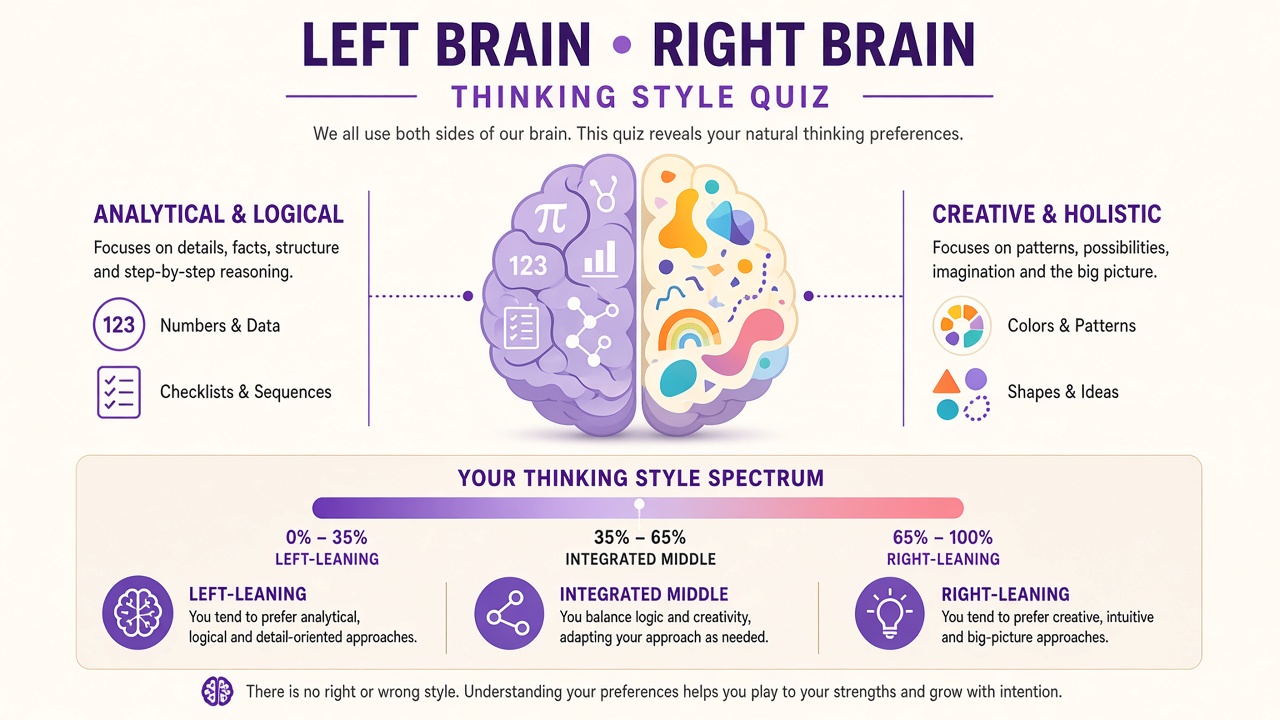
Your left-leaning percentage is the sum of scored items normalized to 0 through 100. Right-leaning percentage is the complement. Higher left-leaning means more agreement with analytical, verbal, and sequential preference items. The band label groups that score into plain-language style stages, not neuroimaging results.
| Style band | Left-leaning range | Typical reading |
|---|---|---|
| Right-Leaning | 0 to 35% | Big-picture, visual, and intuitive preferences dominate on these items today |
| Integrated Middle | 36 to 65% | Mixed pattern; domain chart shows which poles still lean left or right |
| Left-Leaning | 66 to 100% | Analytical, verbal, and sequential preferences dominate on these items today |
Six domains of thinking style
The diagram below shows how domain scores feed an overall left-leaning percentage. High sequential processing with moderate creative holism, for example, can still land you in an integrated middle band until patterns shift.
What this test can and cannot tell you
Can tell you
- How your self-reported thinking preferences cluster across six style domains
- Left-leaning and right-leaning percentages for reflection today
- Which domain bar leans most analytical or most big-picture
- When to try our VVIQ imagery quiz or MBTI type test
Cannot tell you
- Which brain hemisphere literally dominates (both sides cooperate on real tasks)
- Your IQ score, academic potential, or job aptitude
- Whether you have ADHD, dyslexia, or any clinical diagnosis
- How others objectively see your fixed cognitive style across a lifetime
Thinking style metaphor versus real neuroscience
The popular left brain versus right brain story took off in the 1970s and 1980s after split-brain research by Roger Sperry and colleagues showed specialized roles for each hemisphere in some patients. Media summaries stretched those findings into rigid personality types: logical left, creative right. Later neuroimaging work, including reviews summarized by the Nature Reviews Neuroscience literature, shows that healthy adults use networked regions across both hemispheres for math, language, music, and spatial reasoning.
The Quiz Hub built this left brain right brain test as a thinking style preference screener, not a literal hemisphere map. It asks about habits such as trusting checklists, enjoying metaphors, or grasping themes before details. That is closer to cognitive style reflection than to the debunked idea that one half of your brain is dormant. For visual imagery habits specifically, our VVIQ test measures vividness of mental pictures with scenario-based items inspired by Marks (1973).
| The Quiz Hub test | What it adds |
|---|---|
| VVIQ test | Visual imagery vividness across people, light, buildings, and scenery scenarios |
| MBTI type test | Four-preference type language across energy, information, decisions, and structure |
| Big Five personality test | Research-backed openness and conscientiousness trait percentiles |
| This left brain right brain test | Six-domain thinking style preferences with left, right, and integrated bands |
Sample item: agreeing that you prefer finishing one subtask before opening the next raises your sequential processing domain toward left-leaning. Agreeing that you grasp the overall theme before every fact lowers it on a reverse-coded gestalt item. If you searched for a right brain vs left brain test to pick study strategies, use the domain chart to see whether verbal language or intuitive imagery drives your pattern. Read how we review cognitive quizzes in our editorial policy.
Left brain right brain test FAQ
What does this left brain right brain test measure?
This left brain right brain test measures self-reported thinking style preferences across analytical logic, verbal language, creative holism, intuitive imagery, sequential processing, and gestalt big-picture domains. It produces left-leaning and right-leaning percentages plus an integrated middle band. It describes habits and preferences, not literal hemisphere dominance.
Is the left brain right brain split scientifically accurate?
No. Pop culture often claims the left brain is logical and the right brain is creative, but modern neuroscience shows both hemispheres cooperate on nearly every task. The Quiz Hub uses the metaphor for educational reflection only. Your result is a thinking style snapshot, not a brain scan.
What is an integrated middle result?
An integrated middle result means your left-leaning percentage falls in the 36 to 65% band. You may switch between analytical lists and big-picture brainstorming depending on context. Many students, managers, and makers land here.
How do left and right percentages work?
Each item contributes to an overall left-leaning score normalized to 0 through 100%. Right-leaning percentage is the complement, so the two always sum to 100%. Domain bars show the same split for each of the six thinking style areas separately.
Does this test measure IQ or intelligence?
No. Thinking style preference is separate from IQ score. For trait-based reflection, try our Big Five personality test. For visual imagery habits, try our VVIQ test. Formal IQ assessment requires proctored instruments, not online quizzes.
Who reviewed this content?
Dr. James Whitfield, PhD, reviewed the test framing and result explanations. See our editorial policy for review standards.
Reviewed by