What this when will I get married quiz measures
This when will I get married quiz estimates how often you report marriage-readiness signals across six life domains. Twenty-one original Likert items group into clarity, practical stability, and goal themes. Results show readiness bands, not calendar dates. No quiz can name your wedding year; honest reflection beats guessing.
Relationship status clarity
How clearly your stated status matches what you want and how you actually date.
Commitment readiness
Emotional steadiness, resilience after setbacks, and lessons from past relationships.
Life stability
Whether housing, income, education, and routines support serious partnership planning.
Openness to commitment
Willingness for exclusivity, shared future talk, and staying present with a good match.
Social and family pressure
Separating your own marriage interest from outside timeline questions.
Personal goals alignment
Whether marriage fits career, health, travel, or growth goals rather than postponing them blindly.
How it works
Three steps from first question to your readiness snapshot. Click Start Quiz to open the interactive modal.
Rate your focus 21 times
Answer how often each statement applies from Never to Almost always. There is no timer and no auto-advance.
Items map to six domains
Your answers accumulate percentages for status clarity, readiness, stability, openness, pressure, and goals.
View band and next steps
Results show four readiness bands with domain bars and reflection prompts. No wedding date appears anywhere.
Take the when will I get married quiz
Rate 21 marriage-readiness statements on a five-point frequency scale. Your answers produce a marriage readiness index, six domain scores, and a reflective band with plain-language next steps. No calendar predictions.
Opens in a focused modal. No account required. Results stay on screen.
What your result means
Your overall marriage readiness index is the average of six domain scores, each normalized to 0 through 100. Higher percentages mean more frequent endorsement of positive readiness items (and less frequent endorsement of reverse-scored concern items). Domain bars show whether status clarity, life stability, or family pressure drives your band. No score converts to a wedding year.
| Readiness band | Score range | Typical reading |
|---|---|---|
| Not Focused Yet | 0 to 25% | Marriage is not a central focus now, or several readiness areas need attention |
| Building Toward It | 26 to 50% | Mixed signals across clarity, stability, and openness; common during transitions |
| Open When Ready | 51 to 75% | Solid clarity and openness with room to refine stability or goal alignment |
| Actively Seeking Commitment | 76 to 100% | Strong readiness signals across most domains; still not a wedding date forecast |
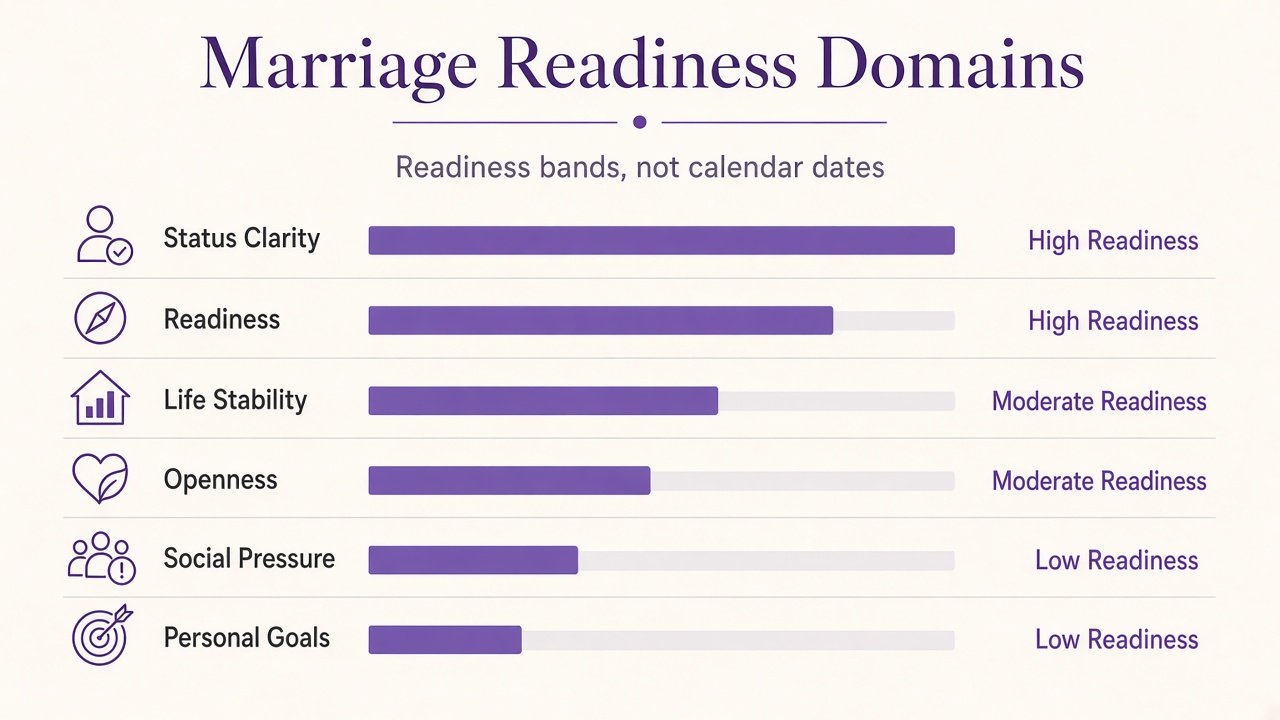
Six marriage readiness domains
The diagram below shows how domain scores appear in your results. High openness with low life stability, for example, can still land you in Building Toward It if your overall average sits between bands.
What this quiz can and cannot tell you
Can tell you
- Whether your self-reported marriage focus leans toward lower, mixed, open, or actively seeking patterns on this screener
- A marriage readiness index and six domain scores for clarity, stability, pressure, and goals
- Which domain bar scores lowest and may deserve honest reflection first
- A starting point before you decide whether to prioritize dating, pause, or seek support
Cannot tell you
- What year, month, or date you will get married
- Who you will marry or whether a specific person is your future spouse
- Whether you should rush marriage because of age or family pressure
- Compatibility fit, love language, or how someone else feels about you
Timeline pressure and honest readiness reflection
Sociologist Andrew Cherlin notes that Americans increasingly treat marriage as a capstone milestone reached after education, career stability, and personal identity feel settled, rather than a foundation built early in adulthood. His work on the "capstone marriage" model helps explain why readiness varies by circumstance rather than a single age chart. A 2019 Pew Research Center report on marriage trends shows median ages rising while cohabitation and delayed commitment grow, which means timeline anxiety often reflects social change more than personal failure.
The Quiz Hub built this when will I get married quiz as a compassionate reflection tool, not a fortune teller. Twenty-one original items ask about status clarity, emotional readiness, stable routines, openness to exclusivity, separating family pressure from your own wishes, and fitting marriage into personal goals. That framework helps organize mixed signals before you compare yourself to cousins who wed at twenty-five. For emotional and practical bandwidth before dating, try our am I ready for a relationship quiz. For partnership health if you are already in a bond, take our relationship test. For partner preference imagination rather than timeline readiness, browse our who will I marry quiz when live on The Quiz Hub.
| The Quiz Hub test | What it adds |
|---|---|
| Am I ready for a relationship quiz | Emotional availability, communication, healing, time, and clarity before dating |
| Relationship test | Partnership health across trust, intimacy, repair, goals, and respect for existing couples |
| Who will I marry quiz | Partner preference and romantic imagination, not calendar timeline prediction |
| Compatibility test | Values, communication, conflict repair, and lifestyle fit domain bars |
| This when will I get married quiz | 21 readiness items with four bands and six domain bars from your self-report |
Sample item: rating Often on knowing whether you are single by choice raises your status clarity bar. Rating Almost always on making dating decisions mainly to quiet family questions lowers your social pressure score through a reverse-scored item. Career pivots, caregiving loads, and healing seasons can temporarily lower scores without meaning you should never marry. Read how we review quizzes in our editorial policy or browse more tests on our relationships and dating hub.
When will I get married quiz FAQ
What does this when will I get married quiz measure?
This when will I get married quiz measures how often you report readiness signals across six domains: relationship status clarity, commitment readiness, life stability, openness to exclusivity, social and family pressure, and personal goal alignment. Twenty-one items use a five-point frequency scale. Results show reflective readiness bands, not a predicted wedding year or calendar date.
Can this quiz tell me what year I will get married?
No. No online quiz can predict a marriage year, month, wedding date, or who you will marry. This screener maps your self-reported focus and readiness patterns into bands such as Not Focused Yet or Actively Seeking Commitment. Honest reflection, therapy when needed, and real-life context beat any score.
What if my result shows Not Focused Yet?
Lower bands mean your answers suggest marriage is not a central focus right now, or several readiness areas still need attention. That can reflect career seasons, healing after breakups, unclear goals, or life chaos. It is a prompt to reflect, not proof that you will never marry or that you must rush because of age.
How is this different from an am I ready for a relationship quiz?
An am I ready for a relationship quiz focuses on emotional availability, communication, healing, and bandwidth before dating. This when will I get married quiz adds status clarity, life stability, family timeline pressure, and how marriage fits your personal goals. Pair both if you wonder about readiness and long-term focus together.
How is this different from a who will I marry quiz?
A who will I marry quiz (when available) explores partner preferences and romantic imagination, not timeline readiness. This quiz does not name a future spouse. It reflects whether you feel focused, building, open, or actively seeking commitment based on your own patterns. No quiz can identify your future partner.
Who reviewed this content?
Dr. Priya Sharma, PhD, reviewed the test framing and result explanations. See our editorial policy for review standards.
Reviewed by