What this friends with benefits quiz measures
This friends with benefits quiz estimates how often FWB ambiguity patterns show up in your casual arrangement. Twenty original frequency items group into four FWB clarity domains inspired by casual sex research from Justin Lehmiller and Kinsey Institute surveys: rules clarity, emotional crossover, exclusivity negotiation, and expectation alignment. Each item also maps to a fear-of-intimacy stack layer so you can see whether vulnerability pull-back, trust hesitation, self-disclosure limits, or closeness anxiety drives confusion most. Your FWB clarity index averages these patterns into a 0 to 100 score where higher numbers mean more ambiguity signals.
Rules clarity
Unclear ground rules, dodged check-ins, mixed signals about what FWB means, and awkward labels.
Emotional crossover
Catching feelings, jealousy spikes, romantic bids, and couple-like habits outside the agreed frame.
Exclusivity negotiation
Dating others while assuming exclusivity, mixed app activity, and unspoken standing to ask.
Expectation alignment
Wanting more commitment than agreed, accepting less than you need, or drifting expectations without talk.
How it works
Three steps from first question to your FWB clarity report with fear-of-intimacy stack. Click Start Quiz to open the interactive quiz in a full-screen modal.
Answer 20 frequency items
Rate how often each FWB ambiguity pattern shows up, from Never to Almost always. You click Next after each answer; nothing auto-advances.
Items map to FWB domains and intimacy stack
Your answers accumulate percentages for rules clarity, emotional crossover, exclusivity negotiation, and expectation alignment, plus four fear-of-intimacy stack layers.
View band, domain bars, and stack chart
Results show Clearer FWB Arrangement, Mixed FWB Signals, or Unclear FWB Patterns with domain bars, stack layers, and reflection prompts.
Take the friends with benefits quiz
Rate 20 statements about your FWB arrangement. Your answers produce an FWB clarity index from 0 to 100, four domain scores, a fear-of-intimacy stack chart, and a band label for reflection or boundaries talks.
Opens in a focused modal. No account required. Results stay on screen.
What your FWB clarity result means
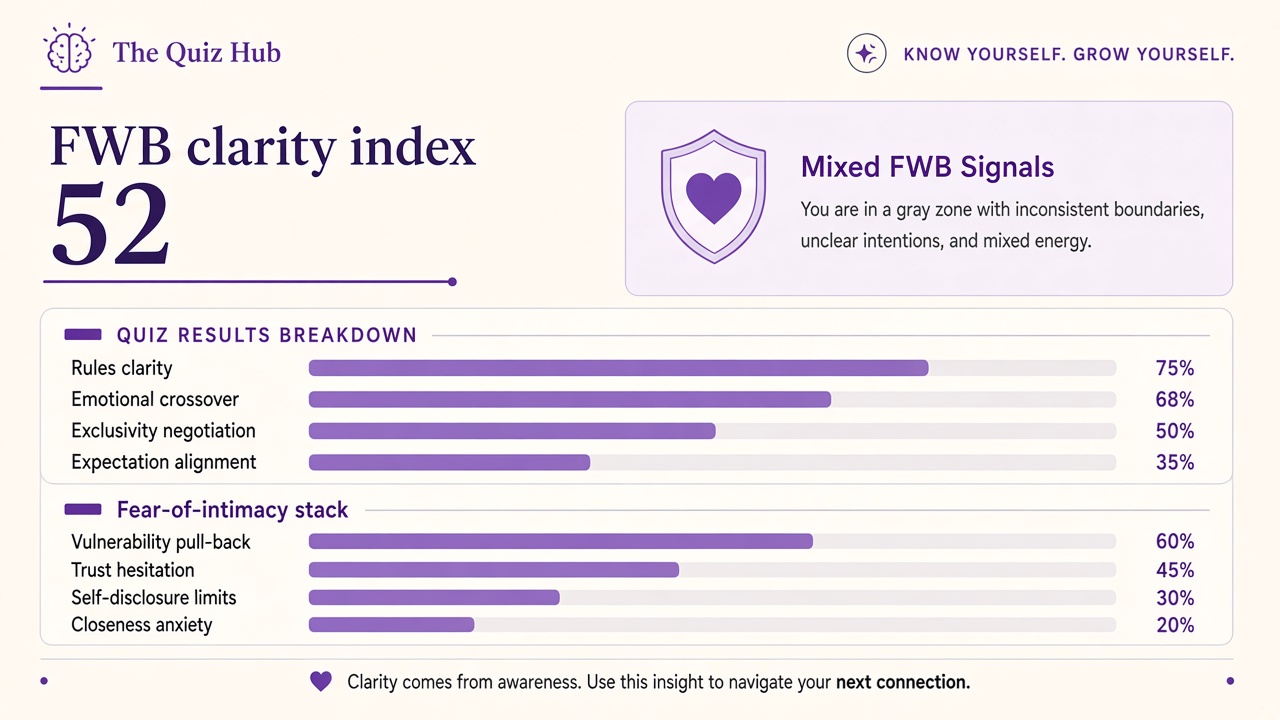
Your FWB clarity index is the normalized total across all 20 items on a 0 to 100 scale. Higher scores mean more frequent endorsement of rules ambiguity, emotional crossover, exclusivity mismatch, and expectation drift items on this screener. Domain bars show endorsement rates so you can see whether unclear rules, blurred feelings, open options, or mismatched expectations drives your result most. The fear-of-intimacy stack chart shows parallel layers for vulnerability pull-back, trust hesitation, self-disclosure limits, and closeness anxiety inside your FWB frame.
| Band | Index range | Typical reading |
|---|---|---|
| Clearer FWB Arrangement | 0 to 35 | Fewer undefined FWB signals; consensual casual sex with honest check-ins can still score here |
| Mixed FWB Signals | 36 to 65 | Blend of workable connection and ambiguity; worth naming rules and feelings before they drift |
| Unclear FWB Patterns | 66 to 100 | Frequent rules ambiguity, emotional crossover, exclusivity mismatch, or expectation drift; boundaries talk or support may help |
What your FWB report looks like
After all 20 items, you get an FWB clarity index from 0 to 100, a band label, four domain bars for rules clarity, emotional crossover, exclusivity negotiation, and expectation alignment, plus a fear-of-intimacy stack chart with vulnerability, trust, disclosure, and closeness anxiety layers.
What this quiz can and cannot tell you
Can tell you
- How often FWB ambiguity patterns showed up in this arrangement on this screener
- An FWB clarity index and four domain bars for rules, feelings, exclusivity, and expectations
- A fear-of-intimacy stack showing which closeness-avoidance layer feels strongest
- A starting point for boundaries check-ins or therapy
Cannot tell you
- Whether your FWB is officially healthy or toxic without your own judgment and dialogue
- Whether casual sex is right or wrong for you in your specific culture and context
- Whether you should stay or leave without honest conversation and self-trust
- What treatment you need without licensed professional guidance
FWB arrangements, rules clarity, and intimacy avoidance
Friends with benefits entered mainstream dating vocabulary as shorthand for recurring sexual contact between friends who skip the boyfriend or girlfriend label. Sex researcher Justin Lehmiller and Kinsey Institute surveys document wide variation in how adults define casual arrangements, from strict no-strings rules to blurred feelings that look like dating without titles. That variation helps explain why FWB can feel liberating for one person and confusing for another when rules stay unspoken.
The Quiz Hub built this friends with benefits quiz as an original self-report screener inspired by those themes plus FOIS-style intimacy avoidance layers, not a reproduction of any single published instrument. Readers often compare it to sibling tools on this site. Our am I in a situationship quiz screens label limbo when you are unsure what to call a connection. The fear of intimacy quiz measures your own vulnerability pull-back across closeness, not FWB rules frequency. The attachment style test maps anxiety and avoidance quadrants rather than exclusivity negotiation inside casual sex.
| The Quiz Hub test | What it adds |
|---|---|
| Am I in a situationship quiz | Label-limbo index for undefined titles, not agreed FWB rules |
| Fear of intimacy quiz | General intimacy avoidance across vulnerability and trust, not FWB-specific rules |
| Am I afraid of love quiz | Love avoidance and romantic panic, not casual arrangement clarity |
| Compatibility test | Values and lifestyle overlap, not exclusivity inside FWB |
| Relationship anxiety quiz | Reassurance seeking and jealousy scan, not rules ambiguity alone |
| This FWB quiz | FWB clarity index plus fear-of-intimacy stack for rules, feelings, exclusivity, and expectations |
Sample item types include frequency ratings such as whether you assume exclusivity while they still date others, or whether you pull back after tender moments because you fear wanting more than FWB. High rules clarity with high emotional crossover often lands in Mixed or Unclear FWB Patterns. Consensual FWB with scheduled check-ins can score in Clearer FWB Arrangement even when sex is frequent. Read how we review quizzes in our editorial policy or browse more tools on our relationships and dating hub.
Friends with benefits quiz FAQ
What is a friends-with-benefits arrangement?
Friends with benefits (FWB) usually means recurring sexual contact between people who also share friendship, without a committed romantic label. Researchers such as Justin Lehmiller and the Kinsey Institute note that casual sex arrangements vary widely in rules, exclusivity, and emotional expectations. This friends with benefits quiz measures how often rules ambiguity, emotional crossover, exclusivity mismatch, and expectation drift show up in your experience. It is not proof your FWB is healthy or unhealthy, and it is not a clinical diagnosis.
What does this FWB quiz measure?
Twenty original frequency items ask how often you notice unclear rules, blurred feelings, mismatched exclusivity, and drifting expectations in your FWB arrangement. Scores map to four FWB clarity domains plus a parallel fear-of-intimacy stack with vulnerability pull-back, trust hesitation, self-disclosure limits, and closeness anxiety layers. You receive an FWB clarity index from 0 to 100 where higher scores mean more ambiguity signals, plus a band from Clearer FWB Arrangement through Unclear FWB Patterns.
What is the fear-of-intimacy stack on this quiz?
The fear-of-intimacy stack is a second results chart inspired by FOIS-style intimacy avoidance themes, adapted to FWB context. Each of the 20 items also maps to one of four stack layers: vulnerability pull-back, trust hesitation, self-disclosure limits, and closeness anxiety. The stack index summarizes how often you dodge feel talks, assume they will bail, edit yourself to stay casual, or panic when connection feels couple-like inside an FWB frame.
How is this different from the situationship quiz?
The am I in a situationship quiz screens label limbo when you are unsure what to call a connection. This FWB quiz focuses on agreed casual sex arrangements: whether rules are clear, feelings are crossing lines, exclusivity matches, and expectations align. It adds a fear-of-intimacy stack layer that the situationship quiz does not include.
Can this quiz prove my FWB is toxic?
No. The FWB clarity index describes self-reported pattern signals on this abbreviated screener. Consensual FWB with honest check-ins can score in any band. Cultural differences, long distance, or one-sided hope can raise scores without dysfunction. Only you plus honest dialogue can define whether the arrangement still works.
Who reviewed this content?
Dr. James Whitfield, PhD, reviewed the test framing and result explanations. See our editorial policy for review standards.
Reviewed by