What this desperation-for-love quiz measures
This am I desperate for love quiz estimates how often patterns that rush or shrink romantic pursuit show up in your dating life. Twenty-two original frequency items group into four domains drawn from attachment and loneliness research: pace rushing, standards bending, loneliness intolerance, and validation chasing. Your desperation-for-love index averages these patterns into a 0 to 100 score with plain-language bands. It reflects your self-report about dating habits, not your worth as a person.
Pace rushing
Forcing labels early, restless pacing, and treating intense chemistry as proof of destiny.
Standards bending
Ignoring red flags, accepting poor treatment, and staying with non-committal partners.
Loneliness intolerance
Restlessness when single, reopening apps to avoid alone time, and staying to escape emptiness.
Validation chasing
Measuring worth through texts, fishing for compliments, and changing self to gain attention.
How it works
Three steps from first question to your desperation-for-love report. Click Start Quiz to open the interactive quiz in a full-screen modal.
Answer 22 frequency items
Rate how often each dating pattern shows up when you think about romantic connection, from Never to Almost always. You click Next after each answer; nothing auto-advances.
Items map to four desperation domains
Your answers accumulate percentages for pace rushing, standards bending, loneliness intolerance, and validation chasing, plus an overall desperation-for-love index.
View band and domain bars
Results show Lower, Mixed, or Higher Desperation for Love with domain bars and reflection prompts. Higher bands include crisis resources.
Take the am I desperate for love quiz
Rate 22 statements about dating urgency, standards, loneliness, and validation seeking. Your answers produce a desperation-for-love index from 0 to 100, four domain scores, and a band label for reflection or therapy conversation.
Opens in a focused modal. No account required. Results stay on screen.
What your result means
Your desperation-for-love index is the normalized total across all 22 items on a 0 to 100 scale, with reverse scoring on loneliness tolerance and validation security items so higher scores mean more desperation overall. Domain bars show endorsement rates so you can see whether pace rushing, standards bending, loneliness intolerance, or validation chasing drives your result most.
| Band | Index range | Typical reading |
|---|---|---|
| Lower Desperation for Love | 0 to 35 | Fewer rushed-pursuit patterns on this screener; normal excitement about a new match may still appear |
| Mixed Desperation Patterns | 36 to 65 | Blend of healthy desire and habits that rush or shrink standards; worth tracking if persistent |
| Higher Desperation for Love | 66 to 100 | Frequent pace rushing, standards bending, or validation chasing; professional support may help |
What your desperation-for-love report looks like
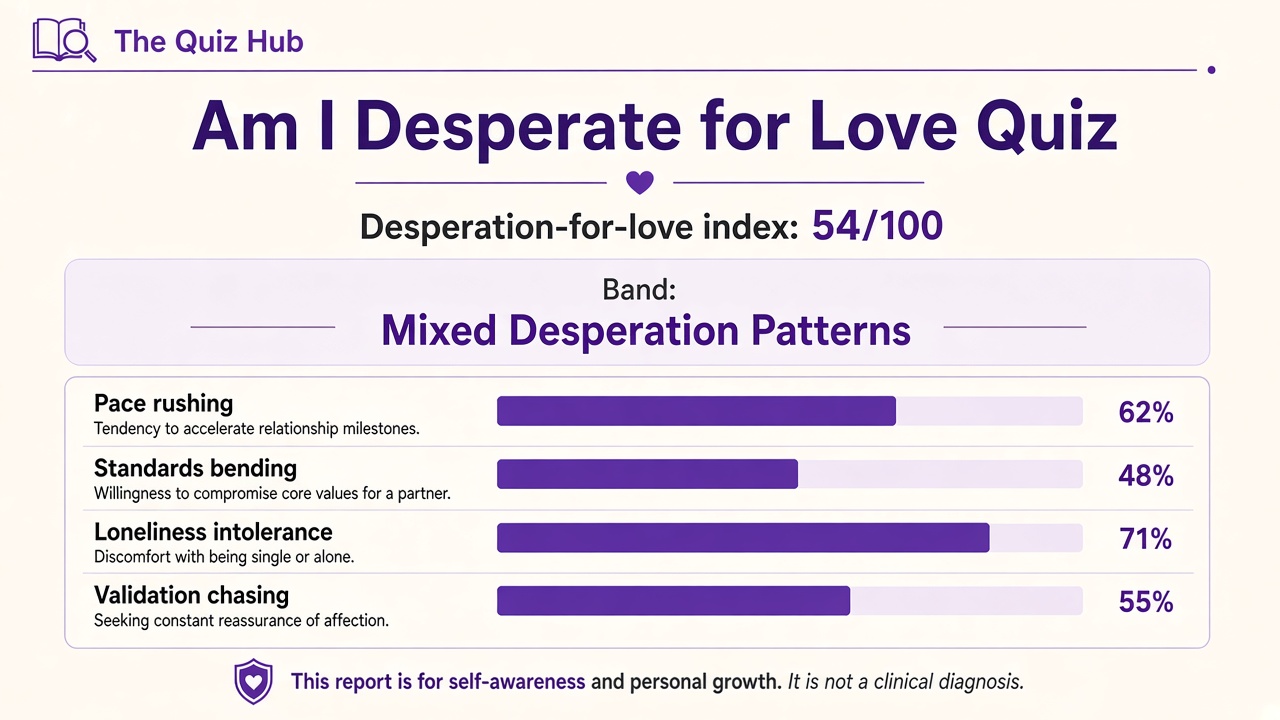
After all 22 items, you get a desperation-for-love index from 0 to 100, a band label, and four domain bars for pace rushing, standards bending, loneliness intolerance, and validation chasing. Percentages reflect how you pursue romantic connection, not a clinical verdict about your worth.
What this quiz can and cannot tell you
Can tell you
- How often desperation-for-love patterns showed up for you in dating
- A desperation-for-love index and four domain bars for pace, standards, loneliness, and validation
- Which domain pattern feels strongest in your current pursuit habits
- A starting point for therapy conversation or retaking after a dating pause
Cannot tell you
- Whether you have relationship anxiety, anxious attachment, or any clinical diagnosis
- Whether you will find a partner or how long your next relationship will last
- Whether wanting love is wrong or shameful (desire itself is not measured as pathology)
- What treatment you need without a licensed clinician's evaluation
Attachment urgency, loneliness, and dating standards
Psychologists Kim Bartholomew and Leonard Horowitz published a four-category model of adult attachment in 1991, distinguishing secure, preoccupied, dismissive, and fearful styles. Later work by Cindy Hazan and Phillip Shaver linked attachment patterns to how adults pursue and sustain romantic bonds. Researchers such as John Cacioppo and Louise Hawkley (2009) showed that perceived loneliness can amplify social threat scanning and push people toward quick relational fixes. Desperation for love in everyday language often maps to those patterns: rushing labels, bending standards, dreading alone time, and chasing validation through dating attention.
The Quiz Hub built this am I desperate for love quiz as an original self-report screener inspired by attachment urgency and loneliness tolerance themes, not a reproduction of any single published instrument. Readers often compare it to sibling tools on this site. Our fear of intimacy quiz screens vulnerability avoidance and trust hesitation when closeness arrives. The relationship anxiety quiz maps reassurance seeking and jealousy scan worry. The codependency level test measures caretaking overload and boundary blur rather than dating pace alone.
| The Quiz Hub test | What it adds |
|---|---|
| Fear of intimacy quiz | Intimacy avoidance index for vulnerability pull-back and disclosure limits, not pursuit urgency |
| Relationship anxiety quiz | Reassurance seeking and jealousy scan worry, not standards bending or pace rushing |
| Codependency level test | Caretaking overload and self-worth through usefulness, not loneliness-driven dating pace |
| Attachment style test | Anxiety and avoidance dimensions across closeness, not desperation frequency alone |
| Self-worth quiz | Global self-esteem swings, not romantic validation chasing habits specifically |
| This desperation-for-love quiz | Four-domain desperation index for pace rushing, standards bending, loneliness, and validation |
Sample item types include frequency ratings such as whether you push to make a new connection official before you feel ready, or whether you enjoy your own company during a long stretch without dating. High pace rushing with high loneliness intolerance often lands in Mixed or Higher Desperation for Love. Recent breakups, friend-group coupling, and long single stretches can spike scores temporarily. Read how we review quizzes in our editorial policy or browse more tools on our relationships and dating hub.
Am I desperate for love quiz FAQ
What does desperate for love mean?
Desperate for love usually refers to patterns that rush romantic pacing, bend personal standards, struggle with being alone, or chase validation through dating attention. Psychologists who study attachment and loneliness note that urgency often reflects unmet needs rather than weak character. This am I desperate for love quiz measures how often those patterns show up when you think about dating. It is not a clinical diagnosis.
What does this desperation-for-love quiz measure?
Twenty-two original frequency items ask how often you experience pace rushing, standards bending, loneliness intolerance, and validation chasing in romantic pursuits. Scores map to four domains drawn from attachment and loneliness research. You receive a desperation-for-love index from 0 to 100 and a band from Lower through Higher Desperation for Love.
How is this different from the fear of intimacy quiz?
The fear of intimacy quiz screens vulnerability avoidance, trust hesitation, and self-disclosure limits when closeness arrives. This desperation quiz focuses on pursuit habits: forcing labels early, ignoring red flags, staying to avoid loneliness, and measuring worth through romantic attention. It uses a dating frequency frame rather than intimacy pull-back items alone.
Can this quiz diagnose relationship anxiety or attachment issues?
No. The desperation-for-love index describes self-reported dating patterns on this abbreviated screener. Excitement about a new match, grief after a breakup, or cultural pressure to partner can raise scores without pathology. Only a licensed clinician can evaluate attachment style or related conditions through structured assessment.
What should I do if I get a higher desperation band?
Consider scheduling an evaluation with a licensed therapist who treats relationship anxiety, attachment, or self-esteem concerns. Bring your result summary and describe which domain feels hardest. If you feel unsafe or in crisis, call or text 988 (US) or your local crisis line.
Who reviewed this content?
Dr. Elena Vasquez, PhD, reviewed the test framing and result explanations. See our editorial policy for review standards.
Reviewed by