What this soulmate initial quiz measures
This soulmate initial quiz asks you to picture an ideal partner across nineteen original scenarios, then maps your answers to six vibe archetypes with weighted letter pools. Results show three suggested initials, a primary cluster profile, secondary influence, and A-through-M versus N-through-Z lean bars. No quiz can read a stranger's monogram. The score is a mirror for the energy you say you want nearby.
Bold spark
Confident first moves, plain speech, and courage when plans need a push.
Gentle embrace
Patient tone, soft reassurance, and affection that feels safe instead of loud.
Creative muse
Playful imagination, artistic noticing, and dates that feel slightly story-like.
Steady anchor
Reliable follow-through, calm logistics, and repair after conflict.
Social flame
Warm charisma, inclusive fun, and energy that loosens up group spaces.
Quiet depth
Late-night honesty, private loyalty, and trust built in slow repeated moments.
How it works
Three steps from first scenario to your playful initial cluster. Click Start Quiz to open the interactive modal.
Rate 19 soulmate scenarios
Answer how well each imagined partner moment fits from Not at all to Exactly. There is no timer and no auto-advance.
Scenarios map to six archetypes
Your answers accumulate percentages for bold, gentle, creative, steady, social, and quiet vibes with linked letter pools.
View initials and cluster profile
Results show three suggested letters, a primary cluster title, bucket lean bars, and conversation starters with clear novelty limits.
Take the soulmate initial quiz
Picture your ideal partner across nineteen playful scenarios on a five-point fit scale. Your answers produce a three-letter cluster, six archetype bars, and an A-through-M versus N-through-Z lean readout with plain-language conversation prompts.
Opens in a focused modal. No account required. Results stay on screen.
What your result means
Your three suggested initials come from the top-scoring archetypes after all nineteen scenarios are answered. Each archetype owns a small letter pool in either the A-through-M or N-through-Z bucket. The primary cluster title names the strongest vibe profile. Bucket lean bars compare average scores across those two playful groupings. Higher archetype percentages mean the scenarios in that domain felt more exactly like your imagined soulmate.
| Archetype domain | Letter bucket | Typical vibe read |
|---|---|---|
| Bold spark | A-M pool | Direct courage, decisive warmth, and momentum in social moments |
| Gentle embrace | A-M pool | Soft patience, calm reassurance, and emotionally safe pacing |
| Creative muse | A-M pool | Dreamy noticing, playful dates, and story-like romance energy |
| Steady anchor | A-M pool | Reliability, practical care, and conflict repair without vanishing |
| Social flame | N-Z pool | Charisma, inclusive fun, and partners who energize group spaces |
| Quiet depth | N-Z pool | Introspective loyalty, late-night honesty, and trust in silence |
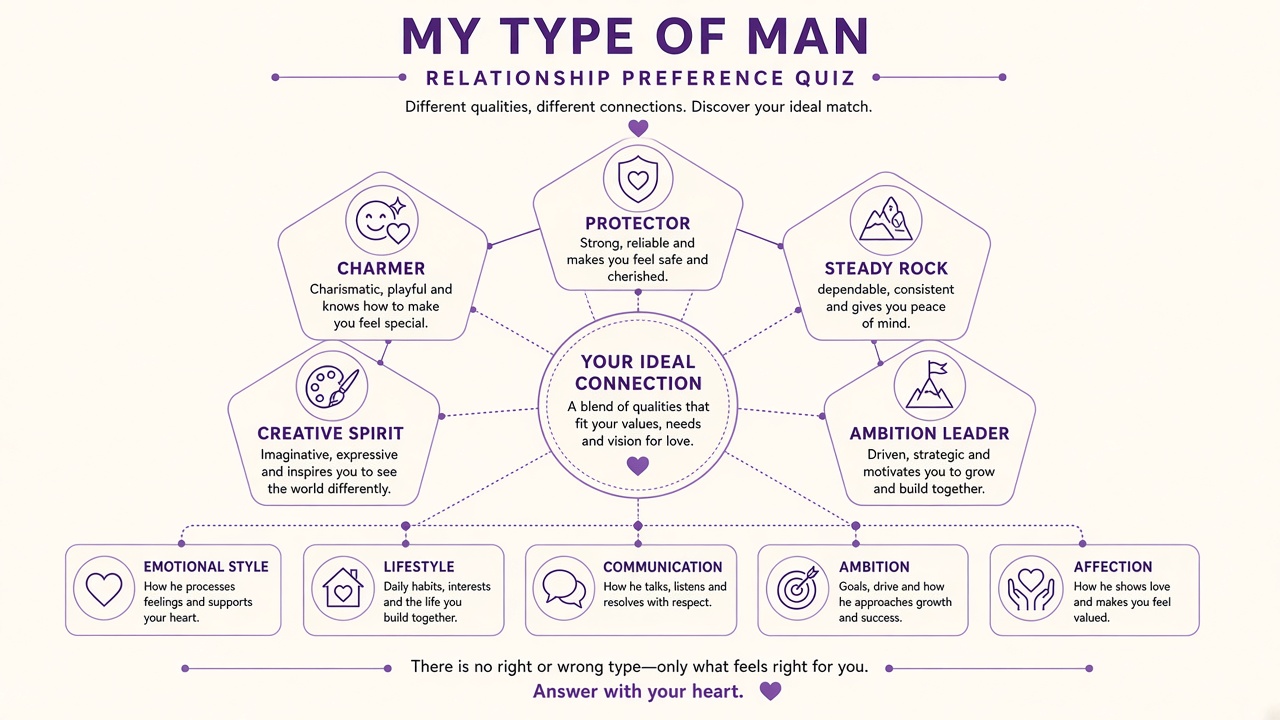
Initial cluster diagram
The diagram below shows how three suggested initials and six archetype bars appear in your results. A strong gentle embrace score with moderate creative muse, for example, might yield initials such as E · C · L rather than random letters.
What this quiz can and cannot tell you
Can tell you
- A playful three-letter cluster weighted by your top soulmate vibe archetypes on this screener
- Six archetype percentages for bold, gentle, creative, steady, social, and quiet imagined partner energy
- An A-through-M versus N-through-Z bucket lean bar tied to this quiz's letter pools only
- Conversation starters about the partner energy you say you want nearby
Cannot tell you
- A real soulmate's initials, full name, or whether you have already met them
- Romantic destiny, fate, twin-flame claims, or who you should marry
- Whether someone with those letters is compatible with you in daily life
- Bond resonance scores, crush intensity, or marriage timing (see sibling tests below)
Why initial quizzes go viral (and where they fail)
Relationship researchers study attachment, values overlap, and repair habits far more often than name games. Still, playful initial quizzes spread because they turn vague longing into a shareable prompt: three letters, one screenshot, a group chat debate. Psychologist John Gottman's work on long-term couples emphasizes bids for connection and repair attempts, not alphabet superstition. The Quiz Hub built this soulmate initial quiz as novelty with guardrails: nineteen imagined scenarios, six archetype domains, weighted letter pools, and copy that says plainly what the tool cannot claim.
Pair this page with tests that answer different questions. Our soulmate test maps bond resonance across deep understanding, ease, values, growth, intuition, and lasting pull when you want felt connection domains instead of initials. Our crush quiz measures butterflies, preoccupation, proximity desire, and nervousness toward someone already on your radar. Our who will I marry quiz sits in the same playful relationship cluster for future-facing romance prompts. If you searched what is my soulmate's initials, treat this screener as a vibe mirror, then follow up with direct communication and time together.
| The Quiz Hub test | What it adds |
|---|---|
| Soulmate test | 22-item bond resonance screener with six connection domains and reflective soulmate signal bands |
| Crush quiz | 20-item crush intensity snapshot with butterflies, thinking, proximity, and nervousness domains |
| Who will I marry quiz | Future-facing romance novelty in the same relationship cluster for marriage-themed reflection |
| This soulmate initial quiz | 19 scenario items with three suggested initials, six archetype bars, and A-M versus N-Z lean readout |
Sample scenario: rating Mostly on a steady-anchor item about keeping small promises raises your reliable-partner bar and can pull a letter such as T into your cluster if that archetype ranks in your top three. Rating Not at all on a social-flame item lowers your N-through-Z bucket contribution even if you still receive a Z from a secondary archetype. Mood, recent heartbreak, and who you have in mind while taking the quiz can shift scores without meaning the letters are wrong forever. Read how we review quizzes in our editorial policy or browse more tests on our relationships and dating hub.
Soulmate initial quiz FAQ
What does this soulmate initial quiz measure?
This soulmate initial quiz maps 19 imagined partner scenarios to six vibe archetypes: bold spark, gentle embrace, creative muse, steady anchor, social flame, and quiet depth. Your answers produce a playful cluster of three suggested initials plus A-through-M versus N-through-Z bucket lean bars. It cannot reveal a real soulmate's initials.
Can this quiz tell me my soulmate's real initials?
No. No online quiz can know a stranger's name, monogram, or destiny. Letters here are weighted outputs from archetype scoring, meant as a conversation starter about the energy you imagine in love. Treat the result like a fun mirror, not fortune-telling.
How is this different from the soulmate test?
The soulmate test uses 22 Likert items on bond resonance domains such as deep understanding, ease, values, growth, intuition, and lasting pull. This initial quiz is shorter, scenario-flavoured, and outputs a three-letter cluster for novelty reflection rather than soulmate signal bands.
What do the A-M and N-Z buckets mean?
A-through-M and N-through-Z buckets are playful groupings tied to archetype letter pools in this quiz only. They show whether your answers leaned toward early-alphabet vibe clusters like bold spark and gentle embrace or later-alphabet clusters like social flame and quiet depth. They are not linguistic science.
How is this different from a crush quiz?
A crush quiz measures your feelings toward someone you already notice: butterflies, preoccupation, proximity desire, and nervousness. This initial quiz asks you to imagine an ideal partner vibe and maps that imagination to reflective initials. Try our crush quiz when you want to name current feelings instead.
Who reviewed this content?
Dr. Priya Sharma, PhD, reviewed the test framing and result explanations. See our editorial policy for review standards.
Reviewed by