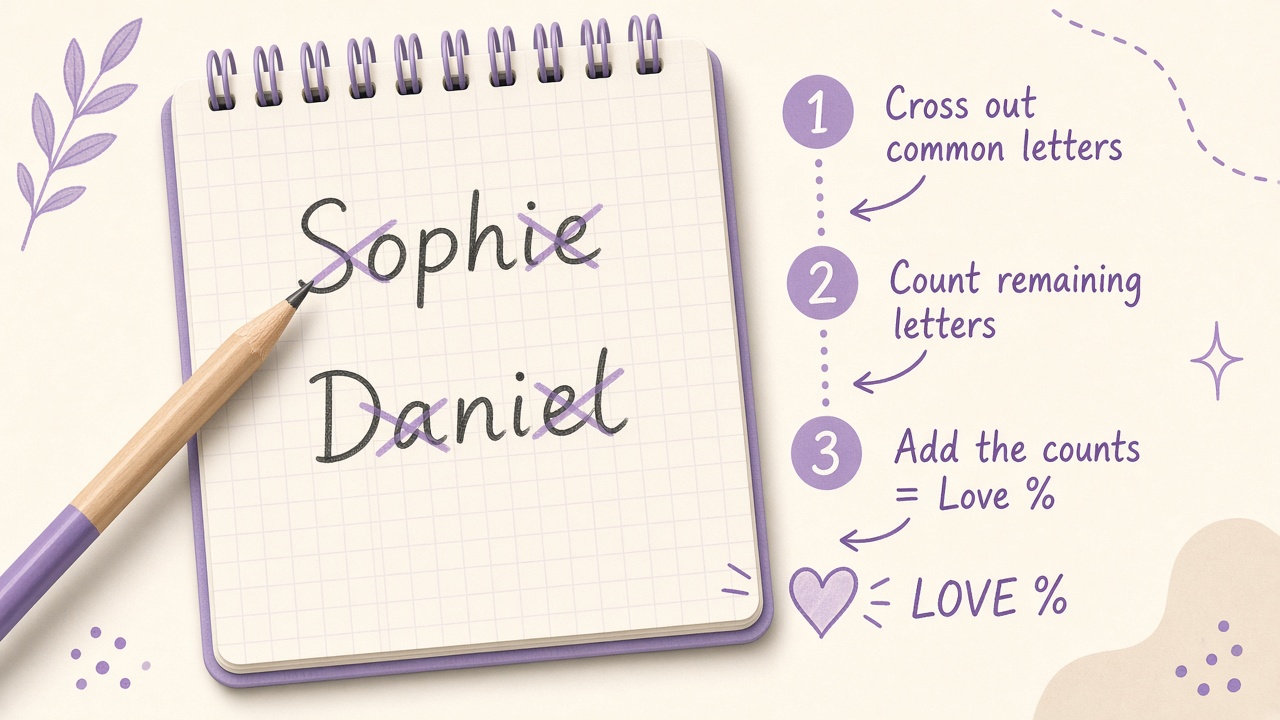
What the paper love percentage trick is
The paper love percentage is a schoolyard game that turns two first names into a single-digit score. Generations of students have passed the same ritual: whisper a crush's name, grab a notebook, and follow a short counting ritual that feels mysteriously official. The method has no research backing. It survives because it is fast, social, and dramatic when someone scores a high number in front of friends.
The Quiz Hub built this guide so you can learn the manual steps and watch them happen on screen. The walkthrough uses the letter-crossing version that appears in many English-speaking classrooms. If your friends use a slightly different rule, such as writing the word LOVES under the names, the spirit is the same: playful arithmetic, not a love detector.
The four paper steps explained
Write both first names clearly
Use capital letters and first names only. Extra letters change the score, so keep nicknames consistent when you compare results with friends.
Cross out matching letters
Find letters that appear in both names. Cross one pair at a time. Each letter can be used only once. Shared vowels and common consonants like N or L disappear quickly.
Count uncrossed letters
Add every letter still visible on the page from both names. If you crossed everything, the count is zero and the classroom score is 0 percent.
Reduce the count and read the percentage
When the count is above 99, add the digits together repeatedly until the total is 99 or below. Some classroom versions stop at a single digit; The Quiz Hub uses the same disclosed tie-break as our love calculator paper page so results stay consistent.
Try the interactive paper walkthrough
Type two first names and follow the same crossing, counting, and digit-reduction steps you would draw on paper. The tool highlights struck letters and shows each math step before the final novelty percentage.
Paper love percentage example
Suppose you write Alex and Jordan. Matching letters a, j, and r cross out between the two names. The remaining letters total seven before any tie-break. Seven is already below 99, so no digit reduction is needed. The Quiz Hub then adds a small alphabet-position adjustment and maps the result to a novelty band. Change one letter in either name and the cross-out pattern shifts, which is why classmates retried the game endlessly.
| Step | What you do on paper | Why it matters |
|---|---|---|
| Normalize | Capital letters, ignore spaces | Keeps lunch-table counts consistent |
| Cross out | One-to-one letter pairs only | Prevents double-counting shared letters |
| Count | Sum uncrossed letters | Produces the raw classroom number |
| Reduce | Add digits when count > 99 | Brings large totals down before the tie-break |
What this paper method can and cannot tell you
Can tell you
- How the classic letter-crossing game works step by step
- Why small spelling changes swing the novelty score
- A fun number to compare with friends at lunch
- Whether you followed the classroom rules correctly
Cannot tell you
- Whether someone actually loves you or is compatible with you
- Relationship quality, loyalty, or long-term fit
- A scientific compatibility percentage backed by research
- A reason to confess, break up, or ignore red flags
Paper tricks, real relationships, and better tools
Social psychologists study attachment, communication, and conflict repair; none of those frameworks use notebook letter counts. John Gottman's work on relationship stability, for example, tracks bids for connection and repair attempts after arguments. A paper percentage ignores all of that and instead rewards names with unusual spelling. Treat the classroom score like a party game, then turn to tools that describe patterns you can actually discuss.
When you want structured reflection instead of playground math, pair this guide with other The Quiz Hub relationship pages. Our love calculator paper page runs the same letter-crossing algorithm instantly if you only need the final number. The compatibility test maps values, communication, conflict repair, and lifestyle fit across thirty items. The crush quiz screens butterflies and preoccupation when you are deciding whether feelings are growing. Browse the full relationships and dating hub for attachment style, love language, and partnership health quizzes with honest limits on every results screen.
| The Quiz Hub page | What it adds beyond paper math |
|---|---|
| Love calculator paper | Instant novelty percentage with the same crossing rules, less manual teaching |
| Compatibility test | Four-domain self-report index for values, communication, repair, and lifestyle |
| Crush quiz | Twenty-item crush intensity screener with domain bars |
| This paper guide | Step-by-step classroom instructions with letter visuals and digit reduction |
Sample classroom moment: two friends write EMMA and JAMES. Shared M and A letters cross out early. The remaining string might land on a double-digit count that reduces to a middling percentage. One friend declares the result "proof" while the other rolls their eyes. That social drama is the point. The number starts a conversation; it does not settle whether the pair should date. Read how we review relationship content in our editorial policy.
Paper love percentage FAQ
How do you find love percentage on paper with two names?
Write both first names in capital letters. Cross out each letter that appears in both names, matching one pair at a time. Count every uncrossed letter left on the page. If the count is above 99, add the digits together until it drops to 99 or below. The Quiz Hub then applies a small alphabet-position tie-break so the same names always produce one disclosed percentage. It is a playground game, not a measure of real feelings.
Is the paper love percentage test accurate?
No. The paper method is a lunch-table novelty that depends on spelling, shared letters, and arbitrary digit rules. Two people with strong chemistry can score low, and casual friends can score high. Use it for fun conversation, not relationship decisions.
What is the difference between this guide and a love calculator paper tool?
This page teaches the manual steps with a walkthrough that shows crossed letters and digit reduction. Our love calculator paper page runs the same letter-crossing math instantly after you type two names. Both are novelty tools with identical limits.
Can I use full names instead of first names?
Most classroom versions use first names only because longer strings change the letter count quickly. You can try surnames for fun, but the result will shift with every extra letter. The interactive tool strips spaces and punctuation so your count stays consistent.
What if my paper count is zero?
When every letter crosses out, the remaining count is zero and the classroom score is 0 percent. That simply means the names share many letters. It does not mean the pair has no connection.
Who reviewed this content?
Dr. Priya Sharma, PhD, reviewed the test framing and result explanations. See our editorial policy for review standards.
Reviewed by