What this is he gay quiz measures
This is he gay quiz organizes observed behavior signals you have noticed into five reflection domains. Twenty-two original frequency items ask about patterns from your point of view, not private messages or hidden accounts. Results show a signal index across fourteen behavior items plus separate stereotype and privacy bars. No quiz can prove orientation; ask him respectfully when appropriate.
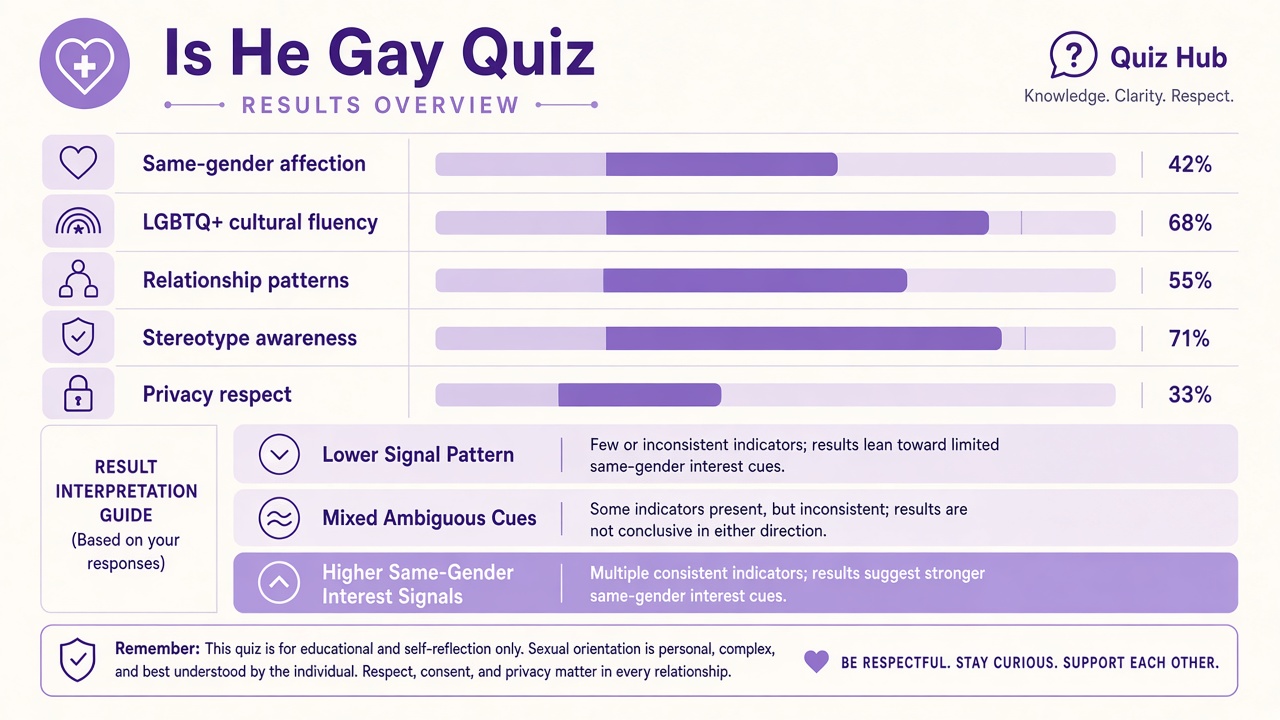
Same-gender affection signals
Warmth, eye contact, crush-like tone, and physical affection with men that stands out to you.
LGBTQ+ cultural fluency
Comfort with queer media, Pride culture, LGBTQ+ friends, and community references without awkward distance.
Relationship patterns observed
Dating history gaps, separate social time with men, and evasive stories about past relationships.
Stereotype guessing awareness
How much voice, walk, hobbies, or pop culture tropes shape your guess about his orientation.
Respect for his privacy
Avoiding intrusive questions, gossip, pressure, and remembering behavior is not proof.
How it works
Three steps from first question to your observed signal snapshot. Click Start Quiz to open the interactive modal.
Rate observed patterns 22 times
Answer how often each statement applies from Never to Almost always. There is no timer and no auto-advance.
Items map to five domains
Your answers accumulate percentages for affection cues, cultural fluency, relationship patterns, stereotype habits, and privacy respect, plus a stereotype core flag.
View band and next steps
Results show Lower Signal Pattern, Mixed Ambiguous Cues, or Higher Same-Gender Interest Signals with domain bars and conversation prompts.
Take the is he gay quiz
Rate 22 behavior statements about patterns you have observed on a five-point frequency scale. Your answers produce a signal index, five domain scores, a stereotype core flag, and a reflective band with plain-language next steps.
Opens in a focused modal. No account required. Results stay on screen.
What your result means
Your signal index normalizes observed behavior items across same-gender affection, LGBTQ+ fluency, and relationship patterns to a 0 through 100 scale. Stereotype and privacy domains appear as separate bars because they measure your guessing habits and ethics, not his orientation. The band groups the behavior index into reflective language. Higher scores mean more frequent observed cues on these items, not proof he is gay.
| Signal band | Index range | Typical reading |
|---|---|---|
| Lower Signal Pattern | 0 to 35 | Fewer frequent same-gender cues on these items; stronger privacy and stereotype skepticism may appear |
| Mixed Ambiguous Cues | 36 to 65 | Blend of observed cues and privacy values; one domain may stand out while others stay calm |
| Higher Same-Gender Interest Signals | 66 to 100 | Frequent observed cues worth reflecting on; still not proof of orientation |
Five observed signal domains
The diagram below shows how domain scores appear in your results. High cultural fluency with moderate affection cues, for example, can still land you in Mixed Ambiguous Cues when relationship patterns stay neutral.
What this quiz can and cannot tell you
Can tell you
- Whether your observed behaviors lean toward lower, mixed, or higher same-gender interest signals on this screener
- A signal index from 0 to 100 and five domain bars for affection, fluency, relationships, stereotypes, and privacy
- A stereotype core flag when three or more core items rate Often or Almost always
- A starting point for reflection before you ask him directly if that fits your relationship
Cannot tell you
- Whether he is gay, straight, bi, closeted, or any other orientation label
- That warm male friendships, queer cultural knowledge, or single status prove gay identity
- Whether you should out him, gossip with friends, or confront him without consent
- Clinical orientation assessments, mind-reading, or permission to label him from stereotypes
Behavior cues, stereotypes, and honest limits
Sexuality researchers emphasize that orientation is self-defined and multidimensional. Lisa Diamond's work on sexual fluidity documents how patterns shift across life stages, while the Klein Sexual Orientation Grid separates attraction, behavior, fantasy, and identity on different axes. None of those frameworks support guessing another person's label from mannerisms, hobbies, or who they hug at parties. A 2014 review led by William Cox at the University of Wisconsin-Madison showed that so-called gaydar accuracy collapses once stereotype cues are removed.
The Quiz Hub built this is he gay quiz for people who notice ambiguous behavior and want structure without mind-reading claims. Twenty-two original items ask about same-gender warmth, LGBTQ+ cultural comfort, relationship ambiguity, stereotype shortcuts, and privacy respect from your observations. Pair it with our gaydar test when pop culture tropes or voice-and-walk guessing shape your curiosity. For your own orientation reflection, try our am I gay test or broad sexuality test.
| The Quiz Hub test | What it adds |
|---|---|
| Gaydar test | Perception bias education debunking stereotype reliance when guessing strangers |
| Am I gay test | Same-gender attraction and identity exploration for your own orientation reflection |
| Sexuality test | Broad attraction and label comfort screener across five reflection domains |
| Do I like him quiz | Crush signal reflection when your curiosity mixes feelings with orientation guessing |
| This is he gay quiz | 22 observed behavior items with five domains, stereotype core flag, and three reflective bands |
Sample item: rating Often on he talks about a specific man with crush-like tone raises your same-gender affection bar. Rating Almost always on you avoid intrusive orientation questions raises privacy respect even when curiosity remains. Hope, jealousy, or crush feelings can inflate relationship-pattern scores without meaning he is gay. Read how we review quizzes in our editorial policy or browse more screeners on our sexuality and LGBTQ+ hub.
Is he gay quiz FAQ
What does this is he gay quiz measure?
This is he gay quiz measures how often you observe behavior signals across five domains: same-gender affection cues, LGBTQ+ cultural fluency, relationship patterns, stereotype-based guessing habits, and respect for his privacy. Twenty-two frequency items ask about patterns you have noticed, not private evidence. Results show a signal index from 0 to 100, five domain bars, a stereotype core flag, and one of three reflective bands. It cannot prove his orientation.
Can this quiz tell me if he is gay?
No. No online quiz can know someone else's orientation. Behavior cues, cultural fluency, and warm male friendships do not prove gay identity. Straight, bi, and closeted people all show overlapping patterns. This screener organizes what you have observed so you can reflect before asking him directly if that fits your relationship.
How is this different from the gaydar test?
The gaydar test measures your perception habits when guessing strangers' orientation from stereotypes, cues, and confidence in gut feelings. This is he gay quiz focuses on specific observed behavior patterns about a man you know. Pair them when you want both bias education and a structured map of behavior signals you have noticed.
Should I ask him if he is gay after taking this quiz?
Only when the relationship context makes that appropriate and you can ask respectfully without pressure or outing. Higher signal bands describe observed patterns on these items, not proof he is gay. A calm question about feelings or boundaries beats accusations based on quiz scores. Respect a no or not-yet answer.
Why does the quiz include stereotype and privacy items?
Many people search is he gay because of voice, walk, hobbies, or pop culture tropes. Stereotype items flag when presentation shortcuts shape your guess. Privacy items remind you that orientation is self-defined information others should not force. Both domains appear as separate bars and a stereotype core flag alongside observed behavior signals.
Who reviewed this content?
Dr. Morgan Chen, PhD, reviewed the test framing and result explanations. See our editorial policy for review standards.
Reviewed by