What this coming out quiz measures
This coming out quiz estimates how strongly you agree with reflective statements about accepting your LGBTQ+ identity, feeling safe enough in your environment, having people to lean on, imagining disclosure to friends or family or work, coping with rejection fear, and knowing what you would share. Four items cover self-acceptance and shame reduction. Four items cover physical safety, job risk, and community hostility. Four items cover affirming friends, mentors, and backup plans. Four items cover comfort telling close friends, trusted family, or coworkers. Four items cover managing shame spikes and recovery after poor reactions. Four items cover what to say, what stays private, and thoughtful timing.
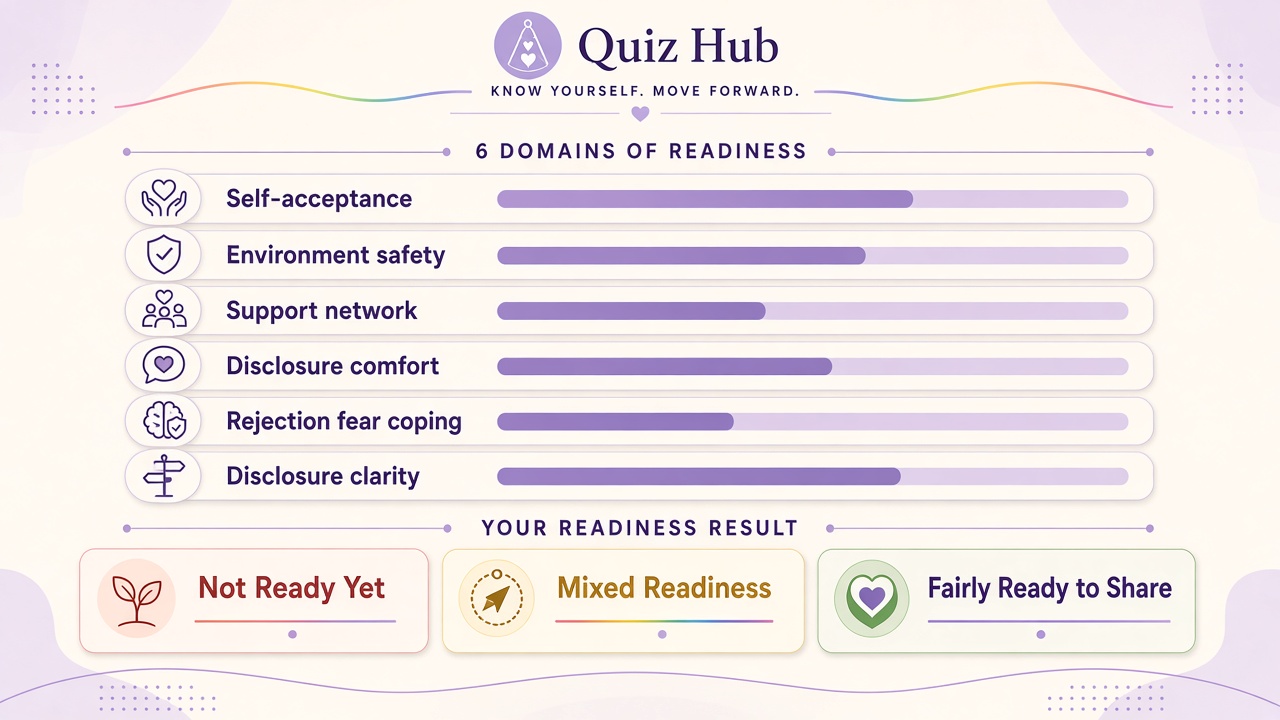
Self-acceptance
Holding your identity as real, reducing shame, and picturing an honest future without self-hatred.
Safety in environment
Physical safety at home, housing or income risk, community hostility, and fear of violence or eviction.
Support network
Affirming friends, mentors, counselors, and practical backup if a conversation goes poorly.
Disclosure comfort
Ease imagining telling close friends, trusted family, or coworkers without panic.
Coping with rejection fear
Managing anxiety spikes, recovery tools, and belief you could rebuild if someone reacts poorly.
Clarity on what to share
Knowing what to say, what stays private, and choosing timing that fits your life.
How it works
Three steps from first question to your readiness band. Click Start Quiz to open the interactive screener in a full-screen modal.
Answer 24 agree items
Rate each statement from Strongly disagree to Strongly agree. There is no timer and no auto-advance between items.
Items map to six domains
Your answers accumulate percentages for self-acceptance, environment safety, support network, disclosure comfort, rejection fear coping, and disclosure clarity.
View a compassionate band
Results show Not Ready Yet, Mixed Readiness, or Fairly Ready to Share with domain bars and affirming next steps. Coming out remains your choice.
Take the coming out quiz
Rate 24 coming-out readiness statements on a five-point agree scale. Your answers produce an overall readiness index, six domain scores, and one of three bands with plain-language guidance that never commands disclosure.
Opens in a focused modal. No account required. Results stay on screen.
What your result means
Your overall readiness index normalizes total agreement across all 24 items to a 0 through 100 scale. The band groups that index into compassionate language about timing and conditions for sharing. Domain bars show whether self-acceptance, safety, support, disclosure comfort, rejection coping, or clarity drive your result. A high self-acceptance bar with low environment safety is common and does not mean you failed.
| Readiness band | Score range | Typical reading |
|---|---|---|
| Not Ready Yet | 0 to 35% | Several domains need care, safety planning, or support before sharing feels sustainable right now |
| Mixed Readiness | 36 to 65% | Blend of growing acceptance and areas where safety or disclosure still feel uncertain |
| Fairly Ready to Share | 66 to 100% | Fairly strong signals across acceptance, safety, support, and clarity; still your choice whether to disclose |
Six coming out readiness domains
The diagram below shows how domain scores appear in your results. High self-acceptance with low environment safety might land you in Mixed Readiness even when disclosure clarity scores higher.
What this quiz can and cannot tell you
Can tell you
- Whether your self-reported readiness signals lean lower, mixed, or stronger on these items
- A readiness index and six domain scores for acceptance, safety, support, disclosure, coping, and clarity
- A starting point for safety planning, journaling, or conversations with affirming mentors
- Which domain to focus on before choosing whether to share anything
Cannot tell you
- That you must come out today, this year, or ever
- How a specific parent, friend, or boss will react
- Whether your environment is safe without your own risk assessment
- That staying private means you are not LGBTQ+ enough
Coming out research and readiness reflection
Psychologists such as Vivienne Cass described coming out as a staged process rather than a single announcement. Early stages often involve private identity acceptance before any disclosure to others. Later stages include selective telling, wider sharing, and integrating an LGBTQ+ identity into daily life. Research on minority stress also shows that hostile environments raise real risks, so timing and safety planning matter as much as self-acceptance.
The Quiz Hub built this coming out quiz as an abbreviated readiness screener for people who search coming out quiz online. It uses original plain-language items across six domains with three compassionate bands rather than reproducing clinical inventories. That trade-off favors readable self-reflection while naming that staying private can be valid when risk is real. The Trevor Project emphasizes that youth should weigh safety, support, and personal readiness before sharing with family or at school.
| The Quiz Hub test | What it adds |
|---|---|
| Sexuality test | Broader orientation reflection when you are still sorting attraction and identity labels |
| Am I gay test | Same-gender attraction and identity exploration signals for men and questioning folks |
| Am I in the closet quiz | Secrecy versus openness themes when hiding feels central to your story |
| This coming out quiz | Twenty-four readiness items across six domains with three bands that never command disclosure |
Sample item: agreeing that you have at least one person you could tell without immediate judgment raises your support network domain score. Agreeing that you know what you would want to say this month raises disclosure clarity even when environment safety stays moderate. Cultural shame, religious pressure, and fear of eviction can pull answers toward the middle, so retake when you can respond privately and honestly. Browse more screeners on our sexuality and LGBTQ+ hub or read how we review quizzes in our editorial policy.
Coming out quiz FAQ
What does this coming out quiz measure?
This coming out quiz measures self-reported agreement on self-acceptance, safety in your environment, support network access, disclosure comfort with friends, family, or work, coping with rejection fear, and clarity about what to share. Twenty-four Likert items produce an overall readiness index, six domain bars, and one of three compassionate bands. It is not a command to come out or stay silent.
Does a high score mean I have to come out?
No. A higher band means your answers suggest stronger readiness signals on these items right now. Coming out is always your choice. Many people with high self-acceptance stay private in unsafe settings. This quiz cannot predict reactions from others or replace your own risk assessment.
What if I am not ready to come out yet?
A Not Ready Yet band is a compassionate snapshot about timing and conditions, not a moral failing. Staying private can be a valid survival strategy when housing, income, or physical safety feels at risk. Consider reaching out to The Trevor Project or a local affirming counselor before forcing disclosure.
How is this different from an orientation quiz?
Orientation quizzes like our sexuality test or am I gay test reflect on attraction and identity labels. This coming out quiz focuses on readiness to share your truth with others, including safety, support, and coping skills. Pair both when you are sorting who you are and whether timing feels right.
How long does the coming out quiz take?
Most people finish in about 6 minutes. There are 24 items on a five-point agree scale from Strongly disagree to Strongly agree. You can pause and return in the same browser session thanks to autosave.
Who reviewed this content?
Dr. Morgan Chen, PhD, reviewed the test framing and result explanations. See our editorial policy for review standards.
Reviewed by