What this am I gay test measures
This am I gay test estimates how strongly you agree with reflective statements about attraction to men, romantic imagination, gay identity curiosity, discomfort with straight assumptions, and pull toward gay community spaces. Five items cover physical and attention-based attraction. Five items cover romantic daydreams and future intimacy with men. Five items cover trying on labels and searching for mirrors. Four items cover performing straightness or tension with heterosexual defaults. Four items cover culture, Pride curiosity, and queer media belonging.
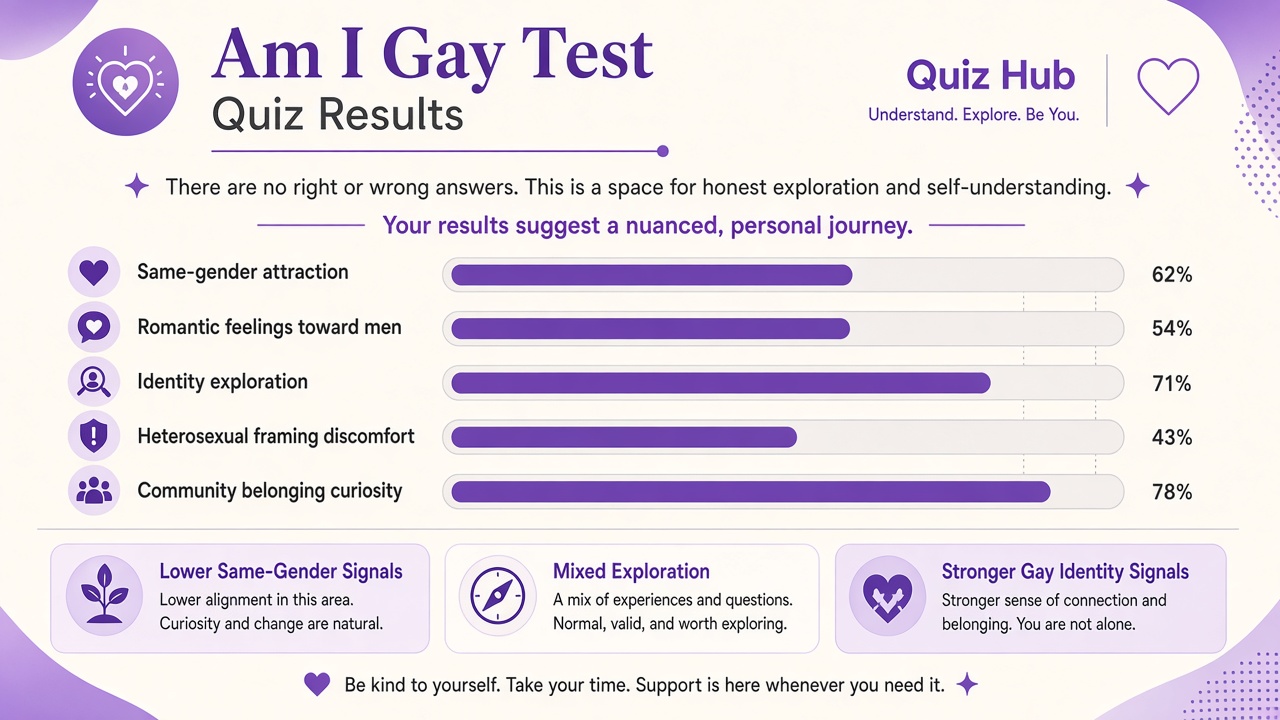
Same-gender attraction
Physical pull toward men, drifting attention, butterflies, and vivid attraction memories compared with reactions to women.
Romantic feelings toward men
Imagining dating men, routine intimacy, crush disappointment, and preferring a male partner in future daydreams.
Identity exploration
Wondering if gay fits, trying labels mentally, relief from LGBTQ+ stories, and curiosity about sharing your truth.
Heterosexual framing discomfort
Performing straightness, tension when others assume a female partner, and misalignment with default hetero stories.
Community belonging curiosity
Interest in gay history, Pride spaces, queer media, and belonging among men who love men.
How it works
Three steps from first question to your reflection band. Click Start Quiz to open the interactive screener in a full-screen modal.
Answer 23 agree items
Rate each statement from Strongly disagree to Strongly agree. There is no timer and no auto-advance between items.
Items map to five domains
Your answers accumulate percentages for attraction, romantic feelings, identity exploration, heterosexual framing discomfort, and community curiosity, plus an attraction core flag.
View a compassionate band
Results show Lower Same-Gender Signals, Mixed Exploration, or Stronger Gay Identity Signals with domain bars and affirming next steps. Only you define your label.
Take the am I gay test
Rate 23 orientation reflection statements on a five-point agree scale. Your answers produce an overall exploration index, five domain scores, an attraction core flag, and one of three bands with plain-language guidance.
Opens in a focused modal. No account required. Results stay on screen.
What your result means
Your overall exploration index normalizes total agreement across all 23 items to a 0 through 100 scale. The band groups that index into compassionate language about same-gender and gay identity signals. Domain bars show whether attraction, romantic feelings, identity questions, heterosexual discomfort, or community curiosity drive your result. Bisexual, pansexual, and queer paths stay valid even when this quiz emphasizes gay signals.
| Reflection band | Score range | Typical reading |
|---|---|---|
| Lower Same-Gender Signals | 0 to 35% | Fewer frequent signals on these items; feelings may still be unfolding or fit another label |
| Mixed Exploration | 36 to 65% | Blend of curiosity and attraction worth sitting with; bisexual and questioning paths often land here |
| Stronger Gay Identity Signals | 66 to 100% | Frequent agreement on attraction, romance, identity, and community items; gay may feel honest, though only you choose labels |
Five orientation reflection domains
The diagram below shows how domain scores appear in your results. High identity exploration with moderate attraction might land you in Mixed Exploration even when romantic feelings toward men score lower.
What this quiz can and cannot tell you
Can tell you
- Whether your self-reported signals lean lower, mixed, or stronger on these gay-oriented items
- An exploration index and five domain scores for attraction, romance, identity, framing discomfort, and community curiosity
- An attraction core flag when four key items rate Agree or Strongly agree
- A starting point for journaling, therapy, or conversations with trusted LGBTQ+ mentors
Cannot tell you
- That you are gay, straight, bisexual, pansexual, or any other orientation label
- When or whether you should come out to family, friends, or coworkers
- Official Kinsey scale scores comparable to published research norms
- Whether your environment is safe for exploration without your own risk assessment
Kinsey continuum research and online orientation quizzes
In the late 1940s, Alfred Kinsey and colleagues at Indiana University published landmark sexuality research showing that attraction and behavior exist on continua rather than rigid gay-or-straight boxes. Later work by Fritz Klein and others expanded multidimensional models with emotional preference, social preference, and identity over time. Clinicians and educators still cite this history when explaining that labels are tools for self-understanding, not moral verdicts.
The Quiz Hub built this am I gay test as an abbreviated reflective screener for men and questioning folks who search am I gay test online. It uses original plain-language items across five domains with three compassionate bands rather than reproducing Kinsey interviews or clinical instruments. That trade-off favors readability and affirming copy for casual users while naming research history honestly. The American Psychological Association notes that sexual orientation develops across the lifespan and that supportive environments improve wellbeing for LGBTQ+ people.
| The Quiz Hub test | What it adds |
|---|---|
| Sexuality test | Broader orientation reflection across multiple labels, not gay-specific domain weighting |
| Am I bisexual quiz | Split attraction signals across genders when gay-only framing feels too narrow |
| Am I straight quiz | Heterosexual framing comfort and opposite-gender attraction items for comparison |
| This am I gay test | Twenty-three gay-oriented domain items with attraction core flag and three affirming bands without declaring you are gay |
Sample item: agreeing that you feel butterflies when imagining closeness with a man raises your same-gender attraction domain score. Agreeing that you wonder whether gay might describe part of your experience raises identity exploration even when physical attraction stays moderate. Cultural shame, religious pressure, and social desirability bias can pull answers toward the middle, so retake when you can respond privately and honestly. Browse more screeners on our sexuality and LGBTQ+ hub or read how we review quizzes in our editorial policy.
Am I gay test FAQ
What does this am I gay test measure?
This am I gay test measures self-reported agreement on same-gender attraction, romantic feelings toward men, gay identity exploration, discomfort with heterosexual assumptions, and curiosity about gay community belonging. Twenty-three Likert items produce an overall exploration index, five domain bars, an attraction core flag, and one of three compassionate bands. It is not a verdict on your orientation label.
Does a high score mean I am gay?
No. A higher band means your answers suggest frequent signals on these items toward men, identity questioning, and community curiosity. Only you define whether gay, bisexual, pansexual, queer, straight, or another label fits. This quiz cannot diagnose orientation or replace counseling, mentorship, or your own timeline for coming out.
Who is this am I gay test for?
The items are written for men and people questioning attraction to men, though anyone exploring same-gender feelings may find the reflection useful. Attraction toward women, non-binary people, or multiple genders can still produce mixed or lower bands. Pair with our broader sexuality test or am I bisexual quiz when your feelings span more than one gender.
How is this different from the Kinsey scale?
Alfred Kinsey and colleagues published continuum-based sexuality research in the 1940s and 1950s, measuring behavior and attraction on a zero-to-six scale. Our online am I gay test uses original plain-language items focused on gay identity signals rather than reproducing the Kinsey interview. It is not validated for research or clinical use.
How long does the am I gay test take?
Most people finish in about 5 minutes. There are 23 items on a five-point agree scale from Strongly disagree to Strongly agree. You can pause and return in the same browser session thanks to autosave.
Who reviewed this content?
Dr. Morgan Chen, PhD, reviewed the test framing and result explanations. See our editorial policy for review standards.
Reviewed by