What this gaydar test measures
This gaydar test estimates how strongly you agree with statements about guessing orientation from appearance, voice, hobbies, and mannerisms. Four items cover stereotype shortcuts such as dress and pop culture tropes. Four items cover scanning cues like walk, laugh, and speech patterns. Four items cover confidence in gut guesses and betting on strangers. Five items cover awareness that gaydar is unreliable and harmful. Four items cover letting people disclose orientation privately without gossip.
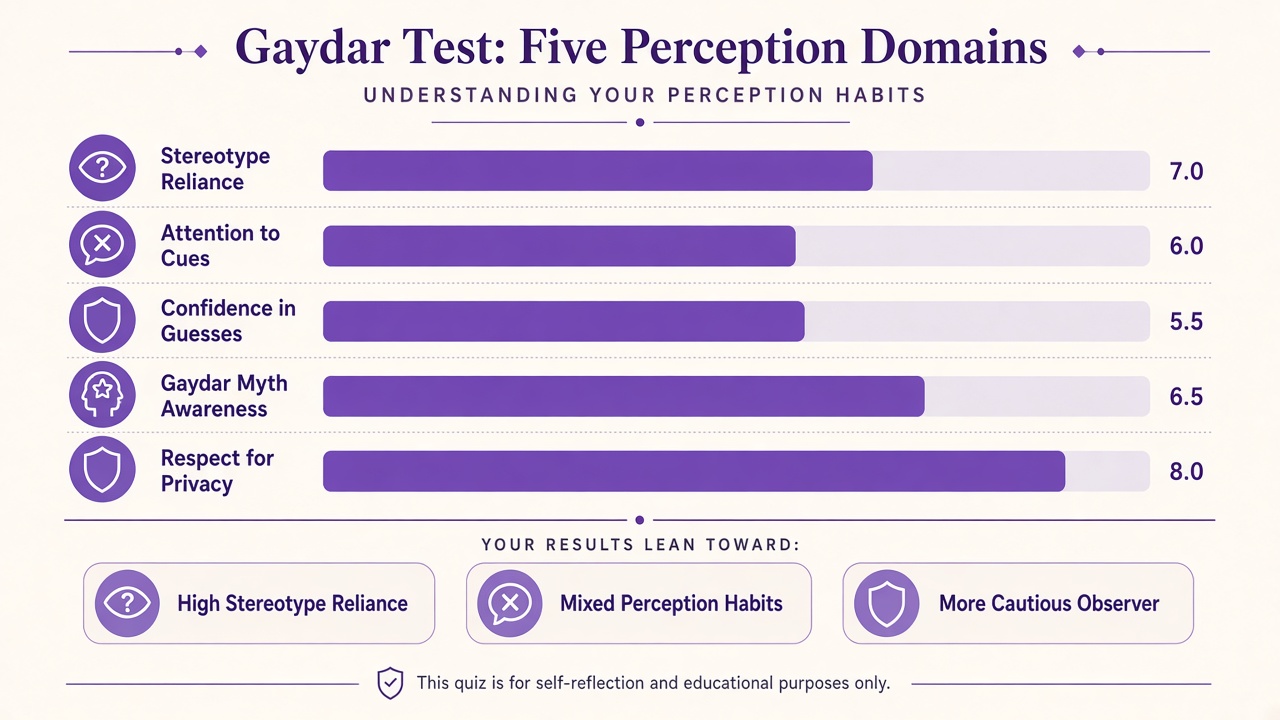
Stereotype reliance
Using fashion, hobbies, voice, or gender presentation as shortcuts when guessing whether someone is LGBTQ+.
Attention to cues
Studying mannerisms, movement, laughter, or dating mentions before deciding if someone might be gay.
Confidence in guesses
Trusting brief interactions, gut feelings, or friendly debates about strangers' orientation from looks alone.
Gaydar myth awareness
Understanding that research rejects accurate gaydar, that intuition often mirrors prejudice, and that mislabeling hurts people.
Respect for privacy
Avoiding intrusive questions, gossip, and pressure for others to confirm orientation before they choose to share.
How it works
Three steps from first question to your perception habits band. Click Start Quiz to open the interactive screener in a full-screen modal.
Answer 21 agree items
Rate each statement from Strongly disagree to Strongly agree. Three short scenario items describe social situations. There is no timer and no auto-advance.
Items map to five domains
Your answers accumulate percentages for stereotypes, cue focus, guessing confidence, myth awareness, and privacy respect, plus a stereotype core flag.
View an educational band
Results show High Stereotype Reliance, Mixed Perception Habits, or More Cautious Observer with domain bars and practical next steps. This is not orientation detection.
Take the gaydar test
Rate 21 perception habit statements on a five-point agree scale. Your answers produce a stereotype reliance index, five domain scores, a stereotype core flag, and one of three educational bands with plain-language guidance.
Opens in a focused modal. No account required. Results stay on screen.
What your result means
Your overall stereotype reliance index normalizes total agreement across all 21 items to a 0 through 100 scale, with myth-awareness and privacy items reverse-weighted so higher scores mean more stereotype-based guessing habits. The band groups that index into educational language. Domain bars show whether stereotypes, cue scanning, confidence, awareness, or privacy drives your result. Lower index scores reflect more cautious observer habits, not moral superiority.
| Perception band | Score range | Typical reading |
|---|---|---|
| More Cautious Observer | 0 to 35% | Lower stereotype reliance with stronger myth awareness and privacy respect on these items |
| Mixed Perception Habits | 36 to 65% | Blend of guessing shortcuts and knowing gaydar is unreliable in principle |
| High Stereotype Reliance | 66 to 100% | Frequent stereotype shortcuts and confident guesses with lower privacy or awareness scores |
Five perception habit domains
The diagram below shows how domain scores appear in your results. High stereotype reliance with moderate awareness often lands you in Mixed Perception Habits even when you know gaydar is a myth in theory.
What this quiz can and cannot tell you
Can tell you
- Whether your self-reported habits lean toward stereotype reliance, mixed guessing, or more cautious observation
- A stereotype reliance index and five domain scores for stereotypes, cues, confidence, awareness, and privacy
- A stereotype core flag when three or more of five core items rate Agree or Strongly agree
- A starting point for unlearning gaydar myths and respecting orientation privacy
Cannot tell you
- Whether someone is gay, straight, bisexual, or any other orientation from their appearance
- That you have real gaydar or accurate intuition about strangers
- Whether you are LGBTQ+ friendly in every context or relationship
- How to out, label, or confront someone about orientation without their consent
Why researchers reject gaydar and what online quizzes miss
In peer-reviewed work, psychologist William Cox and colleagues at the University of Wisconsin-Madison showed that so-called gaydar accuracy often disappears when studies remove stereotype cues such as hairstyle, clothing, and posed expressions. Participants felt confident yet performed near chance. Follow-up research framed gaydar as stereotyping with better branding: the same shortcuts that harm LGBTQ+ people in hiring, housing, and social settings.
The Quiz Hub built this gaydar test as a reflective screener for people who search gaydar test or gaydar quiz online expecting a party trick or orientation detector. It uses original plain-language items across five domains with three educational bands rather than reproducing lab tasks or claiming psychic skill. That trade-off favors readable copy and honest limits for casual users while naming research history. The GLAAD Media Reference reminds journalists and educators that orientation is personal and should not be speculated about from appearance.
| The Quiz Hub test | What it adds |
|---|---|
| Sexuality test | Reflect on your own attractions and label comfort, not guessing strangers |
| Am I gay test | Same-gender attraction and identity exploration for men and questioning folks |
| Is he gay quiz | Observed behavior signals about a man you know with strict privacy limits and stereotype core flag |
| This gaydar test | Twenty-one perception habit items with stereotype core flag and three educational bands debunking gaydar |
Sample item: agreeing that you would bet money on a stranger's orientation raises your confidence-in-guesses domain score. Agreeing that misreading orientation can harm people raises myth awareness even when you still catch yourself scanning mannerisms at parties. Media tropes, regional norms, and friend-group gossip can inflate stereotype reliance without you noticing. Browse more screeners on our sexuality and LGBTQ+ hub or read how we review quizzes in our editorial policy.
Gaydar test FAQ
What does this gaydar test measure?
This gaydar test measures self-reported perception habits across five domains: stereotype reliance, attention to cues, confidence in guesses, awareness that gaydar is unreliable, and respect for privacy. Twenty-one Likert and scenario items produce a stereotype reliance index, five domain bars, a stereotype core flag, and one of three educational bands. It does not claim to detect anyone's orientation.
Is gaydar real?
No. Research consistently shows that so-called gaydar performs near chance once stereotypes are removed. What feels like intuition is often prejudice trained by media tropes about voice, walk, dress, and hobbies. This quiz educates about those habits rather than testing your ability to read strangers.
Does a high score mean I am a bad person?
No. A higher stereotype reliance band describes self-reported guessing habits on these items, not moral worth. Culture teaches stereotype shortcuts. The educational goal is to notice them, respect privacy, and unlearn harm. Mixed and cautious bands are common when people know gaydar is a myth yet still catch themselves guessing.
How is this different from an am I gay test?
Orientation screeners such as our am I gay test and sexuality test help you reflect on your own attractions and labels. This gaydar test focuses on whether you try to guess other people's orientation from looks or mannerisms. It pairs with those tests when you want both self-reflection and bias awareness.
How long does the gaydar test take?
Most people finish in about 5 minutes. There are 21 items on a five-point agree scale from Strongly disagree to Strongly agree, including three short scenario statements. You can pause and return in the same browser session thanks to autosave.
Who reviewed this content?
Dr. Morgan Chen, PhD, reviewed the test framing and result explanations. See our editorial policy for review standards.
Reviewed by