What this am I in the closet quiz measures
This am I in the closet quiz estimates how strongly you agree with reflective statements about hiding your LGBTQ+ identity, fearing accidental discovery, sharing selectively with some people but not others, carrying internalized shame, feeling relief when you can be authentic, and keeping parts private for safety rather than shame alone. Four items cover active concealment and presentation editing. Four items cover anxiety about being found out. Four items cover intentional selective disclosure. Four items cover shame and self-punishment around identity. Four items cover authentic relief and community joy. Four items cover safety-driven privacy as a valid choice.
Hiding LGBTQ+ identity
Editing stories, presentation, and visibility so others assume a straight or cisgender identity.
Fear of discovery
Anxiety about accidental outing through messages, conversations, or people guessing.
Selective disclosure
Choosing who knows what, and sharing some truths while keeping others private on purpose.
Internalized shame
Treating LGBTQ+ identity or attraction as morally wrong, embarrassing, or something to fix.
Relief when authentic
Feeling lighter, less exhausted, or more joyful when honesty or community connection is possible.
Safety and private choice
Keeping identity private for protection in hostile settings rather than shame alone.
How it works
Three steps from first question to your openness band. Click Start Quiz to open the interactive screener in a full-screen modal.
Answer 24 agree items
Rate each statement from Strongly disagree to Strongly agree. There is no timer and no auto-advance between items.
Items map to six domains
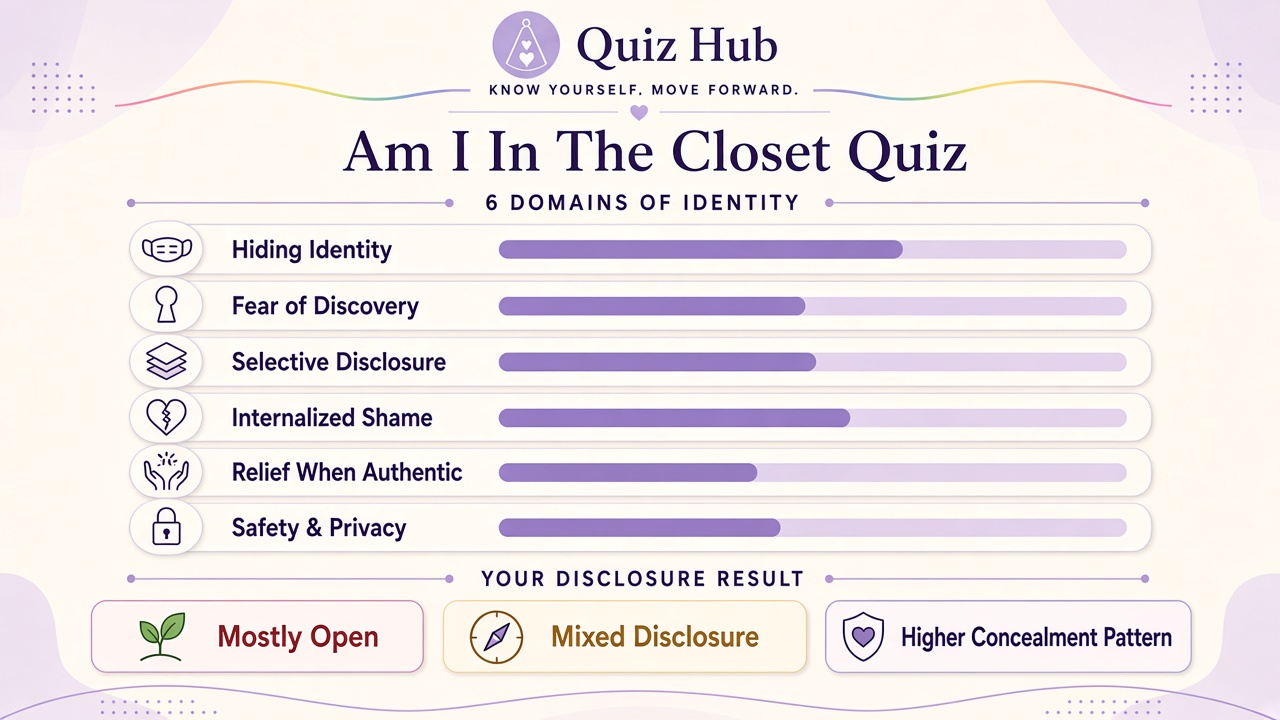
Your answers accumulate percentages for hiding, discovery fear, selective disclosure, shame, authentic relief, and safety-driven privacy.
View a compassionate band
Results show Mostly Open, Mixed Disclosure, or Higher Concealment Pattern with domain bars and affirming next steps. Disclosure remains your choice.
Take the am I in the closet quiz
Rate 24 concealment and openness statements on a five-point agree scale. Your answers produce an overall openness index, six domain scores, and one of three bands with plain-language guidance that never pressures disclosure.
Opens in a focused modal. No account required. Results stay on screen.
What your result means
Your overall openness index normalizes total agreement across all 24 items to a 0 through 100 scale. Higher scores point toward Mostly Open patterns with less active hiding and lower shame on these items. Lower scores point toward Higher Concealment Pattern signals. The band groups that index into compassionate language about how secrecy and openness show up right now. Domain bars show whether hiding, fear, shame, selective sharing, authentic relief, or safety framing drives your result.
| Openness band | Score range | Typical reading |
|---|---|---|
| Higher Concealment Pattern | 0 to 35% | Stronger concealment signals across hiding, fear, shame, or very limited disclosure |
| Mixed Disclosure | 36 to 65% | Blend of selective openness and areas where hiding or shame still feel significant |
| Mostly Open | 66 to 100% | Fairly strong openness signals with lower shame and more authentic relief on these items |
Six concealment and openness domains
The diagram below shows how domain scores appear in your results. High authentic relief with moderate hiding might land you in Mixed Disclosure when some contexts still feel unsafe.
What this quiz can and cannot tell you
Can tell you
- Whether your self-reported concealment and openness signals lean lower, mixed, or stronger on these items
- An openness index and six domain scores for hiding, fear, disclosure, shame, relief, and safety framing
- A starting point for journaling, therapy, or conversations with affirming mentors
- Which domain to focus on when secrecy versus openness feels central to your story
Cannot tell you
- That you must come out today, this year, or ever
- That staying private for safety is wrong or means you are not LGBTQ+ enough
- How a specific parent, friend, or boss will react
- Whether your environment is safe without your own risk assessment
Closet concealment research and disclosure reflection
Psychologists studying minority stress describe concealment as a double-edged survival strategy. Hiding LGBTQ+ identity can reduce immediate rejection risk in hostile settings while increasing long-term anxiety, exhaustion, and internalized shame. Research by Ilan Meyer and others documents how fear of discovery and selective disclosure shape daily life for people who are not fully out in every context. That does not mean concealment is always wrong. Safety-driven privacy and shame-driven hiding deserve different responses.
The Quiz Hub built this am I in the closet quiz as an abbreviated disclosure screener for people who search am I in the closet quiz online. It uses original plain-language items across six domains with three compassionate bands rather than reproducing clinical inventories. That trade-off favors readable self-reflection while naming that staying private can be valid when risk is real. The Trevor Project emphasizes that youth should weigh safety, support, and personal readiness before sharing with family or at school.
| The Quiz Hub test | What it adds |
|---|---|
| Coming out quiz | Readiness to share your truth, including support networks and disclosure clarity |
| Sexuality test | Broader orientation reflection when you are still sorting attraction and identity labels |
| Am I gay test | Same-gender attraction and identity exploration signals for men and questioning folks |
| This am I in the closet quiz | Twenty-four concealment and openness items across six domains with three bands that never pressure disclosure |
Sample item: agreeing that you feel lighter when you can be honest about who you are raises your authentic relief domain score. Agreeing that you keep parts private mainly because your environment feels unsafe raises your safety and private choice bar without treating privacy as failure. Cultural shame, religious pressure, and fear of eviction can pull answers toward the middle, so retake when you can respond privately and honestly. Browse more screeners on our sexuality and LGBTQ+ hub or read how we review quizzes in our editorial policy.
Am I in the closet quiz FAQ
What does this am I in the closet quiz measure?
This am I in the closet quiz measures self-reported agreement on hiding LGBTQ+ identity, fear of discovery, selective disclosure, internalized shame, relief when authentic, and safety-driven reasons for staying private. Twenty-four Likert items produce an overall openness index, six domain bars, and one of three compassionate bands. It is not a command to come out or stay hidden.
Does a higher concealment band mean I am failing?
No. A Higher Concealment Pattern band describes how secrecy shows up on these items right now. Staying private in unsafe settings is a valid survival strategy. Shame-driven hiding and safety-driven privacy are different experiences, and this quiz names both without judging you for either.
How is this different from the coming out quiz?
The coming out quiz focuses on readiness to share your truth, including support networks and disclosure clarity. This am I in the closet quiz focuses on how concealment and openness feel day to day, including hiding behavior, discovery fear, and relief when authentic. Pair both when timing and secrecy themes overlap.
Can I be partially out and still take this quiz?
Yes. Many people land in Mixed Disclosure when they are open with close friends but guarded at work or home. Selective disclosure is a real and valid place on the spectrum. Your domain bars show which contexts still feel hidden versus chosen.
How long does the am I in the closet quiz take?
Most people finish in about 6 minutes. There are 24 items on a five-point agree scale from Strongly disagree to Strongly agree. You can pause and return in the same browser session thanks to autosave.
Who reviewed this content?
Dr. Morgan Chen, PhD, reviewed the test framing and result explanations. See our editorial policy for review standards.
Reviewed by