What this dark triad partner quiz measures
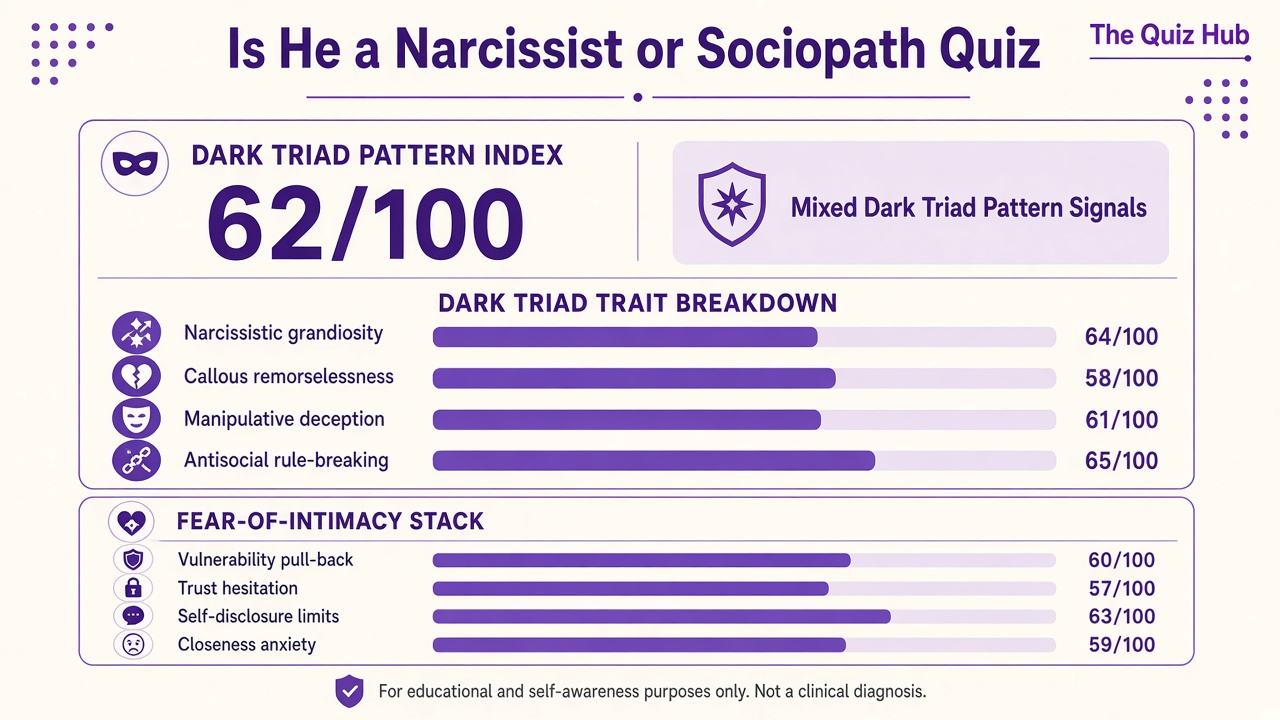
This is he a narcissist or sociopath quiz estimates how often dark triad inspired partner pattern signals show up with him and how they may connect to closeness habits in your relationship. Twenty-two original frequency items group into four domains inspired by Paulhus and Williams (2002): narcissistic grandiosity, callous remorselessness, manipulative deception, and antisocial rule-breaking. Each item also maps to a fear-of-intimacy stack layer so you can see whether vulnerability pull-back, trust hesitation, self-disclosure limits, or closeness anxiety feels strongest. Your dark triad pattern index averages these patterns into a 0 to 100 score with plain-language bands.
Narcissistic grandiosity
Admiration demands, status focus, double standards, and outrage when he is not treated as special.
Callous remorselessness
Little guilt after cruelty, shrugging off your pain, and moving on without real repair.
Manipulative deception
Word twisting, strategic charm, inconsistent stories, and guilt trips to avoid accountability.
Antisocial rule-breaking
Reckless choices, bragging about bending rules, boundary violations, and impulsive harm risk.
How it works
Three steps from first question to your dark triad pattern report with fear-of-intimacy stack. Click Start Quiz to open the interactive quiz in a full-screen modal.
Answer 22 frequency items
Rate how often each dark triad pattern and closeness habit shows up when you think about his behavior, from Never to Almost always. You click Next after each answer; nothing auto-advances.
Items map to dark triad domains and intimacy stack
Your answers accumulate percentages for grandiosity, callousness, manipulation, and rule-breaking domains, plus four fear-of-intimacy stack layers.
View band and dual charts
Results show Lower, Mixed, or Higher Dark Triad Pattern Concern with domain bars and a fear-of-intimacy stack chart. Higher bands include crisis resources.
Take the is he a narcissist or sociopath quiz
Rate 22 statements about his behavior toward you in this relationship. Your answers produce a dark triad pattern index from 0 to 100, a fear-of-intimacy stack index, four domain scores, and a band label for reflection or therapy conversation.
Opens in a focused modal. No account required. Results stay on screen.
What your result means
Your dark triad pattern index is the normalized total across all 22 items on a 0 to 100 scale, with reverse scoring on protective items so higher scores mean more concern overall. The fear-of-intimacy stack index uses the same answers mapped to vulnerability, trust, disclosure, and closeness anxiety layers. Domain bars show endorsement rates so you can see whether narcissistic grandiosity, callous remorselessness, manipulation, or rule-breaking drives your result most.
| Band | Index range | Typical reading |
|---|---|---|
| Lower Dark Triad Pattern Concern | 0 to 35 | Fewer narcissistic or sociopathic partner pattern signals on this screener; normal friction or stress may still appear |
| Mixed Dark Triad Pattern Signals | 36 to 65 | Blend of caring moments and strain; worth tracking if persistent across seasons |
| Higher Dark Triad Pattern Concern | 66 to 100 | Frequent grandiosity, callousness, manipulation, or rule-breaking; professional support may help |
What your dark triad partner report looks like
After all 22 items, you get a dark triad pattern index from 0 to 100, a band label, four dark triad domain bars, and a fear-of-intimacy stack chart with vulnerability pull-back, trust hesitation, self-disclosure limits, and closeness anxiety layers. Percentages reflect how you experience his behavior and closeness habits in this relationship, not a clinical verdict about his personality.
What this quiz can and cannot tell you
Can tell you
- How often dark triad inspired partner pattern signals showed up for you with him
- A dark triad pattern index and fear-of-intimacy stack index with domain bars
- Which dark triad domain or intimacy stack layer feels strongest in your current experience
- A starting point for therapy conversation about relationship dynamics and closeness patterns
Cannot tell you
- Whether he has narcissistic personality disorder, antisocial personality disorder, psychopathy, or sociopathy
- Whether the relationship is abusive without your own judgment and professional support
- Whether the relationship can heal without honest dialogue and mutual effort
- What treatment you need without a licensed clinician's evaluation
Dark triad traits, partner behavior, and the fear-of-intimacy stack
Psychologists Delroy L. Paulhus and Kevin M. Williams (2002) grouped narcissism, Machiavellianism, and subclinical psychopathy under the dark triad label because the traits overlap yet remain distinct in research. Partners high on narcissistic grandiosity may demand admiration while dismissing your feelings. Callous remorselessness and antisocial rule-breaking add a colder, more impulsive edge that popular language sometimes calls sociopathic. Clinical antisocial personality disorder and narcissistic personality disorder require structured evaluation, not a twenty-two item online quiz.
The Quiz Hub built this is he a narcissist or sociopath quiz as an original self-report screener inspired by those themes, not a reproduction of the Short Dark Triad questionnaire or Hare's Psychopathy Checklist. Readers often compare it to sibling tools on this site. Our am I dealing with a narcissist quiz screens gaslighting and control in a current partner with 24 items. The am I a sociopath quiz measures self-reported rule-breaking and remorse patterns in yourself. The fear of intimacy quiz maps vulnerability avoidance in romantic bonds without a partner dark triad lens.
| The Quiz Hub test | What it adds |
|---|---|
| Am I dealing with a narcissist quiz | Current partner: gaslighting, entitlement, empathy gaps, control tactics |
| Is my husband a narcissist quiz | Marriage-focused narcissism pattern index plus fear-of-intimacy stack layers |
| Am I a sociopath quiz | Self-report rule-breaking and remorse facets, not partner observation |
| Am I a psychopath quiz | Self-report callousness, entitlement, and strategic cynicism in yourself |
| Fear of intimacy quiz | FOIS-inspired avoidance index without partner dark triad domains |
| This dark triad partner quiz | Dark triad pattern index plus parallel fear-of-intimacy stack layers with a male partner frame |
Sample item types include frequency ratings such as whether he shows little guilt after saying something cruel, or whether you catch him twisting your words so you doubt what you said. High narcissistic grandiosity with high manipulative deception scores often lands in Mixed or Higher Dark Triad Pattern Concern. Jealousy spikes, money stress, and sleep loss can raise scores temporarily. Read how we review quizzes in our editorial policy or browse more tools on our relationships and dating hub.
Is he a narcissist or sociopath quiz FAQ
What is the difference between narcissistic and sociopathic partner patterns?
In popular psychology language, narcissistic partner patterns often center on admiration demands, entitlement, and status focus. Sociopathic or antisocial pattern signals often add callous remorselessness, deceptive charm, and impulsive rule-breaking. Clinical narcissistic personality disorder and antisocial personality disorder require formal evaluation and are not the same as a difficult boyfriend during stress. This is he a narcissist or sociopath quiz measures how often those dark triad inspired pattern signals show up with him and how they may shape your fear-of-intimacy stack. It is not proof he has any personality disorder.
What does this dark triad partner quiz measure?
Twenty-two original frequency items ask how often you notice narcissistic grandiosity, callous remorselessness, manipulative deception, and antisocial rule-breaking when you think about his behavior toward you. Each item also maps to a fear-of-intimacy stack layer: vulnerability pull-back, trust hesitation, self-disclosure limits, and closeness anxiety. You receive a dark triad pattern index from 0 to 100 and a band from Lower through Higher Dark Triad Pattern Concern.
What is the fear-of-intimacy stack on this quiz?
The fear-of-intimacy stack is a second results chart inspired by FOIS-style intimacy avoidance themes, adapted to partner dark triad dynamics. Each of the 22 items maps to one of four stack layers showing how his pattern signals may connect to your closeness habits: hiding vulnerability, testing trust, limiting disclosure, or panicking when bonds deepen. The stack index summarizes those layers alongside the dark triad pattern index.
How is this different from the is my husband a narcissist quiz?
The is my husband a narcissist quiz focuses on spousal grandiosity, empathy gaps, criticism, and validation-image domains in marriage. This is he a narcissist or sociopath quiz widens the lens to dark triad inspired facets including callous remorselessness and antisocial rule-breaking, helping you compare narcissistic versus sociopathic pattern signals with a male partner. It uses a general relationship frequency frame rather than a marriage-only narcissism index.
Can this quiz diagnose him with narcissistic personality disorder or sociopathy?
No. The dark triad pattern index describes self-reported pattern signals on this abbreviated screener. Cultural norms about masculinity, difficult seasons, and imperfect relationships can raise scores without personality disorder. Only a licensed clinician can evaluate personality disorders through structured interviews. Online quizzes cannot confirm or deny a diagnosis or label him a narcissist or sociopath.
What should I do if I get a higher dark triad pattern band?
Consider speaking with a licensed therapist or advocate who understands coercive control. Contact the National Domestic Violence Hotline at 1-800-799-7233 or thehotline.org for confidential support. If you feel unsafe or in crisis, call or text 988 (US) or your local crisis line.
Who reviewed this content?
Dr. Elena Vasquez, PhD, reviewed the test framing and result explanations. See our editorial policy for review standards.
Reviewed by