What this am i a psychopath quiz measures
This quiz maps three dark triad inspired reflection areas: callousness toward others, entitlement and status focus, and strategic cynicism in relationships. Items use original wording for online self-report. Results describe trait patterns, not clinical labels.
Callousness
Detachment, low remorse, impulse, and comfort when others are hurt or dismissed.
Entitlement
Expectations of special treatment, status sensitivity, and difficulty accepting criticism.
Strategic cynicism
Cynical views of motives, tactical influence, and flexible honesty when stakes rise.
How it works
Three steps from first question to your trait reflection band. Click Start Quiz to open the interactive test in a full-screen modal.
Answer 28 statements
Rate how much you agree with each item on a five-point scale. Most prompts begin with "I tend to."
Items map to three dimensions
Your answers accumulate scores across callousness, entitlement, and strategic cynicism.
View your trait pattern band
Results show typical range, mixed elevation, or elevated trait patterns with dimension bars and honest limits.
Take the am i a psychopath quiz
Rate twenty-eight statements about callousness, entitlement, and strategic cynicism. Your responses suggest trait patterns, not whether you are a psychopath.
Opens in a focused modal. No account required. Results stay on screen.
What your result means
Band labels group your dark triad inspired scores into plain-language patterns. Read dimension bars when the headline band feels too broad. None of these labels prove psychopathy or personality disorder.
| Trait pattern band | Typical reading | What to do next |
|---|---|---|
| Typical Range | Answers stay closer to average on callousness, entitlement, and cynicism items | Check facet bars if one dimension still stands out |
| Mixed Elevation | Some dark triad inspired traits score higher than others | Reflect on context and which facet pulled hardest |
| Elevated Trait Pattern | Your responses suggest elevated traits across multiple facets | Review conflict style; seek support if patterns feel chronic |
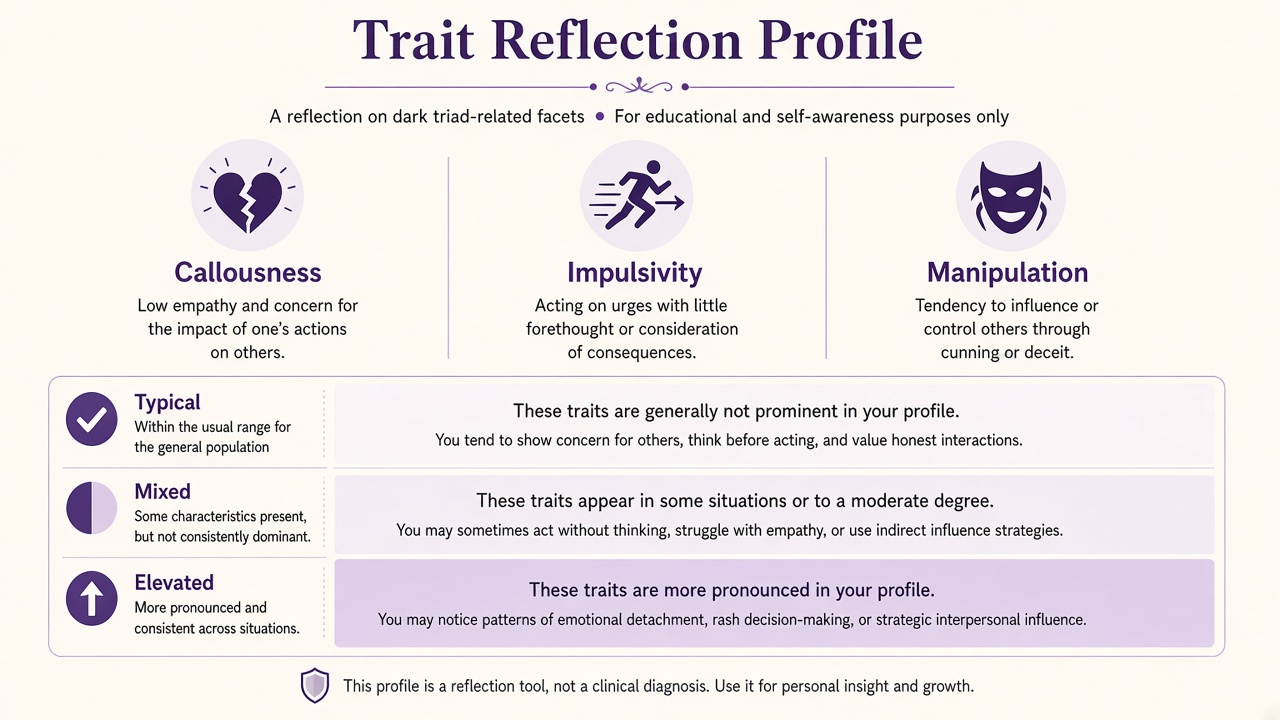
Typical, mixed, and elevated trait patterns
Dark triad traits are dimensional in personality research, not a single yes-or-no verdict. This diagram shows the three bands used on The Quiz Hub plus the callousness, entitlement, and strategic cynicism facets behind your score. Compare with our am i a sociopath quiz for rule-breaking and remorse facets, the Mach IV test for Machiavellianism depth, or the difficult person test for interpersonal friction traits.
What this quiz can and cannot tell you
Can tell you
- How your self-report clusters on dark triad inspired reflection items
- Whether callousness, entitlement, or cynicism pulled hardest in your answers
- A plain-language trait pattern band for reflection and conversation
- A starting point before deeper quizzes like Mach IV or difficult person tests
Cannot tell you
- Whether you are a psychopath, sociopath, or evil
- Antisocial personality disorder or any clinical diagnosis
- Legal guilt, hiring fit, or relationship verdicts
- Scores from any validated clinical psychopathy instrument such as the PCL-R
Why people search am i a psychopath quiz
The question behind am i a psychopath quiz often appears after a cold comment, a fight where empathy felt absent, or curiosity sparked by media portrayals. Personality researchers Paulhus and Williams introduced the dark triad label for three related but distinct traits: psychopathy, narcissism, and Machiavellianism. Online quizzes cannot replicate clinical tools like Hare's Psychopathy Checklist. They can still prompt honest reflection on how detachment, entitlement, and tactical cynicism show up in your life.
Callousness items capture low remorse, thrill-seeking, and emotional distance. Entitlement items capture status hunger and sensitivity to praise. Strategic cynicism items capture skeptical views of others and comfort with influence tactics. High scores on any facet do not mean you are locked into that pattern. Traits shift with stress, trauma recovery, therapy, and deliberate behavior change.
Sample item: "I tend to believe most people act out of self-interest first." High agreement nudges strategic cynicism upward without labeling you manipulative by default. For Machiavellianism depth alone, try our Mach IV test. For broader moral reflection, see the am I a bad person quiz. For five-trait interpersonal friction scoring, see the difficult person test. Context on personality traits appears in the APA personality topic hub. Browse more quizzes on our personality psychology hub.
Am i a psychopath quiz FAQ
What does the am i a psychopath quiz measure?
This quiz measures self-reported patterns across callousness, entitlement, and strategic cynicism from twenty-eight agree-disagree statements inspired by dark triad research. Results group into typical range, mixed elevation, or elevated trait pattern bands. It is not a clinical screen or personality disorder diagnosis.
Does an elevated trait pattern mean I am a psychopath?
No. An elevated trait pattern means your responses suggest elevated traits on this reflection quiz. That flags interpersonal tendencies worth examining, not proof of psychopathy or antisocial personality disorder. Dark triad traits are dimensional in research, not yes-or-no labels.
How is this different from the Mach IV test?
The Mach IV test on The Quiz Hub focuses on Machiavellianism facets such as cynical views and tactical style. This quiz adds callousness and entitlement items so you get a broader dark triad inspired snapshot. Neither test replaces a clinical assessment.
How long does the am i a psychopath quiz take?
Most people finish in about five minutes. There are twenty-eight items on a five-point agree scale. You can pause and return in the same browser session thanks to autosave.
Is this quiz clinical or diagnostic?
No. It does not screen for psychopathy, sociopathy, or antisocial personality disorder. It does not diagnose any condition. It is educational self-reflection only, with crisis resources linked in the limits section.
Who reviewed this content?
Dr. James Whitfield, PhD, reviewed the test framing and result explanations. See our editorial policy for review standards.
Reviewed by