
What this highly sensitive personality test measures
This highly sensitive personality test estimates how much your self-reported style matches HSP trait patterns: thinking deeply, tiring in noisy settings, feeling emotions strongly, and noticing subtle sensory and social cues. Twenty-four original agree-disagree items group into four domains drawn from Elaine Aron DOES research themes. Your HSP trait index averages these patterns into a 0 to 100 score with plain-language bands. It reflects your self-report about sensitivity, not how tough others think you are.
Depth of processing
Replaying conversations, weighing outcomes, and connecting small details into larger patterns.
Overstimulation
Draining quickly in noisy or busy settings, needing recovery time, and hitting exhaustion walls.
Emotional reactivity
Feeling moved by art, absorbing others moods, and carrying praise or criticism with extra weight.
Sensory subtleties
Noticing texture and tone shifts, micro-expressions, harsh scents, and group tension early.
How it works
Three steps from first question to your HSP trait report. Click Start Test to open the interactive quiz in a full-screen modal.
Answer 24 agree-disagree items
Rate each statement from Strongly disagree to Strongly agree. You click Next after each answer; nothing auto-advances.
Items map to four HSP domains
Your answers accumulate percentages for depth of processing, overstimulation, emotional reactivity, and sensory subtleties, plus an overall HSP trait index.
View band and domain bars
Results show Lower, Mixed, or Higher HSP Profile with domain bars and reflection prompts.
Take the highly sensitive personality test
Rate 24 statements about deep processing, sensory overload, emotional intensity, and subtle perception. Your answers produce an HSP trait index from 0 to 100, four domain scores, and a band label for reflection or coaching conversation.
Opens in a focused modal. No account required. Results stay on screen.
What your result means
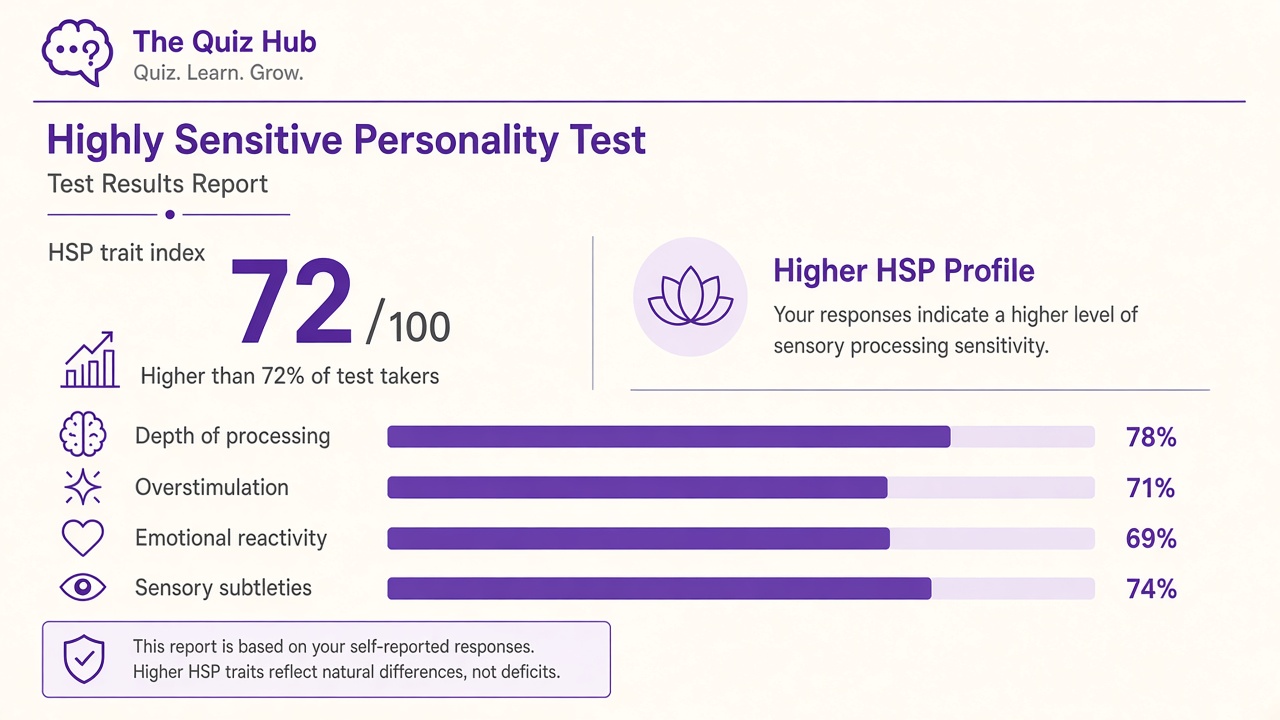
Your HSP trait index is the normalized total across all 24 items on a 0 to 100 scale, with reverse scoring on low-sensitivity items so higher scores mean more HSP pattern overall. Domain bars show endorsement rates so you can see whether depth of processing, overstimulation, emotional reactivity, or sensory subtleties drives your result most.
| Band | Index range | Typical reading |
|---|---|---|
| Lower HSP Profile | 0 to 35 | Fewer HSP trait patterns on this screener; situational overwhelm may still appear during stress |
| Mixed HSP Profile | 36 to 65 | Blend of perceptiveness and selective overload; worth tracking recovery needs if persistent |
| Higher HSP Profile | 66 to 100 | Frequent deep processing, overstimulation, emotional intensity, or sensory sensitivity; recovery planning often helps |
What your HSP report looks like
After all 24 items, you get an HSP trait index from 0 to 100, a band label, and four domain bars for depth of processing, overstimulation, emotional reactivity, and sensory subtleties. Percentages reflect how you describe your sensitivity, not a clinical verdict about your nervous system.
What this test can and cannot tell you
Can tell you
- How much HSP-style patterns showed up for you on this screener
- An HSP trait index and four domain bars for processing, overload, reactivity, and sensory cues
- Which domain pattern feels strongest in your current daily habits
- A starting point for recovery planning or retaking after a major lifestyle change
Cannot tell you
- Whether you have sensory processing disorder, autism, anxiety, or any clinical diagnosis
- Whether you must avoid certain careers or social roles without your own goals and support
- Whether introversion, empathy, or fatigue alone explain your scores without context
- What treatment you need without a licensed clinician's evaluation
Elaine Aron, the DOES model, and HSP research
Psychologist Elaine N. Aron introduced the highly sensitive person concept in 1997 with The Highly Sensitive Person, describing a trait found in roughly 15 to 20 percent of the population. Her later work grouped HSP patterns into the DOES model: depth of processing, overstimulation, emotional reactivity and empathy, and sensitivity to subtle stimuli. Aron and colleagues published peer-reviewed research on sensory processing sensitivity, distinguishing trait sensitivity from shyness, introversion, or neuroticism alone.
The Quiz Hub built this highly sensitive personality test as an original self-report screener inspired by those themes, not a reproduction of any published HSP questionnaire. Readers often compare it to sibling tools on this site. Our Big Five personality test scores OCEAN traits with percentile bands. The four types of introverts quiz maps social energy patterns rather than sensory processing depth. The dark empath quiz screens cognitive empathy paired with detachment, not HSP overload.
| The Quiz Hub test | What it adds |
|---|---|
| Big Five personality test | OCEAN trait percentiles across 48 items, not HSP DOES domain index |
| Four types of introverts quiz | Social energy archetypes, not sensory overload or subtle cue detection |
| Am I an empath or narcissist quiz | Empath absorption versus narcissistic trait patterns, not HSP trait index |
| EQ test | Emotional intelligence skill domains, not overstimulation recovery needs |
| Dark empath quiz | Strategic empathy and detachment pairing, not HSP sensory sensitivity |
| This highly sensitive personality test | Four-domain HSP trait index for processing depth, overload, reactivity, and sensory subtleties |
Sample item types include agree-disagree statements such as whether you replay conversations long after they end, or whether bright lights and loud noise drain you faster than they seem to drain others. High overstimulation with high emotional reactivity often lands in Mixed or Higher HSP Profile. Parenting young children, open-plan offices, and poor sleep can spike overload temporarily. Read how we review quizzes in our editorial policy or browse more tools on our personality psychology hub.
Highly sensitive personality test FAQ
What is a highly sensitive person (HSP)?
A highly sensitive person processes information deeply, notices subtle sensory and social cues, reacts strongly to emotions, and can tire quickly in overstimulating settings. Psychologist Elaine N. Aron introduced the HSP concept in 1997 and later described the DOES model: depth of processing, overstimulation, emotional reactivity, and sensory subtleties. This highly sensitive personality test measures self-reported patterns inspired by that framework. It is not a clinical diagnosis.
What does this highly sensitive personality test measure?
Twenty-four original agree-disagree items ask about depth of processing, overstimulation, emotional reactivity, and sensory subtleties in everyday life. Scores map to four domains inspired by Elaine Aron HSP research themes. You receive an HSP trait index from 0 to 100 and a band from Lower through Higher HSP Profile.
How is this different from the Big Five personality test?
The Big Five personality test scores broad OCEAN traits with 48 items and percentile bands. This highly sensitive personality test focuses on sensory processing, emotional intensity, and recovery needs from HSP research rather than general openness or neuroticism alone. It uses trait agreement statements rather than frequency screeners.
Can this test diagnose sensory processing disorder?
No. The HSP trait index describes self-reported sensitivity patterns on this abbreviated screener. Only a licensed clinician can evaluate sensory processing disorder or related conditions through structured assessment. Online quizzes cannot confirm or deny a diagnosis.
What should I do if I get a higher HSP profile band?
Consider reading Elaine Aron HSP resources, building recovery routines for overstimulation, and talking with a licensed therapist if overload blocks sleep, work, or relationships you want. Track which DOES domain feels most costly before making big life changes.
Who reviewed this content?
Dr. James Whitfield, PhD, reviewed the test framing and result explanations. See our editorial policy for review standards.
Reviewed by
