What this covert narcissist test measures
This covert narcissist test estimates how often hidden narcissism patterns show up in everyday social life. Twenty-four original agree-disagree items group into four domains drawn from covert narcissism research: victim framing, passive superiority, empathy performance, and resentment storage. Your covert narcissism index averages these patterns into a 0 to 100 score with plain-language bands. It reflects your self-report about social habits, not a clinical verdict about your personality.
Victim framing
Feeling unfairly blamed, unnoticed sacrifice, and chronic misunderstanding in groups.
Passive superiority
Quiet moral judgment, sideline advice, and relief when others fail without your method.
Empathy performance
Wanting recognition for compassion, overstating felt pain, and caring as self-image.
Resentment storage
Mental scorekeeping, warmth withdrawal, replaying slights, and testing whether others notice.
How it works
Three steps from first question to your covert narcissism report. Click Start Quiz to open the interactive test in a full-screen modal.
Answer 24 agree-disagree items
Rate how much you agree with each statement about social and emotional habits, from Strongly disagree to Strongly agree. You click Next after each answer; nothing auto-advances.
Items map to four covert domains
Your answers accumulate percentages for victim framing, passive superiority, empathy performance, and resentment storage, plus an overall covert narcissism index.
View band and domain bars
Results show Lower, Mixed, or Higher Covert Narcissism Signals with domain bars and reflection prompts. Higher bands include crisis resources.
Take the covert narcissist test
Rate 24 agree-disagree statements about hidden narcissism patterns in social life. Your answers produce a covert narcissism index from 0 to 100, four domain scores, and a band label for reflection or therapy conversation.
Opens in a focused modal. No account required. Results stay on screen.
What your result means
Your covert narcissism index is the normalized total across all 24 items on a 0 to 100 scale, with reverse scoring on accountability and forgiveness items so higher scores mean more covert narcissism signals overall. Domain bars show endorsement rates so you can see whether victim framing, passive superiority, empathy performance, or resentment storage drives your result most.
| Band | Index range | Typical reading |
|---|---|---|
| Lower Covert Narcissism Signals | 0 to 35 | Fewer hidden entitlement patterns on this screener; normal frustration after unfair treatment may still appear |
| Mixed Covert Narcissism Signals | 36 to 65 | Blend of self-protection and covert entitlement; worth tracking if persistent |
| Higher Covert Narcissism Signals | 66 to 100 | Frequent victim framing, passive superiority, or resentment storage; professional support may help |
What your covert narcissist report looks like
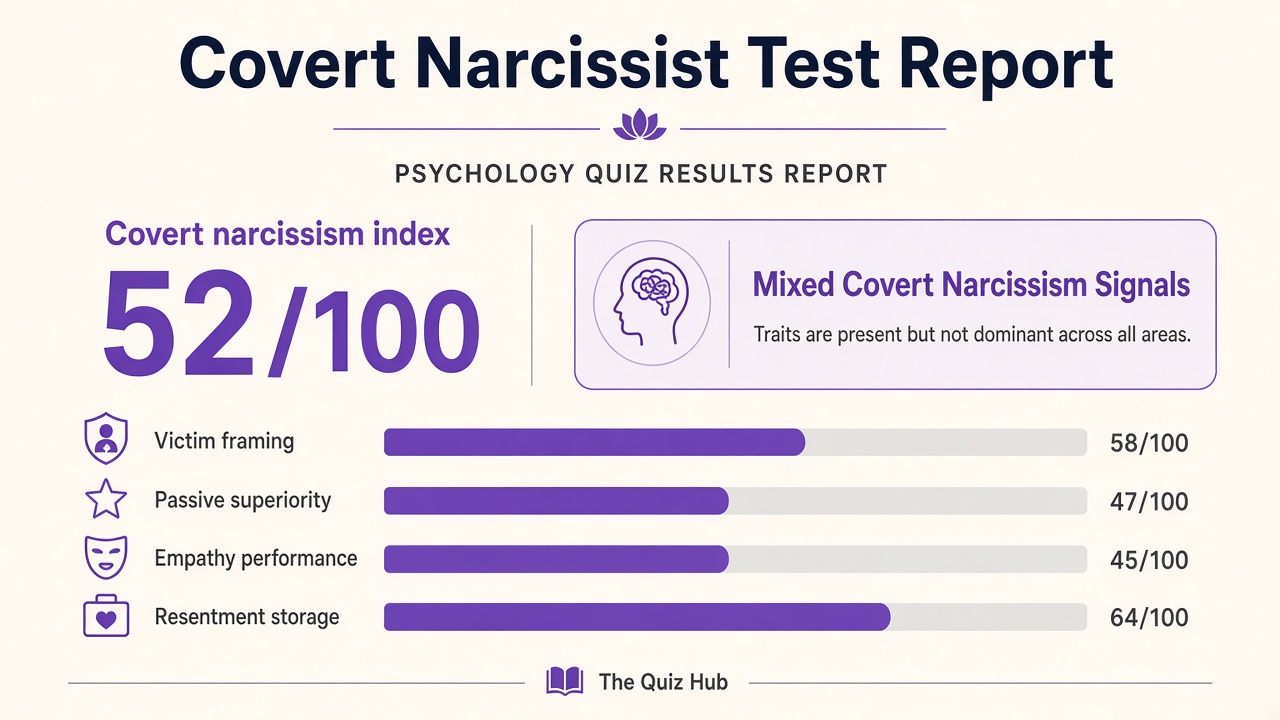
After all 24 items, you get a covert narcissism index from 0 to 100, a band label, and four domain bars for victim framing, passive superiority, empathy performance, and resentment storage. Percentages reflect how you handle social and emotional habits, not a clinical verdict about narcissistic personality disorder.
What this test can and cannot tell you
Can tell you
- How often covert narcissism patterns showed up for you in social life
- A covert narcissism index and four domain bars for victim framing, superiority, empathy performance, and resentment
- Which domain pattern feels strongest in your current social habits
- A starting point for therapy conversation or retake after personal growth work
Cannot tell you
- Whether you have narcissistic personality disorder or any clinical diagnosis
- Whether someone else in your life is a covert narcissist without their own self-report
- Whether your relationships can improve without honest dialogue and mutual effort
- What treatment you need without a licensed clinician's evaluation
Covert narcissism research and sibling screeners
Psychologist Paul Wink published work in 1991 distinguishing overt and covert narcissism in the Journal of Personality and Social Psychology. Later researchers such as Aaron Pincus and Mark Lukowitsky (2010) in the Personality Disorders journal linked grandiose and vulnerable presentations to different interpersonal styles. Covert narcissism in everyday language often maps to those hidden patterns: martyrdom, silent moral superiority, performative compassion, and grudge keeping rather than loud self-promotion.
The Quiz Hub built this covert narcissist test as an original self-report screener inspired by those themes, not a reproduction of any single published instrument. Readers often compare it to sibling tools on this site. Our am I narcissistic quiz screens grandiosity, entitlement, and exploitation with NPI-inspired items. The difficult person test maps callousness, suspicion, and manipulation across five traits. The am I toxic quiz measures criticism, jealousy, and control patterns rather than covert victim framing.
| The Quiz Hub test | What it adds |
|---|---|
| Am I narcissistic quiz | Grandiosity, entitlement, and exploitation facets, not martyrdom or silent superiority |
| Difficult person test | Five DPS-inspired traits including callousness and suspicion, not empathy performance |
| Am I toxic quiz | Criticism, jealousy, and control bands, not resentment storage or victim framing |
| Am I manipulative quiz | Gaslighting and guilt-trip tactics, not passive moral superiority |
| Narcissistic abuse quiz | Partner behavior red flags when you suspect abuse, not your own covert trait patterns |
| This covert narcissist test | Four-domain covert narcissism index for victim framing, superiority, empathy performance, and resentment |
Sample item types include agree-disagree statements such as whether you keep mental notes when someone disappoints you, or whether you want people to notice when you go out of your way to be supportive. High victim framing with high resentment storage often lands in Mixed or Higher Covert Narcissism Signals. Stress, family roles, and recent betrayal can spike scores temporarily. Read how we review quizzes in our editorial policy or browse more tools on our personality psychology hub.
Covert narcissist test FAQ
What is covert narcissism?
Covert narcissism refers to self-esteem patterns that stay hidden: playing the victim, quiet moral superiority, performative empathy, and storing resentment instead of open grandiosity. Researchers such as Wink (1991) and Pincus and Lukowitsky (2010) contrast covert with overt narcissism in personality studies. This covert narcissist test measures how often those patterns show up in your self-report. It is not a clinical diagnosis.
What does this covert narcissist test measure?
Twenty-four original agree-disagree items ask about victim framing, passive superiority, empathy performance, and resentment storage. Scores map to four domains inspired by covert narcissism research. You receive a covert narcissism index from 0 to 100 and a band from Lower through Higher Covert Narcissism Signals.
How is this different from the am I narcissistic quiz?
The am I narcissistic quiz screens grandiosity, entitlement, and exploitation with NPI-inspired items. This covert narcissist test focuses on hidden patterns: martyrdom, silent judgment, caring as self-image, and grudge keeping. It uses agree-disagree statements rather than spotlight-seeking frequency items.
Can this test diagnose narcissistic personality disorder?
No. The covert narcissism index describes self-reported social and emotional habits on this abbreviated screener. Only a licensed clinician can evaluate personality disorders through structured interviews. Online quizzes cannot confirm or deny a diagnosis.
What should I do if I get a higher covert narcissism band?
Consider scheduling an evaluation with a licensed therapist who treats personality or relationship concerns. Bring your result summary and describe which domain feels hardest. If you feel unsafe or in crisis, call or text 988 (US) or your local crisis line.
Who reviewed this content?
Dr. James Whitfield, PhD, reviewed the test framing and result explanations. See our editorial policy for review standards.
Reviewed by