What this dark empath quiz measures
This dark empath quiz estimates how much your self-reported style matches the dark empath profile: reading people well while staying emotionally cool, using charm strategically, and tracking guilt dynamics in conflict. Twenty-four original agree-disagree items group into four domains drawn from dark empath research. Your dark empath pattern index averages these patterns into a 0 to 100 score with plain-language bands. It reflects your self-report about social style, not how others secretly judge you.
Cognitive empathy
Reading hidden feelings, predicting reactions, and adjusting language to land with different people.
Affective detachment
Staying analytical when others are upset, limited mood contagion, and emotional coolness under stress.
Charm and influence
Magnetic first impressions, warmth as a steering tool, and recovering when someone pulls away.
Guilt awareness
Noticing guilt in others, using fairness language, and tracking apology quality in conflict.
How it works
Three steps from first question to your dark empath pattern report. Click Start Quiz to open the interactive quiz in a full-screen modal.
Answer 24 agree-disagree items
Rate each statement from Strongly disagree to Strongly agree. You click Next after each answer; nothing auto-advances.
Items map to four domains
Your answers accumulate percentages for cognitive empathy, affective detachment, charm and influence, and guilt awareness, plus an overall dark empath pattern index.
View band and domain bars
Results show Lower, Mixed, or Higher Dark Empath Pattern with domain bars and reflection prompts.
Take the dark empath quiz
Rate 24 statements about social insight, emotional coolness, charm, and guilt tracking. Your answers produce a dark empath pattern index from 0 to 100, four domain scores, and a band label for reflection or therapy conversation.
Opens in a focused modal. No account required. Results stay on screen.
What your result means
Your dark empath pattern index is the normalized total across all 24 items on a 0 to 100 scale, with reverse scoring on protective items such as genuine remorse or deep emotional resonance so higher scores mean more dark empath pattern overall. Domain bars show endorsement rates so you can see whether cognitive empathy, detachment, charm, or guilt tracking drives your result most.
| Band | Index range | Typical reading |
|---|---|---|
| Lower Dark Empath Pattern | 0 to 35 | Fewer strategic empathy and detachment patterns on this screener; normal social skill may still appear |
| Mixed Dark Empath Pattern | 36 to 65 | Blend of social insight and guarded warmth; worth tracking if persistent |
| Higher Dark Empath Pattern | 66 to 100 | Frequent detachment, charm use, or guilt tracking paired with cognitive empathy; professional reflection may help |
What your dark empath report looks like
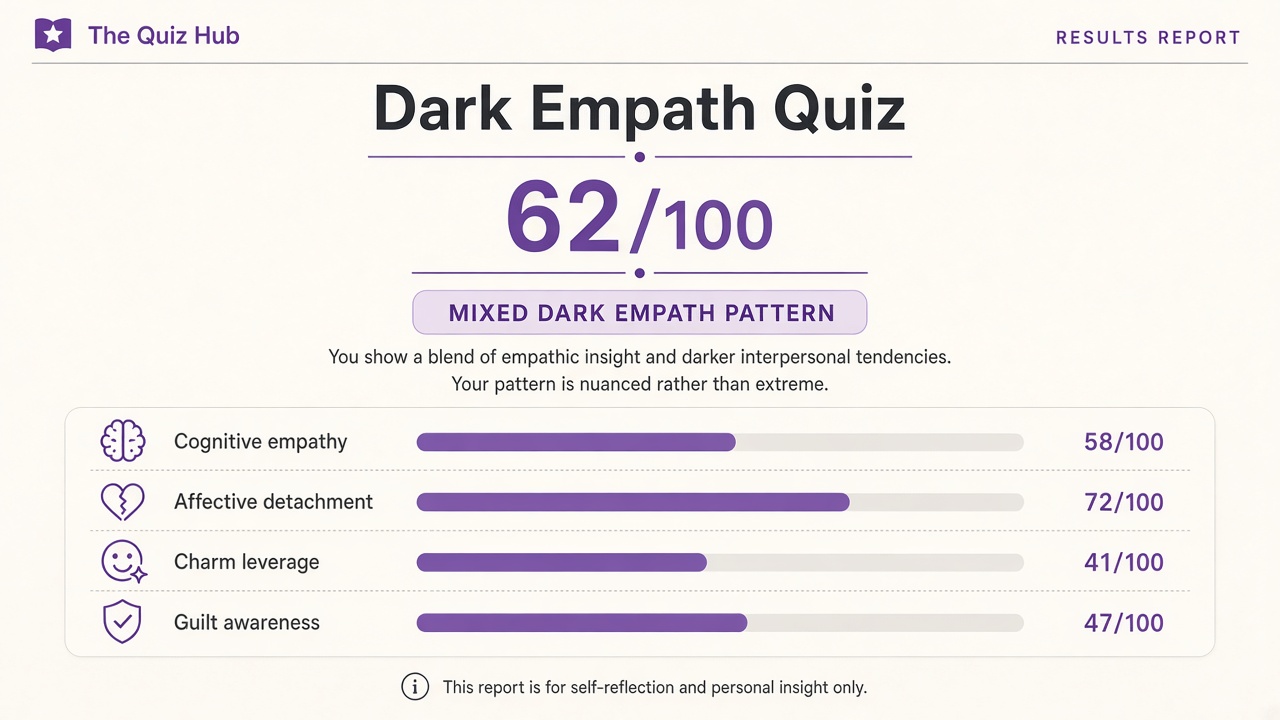
After all 24 items, you get a dark empath pattern index from 0 to 100, a band label, and four domain bars for cognitive empathy, affective detachment, charm and influence, and guilt awareness. Percentages reflect how you describe your interpersonal style, not a clinical verdict about your personality.
What this quiz can and cannot tell you
Can tell you
- How much dark empath patterns showed up for you on this screener
- A dark empath pattern index and four domain bars for empathy, detachment, charm, and guilt tracking
- Which domain pattern feels strongest in your current social habits
- A starting point for therapy conversation or retaking after a major role change
Cannot tell you
- Whether you have narcissism, psychopathy, Machiavellianism, or any clinical diagnosis
- Whether coworkers or partners experience you as cold without their own feedback
- Whether leadership charm is healthy influence or manipulation without context
- What treatment you need without a licensed clinician's evaluation
Dark empaths, cognitive empathy, and the dark triad
Psychologists Nadine A. Napier, Kevin Lloyd, and colleagues published work in 2021 in Personality and Individual Differences describing dark empaths as people who score high on dark triad traits while also reporting elevated empathy, especially cognitive empathy. Paulhus and Williams (2002) defined the dark triad as narcissism, Machiavellianism, and subclinical psychopathy. The dark empath idea suggests some people understand feelings well yet use that insight with detachment or charm rather than warm concern.
The Quiz Hub built this dark empath quiz as an original self-report screener inspired by that research thread, not a reproduction of any published clinical instrument. Readers often compare it to sibling tools on this site. Our Mach IV test screens Machiavellian cynicism and manipulation tactics. The am I narcissistic quiz maps grandiosity and entitlement facets. The difficult person test scores five interpersonal hostility traits from Sleep, Lynam, and Miller inspired items.
| The Quiz Hub test | What it adds |
|---|---|
| Mach IV test | Machiavellian worldview and cynical manipulation items, not empathy paired with detachment |
| Am I narcissistic quiz | Grandiosity and entitlement facets, not cognitive empathy with charm patterns |
| Am I manipulative quiz | Influence-style tactics in three dimensions, not dark empath four-domain index |
| Difficult person test | Five-trait hostility profile, not empathy plus detachment pairing |
| Big Five personality test | OCEAN trait percentiles, not dark empath pattern bands |
| This dark empath quiz | Four-domain dark empath pattern index for cognitive empathy, detachment, charm, and guilt awareness |
Sample item types include agree-disagree statements such as whether you can tell what someone is feeling when they hide it, or whether you stay calm and analytical when someone else is upset. High cognitive empathy with high affective detachment often lands in Mixed or Higher Dark Empath Pattern. Leadership roles, debate skill, and past betrayal can shift scores temporarily. Read how we review quizzes in our editorial policy or browse more tools on our personality psychology hub.
Dark empath quiz FAQ
What is a dark empath?
A dark empath is a personality profile described in research as combining dark triad traits (such as narcissism, Machiavellianism, or psychopathy) with high cognitive empathy. People with this pattern may read emotions well while staying affectively cool or using charm strategically. This dark empath quiz measures self-reported patterns inspired by that concept. It is not a clinical diagnosis.
What does this dark empath quiz measure?
Twenty-four original agree-disagree items ask about cognitive empathy, affective detachment, charm and social influence, and guilt awareness in conflict. Scores map to four domains inspired by Napier, Lloyd, and colleagues (2021) dark empath research. You receive a dark empath pattern index from 0 to 100 and a band from Lower through Higher Dark Empath Pattern.
How is this different from the Mach IV test?
The Mach IV test screens Machiavellianism with cynical worldview and manipulation items. This dark empath quiz pairs social insight with detachment and charm patterns rather than measuring Machiavellianism alone. It uses trait agreement statements rather than the Mach scale wording.
Can this quiz diagnose narcissism or psychopathy?
No. The dark empath pattern index describes self-reported interpersonal style on this abbreviated screener. Only a licensed clinician can evaluate personality disorders through structured interviews. Online quizzes cannot confirm or deny a diagnosis.
What should I do if I get a higher dark empath pattern band?
Consider scheduling a session with a licensed therapist who treats personality or relationship patterns. Bring your result summary and describe which domain feels most automatic in conflict. Honest feedback from people you trust can also clarify how your warmth reads to others.
Who reviewed this content?
Dr. James Whitfield, PhD, reviewed the test framing and result explanations. See our editorial policy for review standards.
Reviewed by