What this am I straight quiz measures
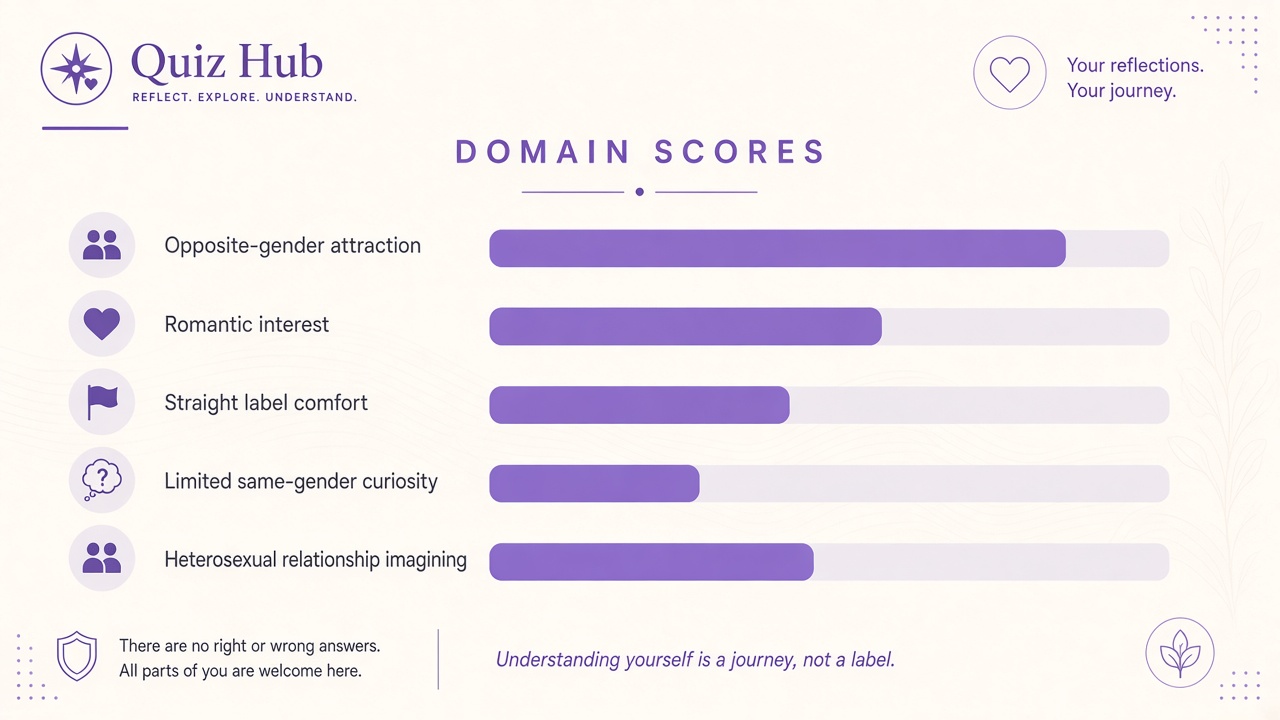
This am I straight quiz screens five reflection domains associated with straight and heterosexual experiences. Five items cover opposite-gender attraction. Five items cover romantic interest in a different gender. Four items cover comfort with the straight label. Five items cover limited same-gender curiosity. Four items cover heterosexual relationship imagining.
Opposite-gender attraction
Physical spark, attention toward different-gender people, and vivid chemistry in daily life.
Romantic interest in other gender
Crush history, dating imagination, and romantic disappointment with different-gender partners.
Straight label comfort
Whether straight language, heterosexual media stories, and assumed framing feel resonant.
Limited same-gender curiosity
How little same-gender attraction and questioning show up in your self-report right now.
Heterosexual relationship imagining
Long-term partnership, intimacy, and life-path daydreams with a different-gender partner.
How it works
Three steps from first statement to your reflection band. Click Start Quiz to open the interactive screener in a full-screen modal.
Answer 23 statements
Rate how much you agree with each item on a five-point scale from strongly disagree to strongly agree. There is no timer and no auto-advance between items.
Items map to five domains
Your answers accumulate percentages for attraction, romantic interest, label comfort, same-gender curiosity, and relationship imagining, plus attraction core and label resonance flags.
View reflection band and next steps
Results show Mixed Orientation Curiosity, Mostly Straight Pattern, or Stronger Straight Identity Signals with domain bars and affirming guidance.
Take the am I straight quiz
Rate 23 statements about opposite-gender attraction, romantic interest in a different gender, straight label comfort, limited same-gender curiosity, and heterosexual relationship imagining. Your answers produce an overall pattern score, five domain bars, and three reflection bands with plain-language next steps.
Opens in a focused modal. No account required. Results stay on screen.
What your result means
Your overall straight-pattern index is the average of five domain percentages, each normalized to 0 through 100. The band groups that average into plain-language reflection signals. Domain bars show whether attraction, romantic interest, label comfort, same-gender curiosity, or relationship imagining drive your result. Flags highlight opposite-gender attraction core, straight label resonance, and same-gender curiosity patterns.
| Reflection band | Score range | Typical reading |
|---|---|---|
| Mixed Orientation Curiosity | 0 to 35% | More questioning and same-gender curiosity than a clear straight pattern on these items |
| Mostly Straight Pattern | 36 to 65% | Blended scores worth sitting with; labels optional and fluid |
| Stronger Straight Identity Signals | 66 to 100% | Stronger opposite-gender attraction and straight framing comfort; straight identity valid when it fits |
Five straight reflection domains
The diagram below shows how domain scores appear in your results. High romantic interest with moderate label comfort, for example, can still matter even if your overall average sits in a middle band.
What this quiz can and cannot tell you
Can tell you
- Whether your self-reported patterns lean curious, mostly straight, or stronger straight on this screener
- Five domain scores for attraction, romantic interest, label comfort, curiosity, and relationship imagining
- Attraction core, label resonance, and same-gender curiosity flags for reflection
- A starting point for conversations with trusted friends or affirming community resources
Cannot tell you
- Whether you are straight, bisexual, gay, lesbian, queer, or any fixed label
- Whether you must date a different-gender partner or perform heterosexuality
- Official Kinsey scale scores comparable to published research norms
- How others perceive your orientation or whether you belong in LGBTQ spaces
Straight identity, questioning, and research context
In 1948, Alfred Kinsey published research describing sexual behavior along a continuum rather than a strict gay-or-straight binary. Later scholars such as Fritz Klein expanded orientation measurement to include attraction, behavior, fantasy, and identity on different axes. Contemporary research on sexual fluidity, including Lisa Diamond's longitudinal work, documents how patterns can shift across life stages even for people who identify as straight.
The Quiz Hub built this am I straight quiz as an affirming reflection screener inspired by those themes. It uses original agree-disagree items across five domains with three result bands and explicit reminders that straight is valid without being a default everyone must meet. That trade-off favors readable self-reflection for casual users while naming Kinsey (1948) and Klein as historical context honestly. The GLAAD straight allies resource notes that supporting LGBTQ people includes respecting that orientation is self-defined, not assumed from appearance or relationship history.
| The Quiz Hub test | What it adds |
|---|---|
| Sexuality test | Broader orientation reflection across multiple dimensions, not straight-specific label comfort items |
| Am I gay test | Same-gender attraction focus relative to other-gender patterns, not heterosexual framing comfort |
| Am I bisexual quiz | Multi-gender attraction and bi-erasure items when straight-only framing feels too narrow |
| This am I straight quiz | Opposite-gender attraction, romantic interest, straight label comfort, limited same-gender curiosity, and heterosexual relationship imagining with three affirming bands |
Sample item: agreeing that you feel a physical spark toward someone of a different gender raises your opposite-gender attraction domain score. Agreeing that the word straight feels like it could describe your experience raises label comfort. Pair results with our sexuality test, am I gay test, or am I bisexual quiz when you want sibling lenses. Browse more quizzes on our sexuality and LGBTQ+ hub or read how we review content in our editorial policy.
Am I straight quiz FAQ
What does this am I straight quiz measure?
This am I straight quiz measures self-reported agreement with statements about opposite-gender attraction, romantic interest in a different gender, comfort with the straight label, limited same-gender curiosity, and heterosexual relationship imagining. Twenty-three items produce an overall pattern score, five domain bars, attraction core and label resonance flags, and one of three reflection bands. It is not a clinical diagnosis or a certificate of orientation.
Does a high score mean I am straight?
A higher band means your answers suggest stronger straight-pattern signals on this screener. Only you can decide whether straight, heterosexual, questioning, bi, gay, lesbian, queer, or another label fits. A lower band does not disprove straight identity, and a higher band does not require you to call yourself straight. Questioning and fluidity remain valid.
Is this quiz pressuring me to be straight?
No. The Quiz Hub built this screener as a reflective tool, not a heteronormative pressure test. Straight is valid when it fits your experience. So is questioning, fluidity, and every LGBTQ+ identity. Results describe patterns on these items only. They do not prescribe labels or relationship paths.
How is this different from an am I gay test or sexuality test?
An am I gay test focuses on same-gender attraction and gay identity exploration. A broad sexuality test maps multiple orientation dimensions. This am I straight quiz centers opposite-gender attraction, straight label comfort, and limited same-gender curiosity specifically. Pair results across quizzes if you want a wider reflection map.
How long does the am I straight quiz take?
Most people finish in about 6 minutes. There are 23 agree-disagree items on a five-point scale. You can pause and return in the same browser session thanks to autosave.
Who reviewed this content?
Dr. Morgan Chen, PhD, reviewed the test framing and result explanations. See our editorial policy for review standards.
Reviewed by