What this DSKB test measures
The viral DSKB kink typology parodies MBTI with four adult reflection dichotomies. Each pair names a style preference, not a prescription. Uppercase letters mark the bold pole; lowercase letters mark the reserved, calm, receptive, or detached pole.
-
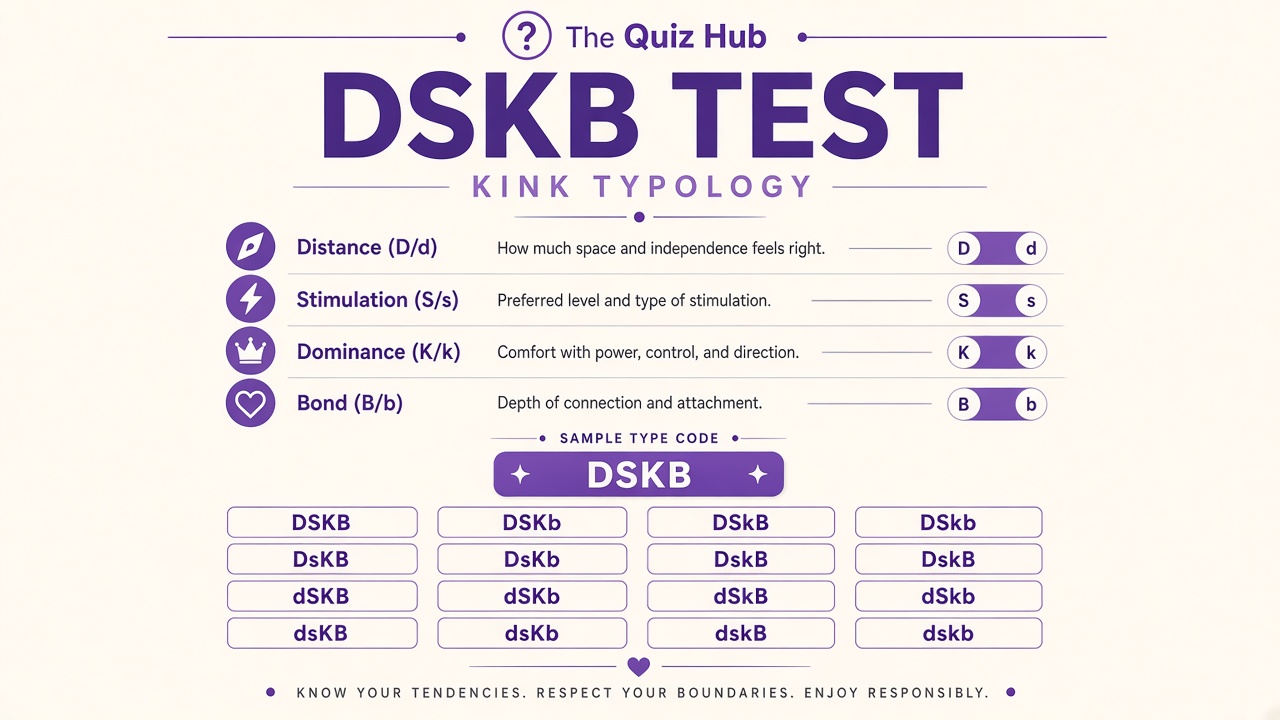
Distance: D / d
Bold distance: Comfort with direct initiation, overt flirtation, and visible confidence.
Reserved distance: Preference for subtle cues, slow buildup, and private intimacy signals.
-
Stimulation: S / s
Taboo thrill: Pull toward novelty, edge, and negotiated transgression.
Calm warmth: Pull toward safe pacing, tenderness, and familiar comfort.
-
Relational style: K / k
Dominant tease: Natural lead, teasing control, and scene direction when opted in.
Submissive flow: Natural follow, receptive surrender, and guided presence.
-
Bond: B / b
Deep immersion: All-in emotional attachment and immersive intensity with a partner.
Playful detachment: Light, playful energy without heavy commitment or soul-bond pressure.
How it works
Three steps from first statement to your four-letter DSKB code. Click Start Quiz to open the interactive test in a full-screen modal.
-
Answer 32 statements
Rate how much you agree with each consent-forward item on a five-point scale. There is no timer and no auto-advance between items.
-
Items map to four dichotomies
Eight items per axis with reverse scoring. Your stronger pole in each pair becomes one letter of your code, such as DSKB or dskb.
-
View type profile and clarity chart
Results show your four-letter code, an original English archetype name, clarity percentages per dichotomy, and strengths plus growth edges.
Take the DSKB test
Rate 32 statements about distance, stimulation, relational style, and bond preferences. Your answers produce a four-letter DSKB code and one of sixteen archetype profiles such as The Devoted Director or The Daydream Drifter.
Opens in a focused modal. No account required. Results stay on screen.
What your DSKB result means
Your four-letter code summarizes which pole you leaned toward in each dichotomy. Clarity percentages show how decisive those leanings were in this session. Browse all sixteen types on our 16 DSKB types guide for side-by-side comparisons.
| Clarity range | Typical reading |
|---|---|
| Below 25% | Slight preference; you may switch styles by context or partner |
| 25 to 44% | Moderate preference; noticeable but not rigid |
| 45 to 69% | Clear preference; shows up regularly in reflection items |
| 70% and above | Very clear preference; strongly shapes your default approach |
What your DSKB type report looks like
After all 32 items, you get a four-letter DSKB code badge, an original English archetype title and tagline, four dichotomy clarity bars with pole labels, and a short profile with strengths and growth edges. The hero diagram below matches this test's sixteen-type framing, not a different quiz's results graphic.
What this quiz can and cannot tell you
Can tell you
- Your self-reported lean on four viral DSKB dichotomies in this session
- A four-letter code with clarity scores per axis
- An original English archetype profile for playful reflection
- A starting point for honest conversations with a trusted partner
Cannot tell you
- What role you must perform or what any partner owes you
- Official clinical scores or validated psychometric certification
- Permission to skip consent, limits, safewords, or aftercare
- A fixed identity that will never change across partners or life stages
The viral DSKB trend and how this quiz differs from our BDSM screener
In April 2026, Japanese creators including karoooome and Novel Game Collection popularized DSKB as an MBTI-parody kink typology: four dichotomies produce sixteen four-letter codes with meme-ready archetype energy. The Quiz Hub built this DSKB test as a consent-forward, non-graphic English reflection screener with thirty-two original Likert items, expanded from the viral twelve-item starter for better axis clarity. We invented original English archetype names such as The Devoted Director and The Velvet Whisper rather than copying Japanese type labels verbatim.
Scoring follows MBTI-style dichotomy sums: each axis compares pole totals from eight items with reverse scoring, then picks the stronger letter. Clarity percentages show how decisive the win was. Pair results with our BDSM test for a broad nine-domain kink snapshot, our vanilla or kinky quiz for gentle-versus-adventurous spectrum bands, and our how kinky are you quiz for seven-domain openness reflection. Browse every code on the 16 DSKB types sibling page.
| The Quiz Hub test | What it adds |
|---|---|
| BDSM test | Nine kink domains with role tendency bands, not four-letter MBTI-parody codes |
| 16 DSKB types | Reference guide to all sixteen codes without taking the interactive quiz |
| Vanilla or kinky quiz | Cosmo-style gentle-versus-adventurous spectrum, not four-dichotomy typology |
| How kinky are you quiz | Seven openness domains with four bands, not sixteen fixed archetypes |
| This DSKB test | Four viral dichotomies, sixteen type codes, clarity chart, original English archetype profiles |
Sample item: agreeing that direct initiation energizes you more than guessing games raises your bold Distance (D) score. Agreeing that calm warm pacing beats intensity for its own sake raises calm Stimulation (s). Read how we review adult content in our editorial policy or browse the kink and BDSM hub.
DSKB test FAQ
What is the DSKB test?
The DSKB test is a viral Japanese MBTI-parody kink typology with four dichotomies: Distance (bold vs reserved), Stimulation (taboo thrill vs calm warmth), relational style (dominant tease vs submissive flow), and Bond (deep immersion vs playful detachment). Thirty-two Likert items produce a four-letter code such as DSKB or dskb and one of sixteen archetype profiles. It is parody entertainment for adults, not clinical role assignment.
Is the DSKB test for adults only?
Yes. This quiz is for adults 18 and older reflecting on consensual kink between adults. It is not for minors. Results assume SSC or RACK frameworks where enthusiastic consent, limits, safewords, and aftercare are non-negotiable.
How is DSKB different from the BDSM test?
Our BDSM test maps nine broad kink domains with role tendency bands. The DSKB test uses four MBTI-style dichotomies and sixteen fixed type codes inspired by the April 2026 karoooome and Novel Game Collection trend. Pair both for complementary reflection lenses.
Can an online DSKB test assign me a permanent role?
No. No online quiz can certify your power-exchange style or tell you what you must do with a partner. DSKB results name a playful archetype from self-report for reflection only. Only you and your partners decide labels through honest negotiation.
What does clarity percentage mean on each dichotomy?
Clarity shows how decisively you leaned toward one pole in that session. A near-even split does not mean the quiz failed. It may reflect genuine flexibility, mood, or situational adaptation. Retake when you can answer more decisively if clarity feels too low.
Who reviewed this content?
Dr. Morgan Chen, PhD, reviewed the test framing and result explanations. See our editorial policy for review standards.
Reviewed by