What this BDSM test measures
This BDSM test estimates interest patterns across nine multidimensional domains inspired by classic kink preference screeners but with entirely original wording. Forty-five Likert items group into dominance, submission, sensation play, bondage, exhibition and voyeurism, roleplay, fetish curiosity, switch flexibility, and consent with aftercare. Results show a preference index, domain bars, a role tendency, and reflective bands. No quiz can name your role for you or replace negotiation with partners.
Dominance
Leading scenes, giving direction, and holding authority with enthusiastic consent.
Submission
Yielding control, following negotiated rules, and serving within boundaries.
Sensation play
Giving or receiving stronger physical sensation within agreed limits.
Bondage
Restraint, rope, cuffs, and the focus limited movement can create.
Exhibition / voyeur
Consensual being seen or watching others in controlled settings.
Roleplay
Characters, scenarios, and fantasy roles during intimacy.
Fetish curiosity
Specialized materials, props, and niche kink categories.
Switch flexibility
Comfort shifting between dominant and submissive roles.
Consent & aftercare
Negotiation, safewords, ongoing consent, and post-scene care.
How it works
Three steps from first question to your BDSM preference snapshot. Click Start Quiz to open the interactive modal.
Rate 45 reflection statements
Answer from Strongly disagree to Strongly agree. There is no timer and no auto-advance between items.
Items map to nine domains
Your answers accumulate percentages for dominance, submission, sensation, bondage, and related areas.
View index, role tendency, and band
Results show Curious Explorer, Mixed Interests, or Clearer Lean bands with domain bars and consent-forward next steps.
Take the BDSM test
Rate 45 reflection statements about power exchange, sensation, bondage, roleplay, fetish curiosity, switching, and consent values on a five-point agreement scale. Your answers produce a preference index, nine domain scores, a role tendency, and a reflective band with plain-language next steps.
Opens in a focused modal. Adults 18+ only. Results stay on screen.
What your result means
Your preference index is the average of all nine domain scores, each normalized to 0 through 100. Higher percentages mean more frequent agreement with kink-interest items (and less frequent agreement with reverse-scored avoidance items). Domain bars show whether dominance, submission, sensation, or consent values drive your band. Role tendency is computed separately from dominance versus submission balance and switch flexibility.
| Reflective band | Score range | Typical reading |
|---|---|---|
| Curious Explorer | 0 to 35% | Lower agreement overall; valid whether vanilla, new to kink, or cautious |
| Mixed Interests | 36 to 65% | Blend of domain signals; common when interests are situational |
| Clearer Lean | 66 to 100% | Stronger multi-domain agreement; still not a role prescription |
| Role tendency | How it is estimated |
|---|---|
| Dominant-leaning | Dominance domain meaningfully higher than submission with moderate agreement |
| Submissive-leaning | Submission domain meaningfully higher than dominance with moderate agreement |
| Switch | Balanced dominance and submission or high switch flexibility scores |
| Explorer | Lower dominance and submission scores or overall curious band |
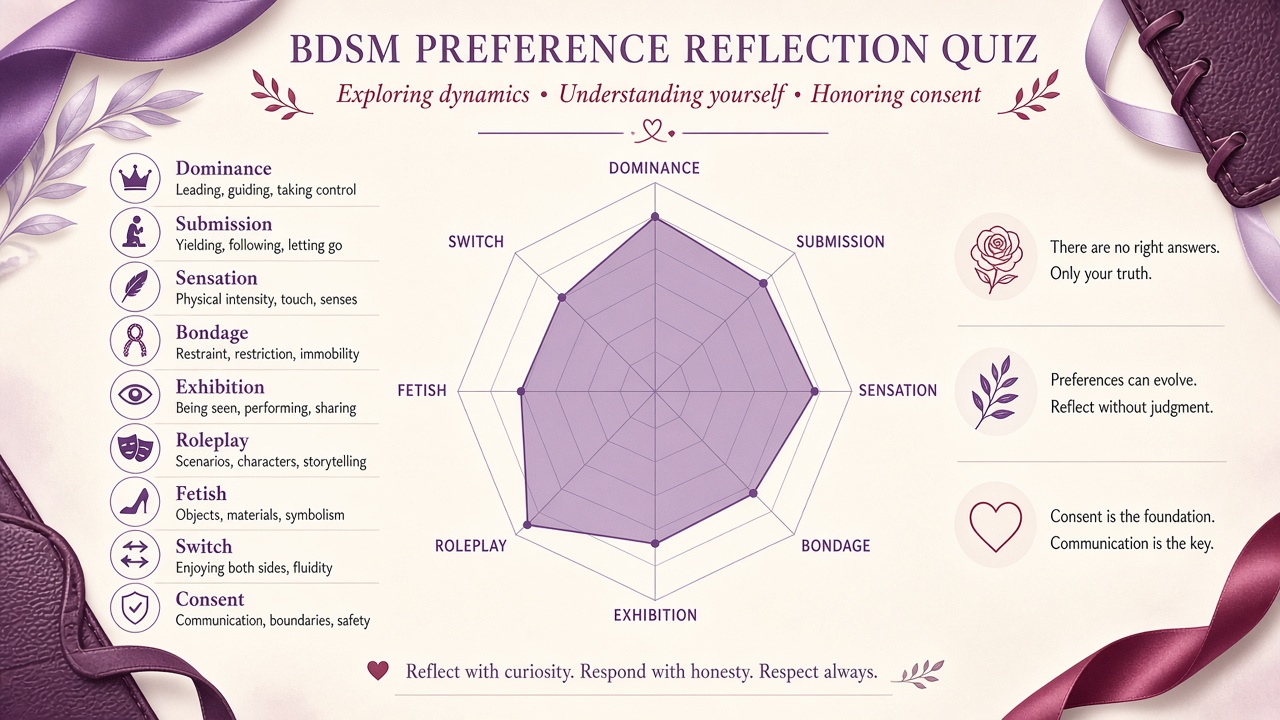
Nine-domain BDSM preference chart
The diagram below shows how domain scores appear in your results. High bondage curiosity with low exhibition scores, for example, is a common mixed pattern that still lands in Mixed Interests when your overall index sits between bands.
What this BDSM test can and cannot tell you
Can tell you
- Whether your self-reported patterns lean toward curious, mixed, or clearer kink interest on this screener
- A preference index and nine domain scores for reflection and journaling
- A role tendency snapshot such as dominant-leaning, submissive-leaning, switch, or explorer
- A starting vocabulary before you negotiate with trusted adult partners
Cannot tell you
- Whether you must call yourself a dom, sub, switch, or any community label
- Whether you should pressure a partner into kink they have not agreed to
- Clinical scores from validated psychosexual inventories
- Permission to skip safewords, limits, or aftercare because a score was high
Consent, power exchange, and kink self-reflection
Community educators have long emphasized that kink is about negotiated power exchange between adults, not abuse. The National Coalition for Sexual Freedom promotes consent education and legal advocacy for consensual BDSM practitioners. The Quiz Hub built this BDSM test as a compassionate reflection tool inspired by multidimensional kink screeners, not as a clinical inventory or a gatekeeping credential.
Forty-five original items ask about leading and yielding, sensation and restraint, roleplay and fetish curiosity, switching, and consent values. That framework helps organize mixed feelings before you decide what activities fit with a partner. For broader sexuality reflection, browse our sexuality and LGBTQ+ hub. For relationship patterns separate from kink, see our relationships and dating hub. For personality patterns that may shape negotiation style, try our Big Five personality test.
| Framework | What it means for you |
|---|---|
| SSC | Safe, Sane, Consensual: activities stay within negotiated physical and emotional limits |
| RACK | Risk-Aware Consensual Kink: partners acknowledge risks and consent with informed awareness |
| Enthusiastic consent | Yes means yes actively given; silence or pressure never counts as agreement |
| Aftercare | Post-scene comfort, hydration, and emotional check-in are part of the activity |
Sample item: agreeing that you want explicit check-ins before intense play raises your consent and aftercare bar. Agreeing that detailed negotiation slows intimacy too much lowers that bar through a reverse-scored item. Partner mismatch, shame, or privacy concerns can keep scores moderate even when curiosity is real. Read how we review quizzes in our editorial policy or browse more tests on our kink and BDSM hub.
BDSM test FAQ
What does this BDSM test measure?
This BDSM test measures self-reported interest across nine reflection domains: dominance, submission, sensation play, bondage, exhibition and voyeurism, roleplay, fetish curiosity, switch flexibility, and consent with aftercare. Forty-five Likert items produce a preference index, nine domain bars, a role tendency such as Dominant-leaning or Switch, and a reflective band. It cannot diagnose you or give permission to coerce anyone.
Is this BDSM test for adults only?
Yes. This screener is for adults 18 and older reflecting on consensual kink between adults. It is not for minors. Results assume SSC or RACK frameworks where enthusiastic consent, limits, and aftercare are non-negotiable.
Can an online BDSM test tell me if I am a dom or sub?
No. No online quiz can assign a permanent role or certify your power-exchange style. This screener estimates a role tendency from your self-report and domain scores for reflection only. Only you and your partners decide what labels fit through honest negotiation.
What if my result shows Curious Explorer?
Curious Explorer means your answers suggest lower agreement with kink-themed items overall. That is valid whether you prefer mostly vanilla intimacy, are new to kink language, or are cautious. Lower scores do not mean you must try BDSM or that something is wrong with you.
Does a high score mean I can dominate someone without asking?
Absolutely not. High dominance or sensation scores are interest signals on a reflection screener, not permission to pressure, coerce, or skip consent. Enthusiastic consent between adults is required for every activity. Quiz results never override a partner's boundaries.
Who reviewed this content?
Dr. Morgan Chen, PhD, reviewed the test framing and result explanations. See our editorial policy for review standards.
Reviewed by