What this dominant submissive quiz measures
This dominant or submissive test screens eight domains researchers and community educators associate with consensual dominance and submission preference. Every item assumes adults, negotiated limits, and the right to stop. Results describe lean on a spectrum, not a command for how any partner should treat you.
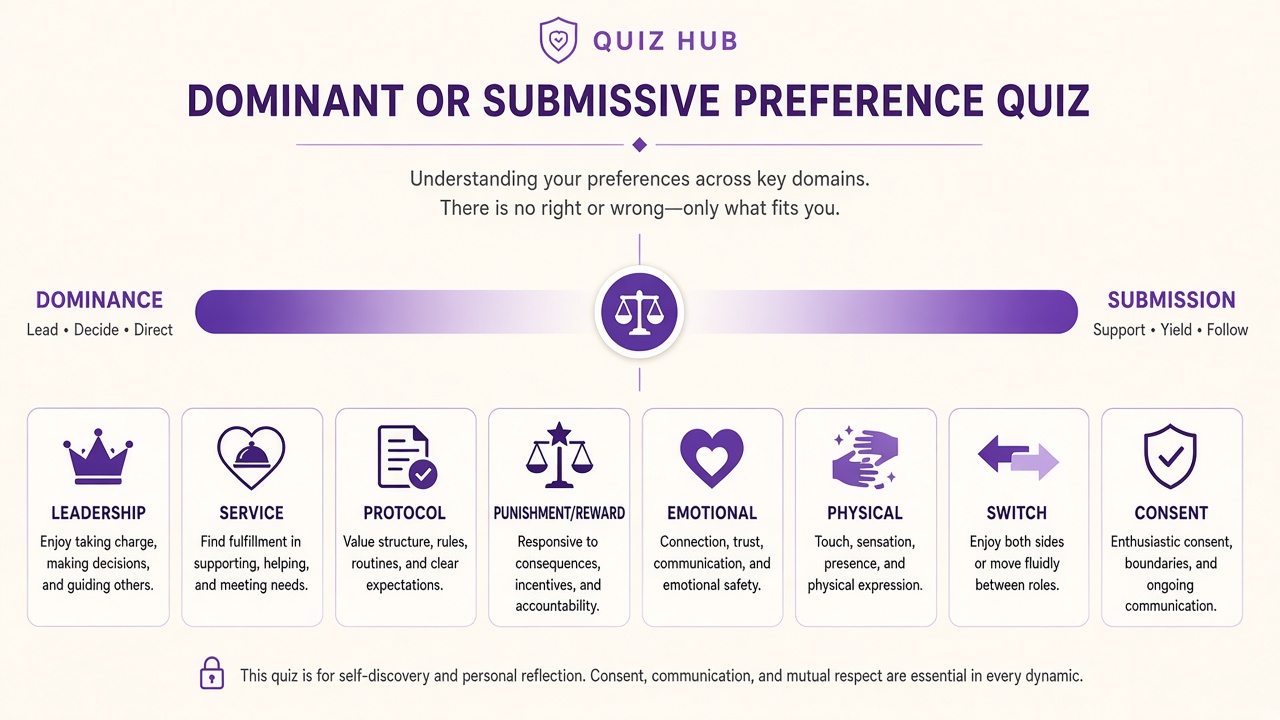
Leadership and control
Comfort taking lead versus relaxing when a trusted partner guides pace after boundaries are set.
Service and deference
Meaning found in giving or receiving attentive service within reciprocity and agreed limits.
Protocol enjoyment
Appeal of structured rituals, titles, or routines when both people have opted in.
Punishment and reward
Interest in accountability structures only after explicit negotiation and safeword planning.
Emotional tone
Preference for holding steadiness versus yielding emotional guidance in intense scenes.
Physical direction
Appeal of physically guiding or being guided with ongoing check-ins.
Switch flexibility
How much your role shifts by partner chemistry, mood, and scene type.
Consent negotiation
Priority on safewords, check-ins, aftercare, and slow discovery of themes.
How it works
Three steps from first statement to dominance and submission indices plus a band label. Click Start Test to open the interactive quiz in a full-screen modal with session autosave.
Answer 26 statements
Rate agreement on a five-point scale. Each prompt begins with a consensual adult context reminder. There is no timer and no auto-advance.
Items map to poles and domains
Dominant-leaning, submissive-leaning, switch, and consent items combine into indices and eight domain percentage bars.
View indices and band
Results show dominance index, submission index, switch flexibility, consent priority, domain chart, and one of four bands with consent-first next steps.
Take the dominant or submissive test
Rate 26 consent-first statements about leadership, service, protocol, accountability themes, emotional and physical direction, switch flexibility, and negotiation habits. Your answers produce dominance and submission indices plus a band label.
Opens in a focused modal. Adults only. Results stay on screen.
What your result means
Dominance and submission indices (0 to 100) reflect agreement with pole-mapped items on this snapshot. Switch flexibility and consent priority score separately. Band assignment weighs the gap between indices, switch scores, and exploration patterns. No band ranks one role as morally superior.
| Band | Typical pattern | Plain-language reading |
|---|---|---|
| Dominant-leaning | Dominance index clearly exceeds submission index | Often gravitates toward lead, direction, and structure after negotiation |
| Balanced Switch | Indices close together or high switch flexibility | Role comfort shifts by partner, mood, and consensual scene type |
| Submissive-leaning | Submission index clearly exceeds dominance index | Often gravitates toward yield, service, and guided tone within limits |
| Still Exploring | Low pole indices or high exploration and consent items | Still mapping themes; slow discovery is a valid outcome |
D/s domains and the preference spectrum
The diagram below shows how eight domains feed dominance and submission indices alongside switch and consent scores. High protocol enjoyment with moderate physical direction, for example, can still produce a dominant-leaning band if leadership items score higher than deference items.
What this test can and cannot tell you
Can tell you
- How your answers lean toward dominant or submissive themes today
- Switch flexibility and consent priority scores alongside pole indices
- Which of eight domain bars scored highest on this snapshot
- When to explore our BDSM test or top or bottom quiz for sibling maps
Cannot tell you
- What any specific partner wants or owes you sexually
- Whether you must obey, serve, or dominate outside negotiated scenes
- Whether you are safe with a given person without direct conversation
- A fixed label that will never change as you gain experience
Dominance, submission, and consensual power exchange
Community educators and researchers such as Dossie Easton and Janet Hardy have long emphasized that BDSM roles describe negotiated dynamics between adults, not innate hierarchy in everyday life. The National Coalition for Sexual Freedom promotes consent policies that treat safewords, negotiation, and aftercare as baseline requirements. The Quiz Hub built this dominant submissive quiz to mirror that framing: every item references agreed boundaries, and consent negotiation is its own scored domain.
Popular searches mix dominant or submissive test intent with broader BDSM curiosity or top versus bottom language. This page stays focused on D/s lean across eight themes. Our planned BDSM test will map wider kink interests. Our planned top or bottom quiz will separate giving and receiving roles that do not always match dominance labels. Pair them when you want more than one lens.
| The Quiz Hub test | What it adds |
|---|---|
| BDSM test (planned) | Broader kink theme map beyond D/s lean alone |
| Top or bottom quiz | Giving versus receiving focus that may diverge from dominance labels |
| Kink and BDSM hub | Category home for consent-first adult quizzes as they ship |
| This dominant or submissive test | Dominance and submission indices, switch flexibility, consent priority, and eight domain bars |
Sample item: agreeing that you would only explore punishment or reward play after explicit negotiation raises your consent priority score without automatically pushing you toward either pole. Agreeing that you relax when a trusted partner guides pace after limits are set raises submission index. If switch items score highest, expect a Balanced Switch band even when one pole leads slightly. Browse more adult quizzes on our kink and BDSM hub or read how we review them in our editorial policy.
Dominant or submissive test FAQ
What does this dominant or submissive test measure?
This dominant submissive quiz measures self-reported pull toward leading versus yielding in consensual adult dynamics. Eight domains cover leadership, service, protocol, punishment and reward themes, emotional tone, physical direction, switch flexibility, and consent negotiation. Results show dominance and submission indices plus a band label. It describes preference patterns, not a mandate for any partner role.
What is the difference between dominant and submissive in BDSM?
In consensual kink, dominant often describes someone who leads scenes, sets pace, or holds structure after negotiation. Submissive describes someone who yields authority, enjoys service, or relaxes into guided tone within agreed limits. Both roles require enthusiastic consent, safewords, and aftercare. This quiz maps lean on those poles without ranking one as better.
Can I be both dominant and submissive?
Yes. Many people identify as switches and move between roles by partner, mood, or scene type. This test includes switch flexibility items and a Balanced Switch band when dominance and submission indices sit close together or switch scores run high. Role preference can also evolve over time.
Does a submissive result mean I must obey a partner?
No. A submissive lean on this quiz describes what you might enjoy when you have opted in. It never excuses pressure, coercion, or ignoring a safeword. Consent can be revoked at any time. High consent negotiation scores should accompany any pole lean.
How is this different from a BDSM test or top bottom quiz?
This page focuses on dominance versus submission preference across eight D/s domains. Our planned BDSM test will map broader kink themes. Our planned top or bottom quiz will focus on giving versus receiving roles. Pair them when you want a wider map than D/s lean alone.
Who reviewed this content?
Dr. Morgan Chen, PhD, reviewed the test framing and result explanations. See our editorial policy for review standards.
Reviewed by