What this how freaky are you quiz measures
This openness screener screens seven reflection domains associated with playful curiosity about unconventional adult themes. Three items cover novelty appetite and variety. Three items cover taboo curiosity. Three items cover adventurous communication. Four items cover partner negotiation comfort. Three items cover fantasy diversity. Three items cover public and private boundary play with consensual framing. Three items cover humor about sex.
Novelty and taboo curiosity
Interest in variety, playful surprises, and edgy themes society labels taboo when framed as consensual adult play.
Communication and negotiation
Comfort naming unconventional desires, negotiating limits, and checking in before and during intimate time.
Fantasy and boundary play
Breadth of imagined scenarios and interest in discreet settings or public-private boundaries within agreed rules.
Humor about sex
Comfort with playful teasing, innuendo, and laughing together about awkward intimate moments.
How it works
Three steps from first statement to your openness band. Click Start Quiz to open the interactive freakiness screener in a full-screen modal.
Answer 22 statements
Rate how much you agree with each item on a five-point scale from strongly disagree to strongly agree. There is no timer and no auto-advance between items.
Items map to seven domains
Your answers accumulate percentages for novelty appetite, taboo curiosity, adventurous communication, partner negotiation comfort, fantasy diversity, public and private boundary play, and humor about sex, plus negotiation comfort, novelty drive, taboo curiosity, and humor comfort flags.
View openness band and next steps
Results show Mildly Conventional, Playfully Curious, Quite Freaky, or Wildly Adventurous with domain bars and consent-centered guidance.
Take the how freaky are you quiz
Rate 22 statements about novelty appetite, taboo curiosity, adventurous communication, partner negotiation comfort, fantasy diversity, public and private boundary play, and humor about sex. Your answers produce an overall freakiness score, seven domain bars, and four playful bands with plain-language next steps.
Opens in a focused modal. No account required. Results stay on screen.
What your result means
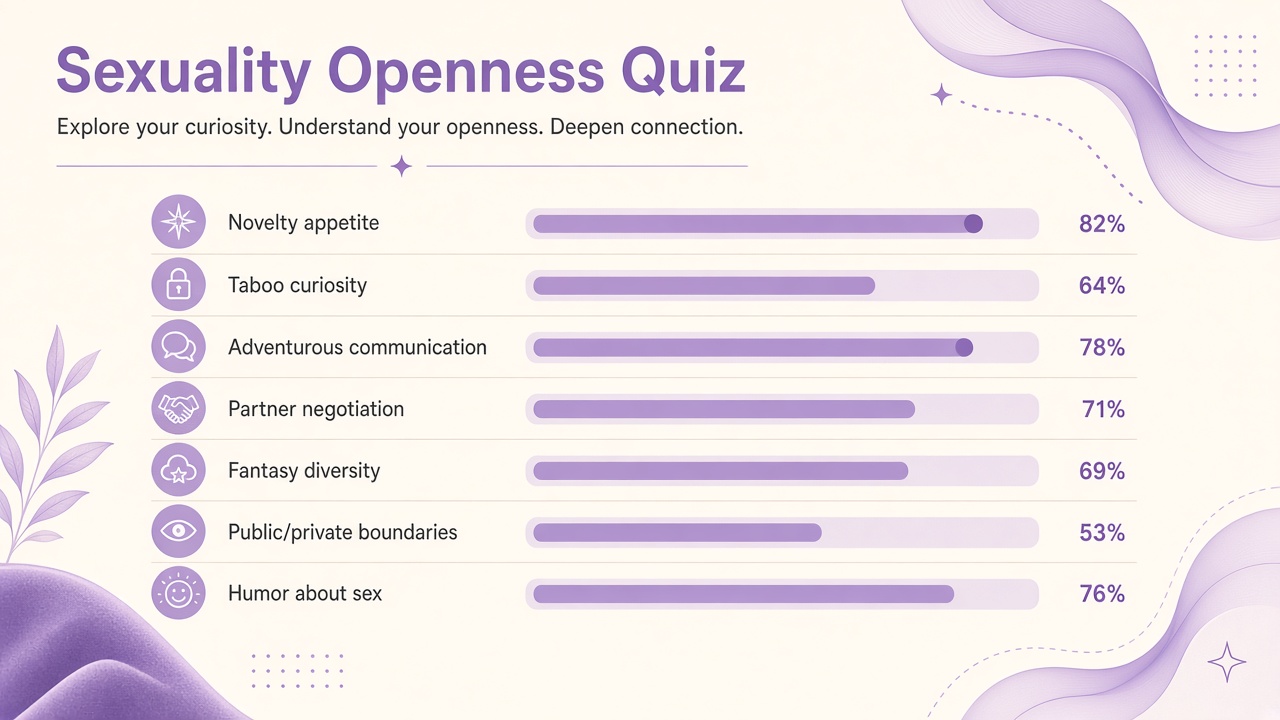
Your overall freakiness score is the average of seven domain percentages, each normalized to 0 through 100. The band groups that average into plain-language reflection signals. Domain bars show whether novelty appetite, taboo curiosity, adventurous communication, partner negotiation comfort, fantasy diversity, boundary play, or humor about sex drive your result. Flags highlight negotiation comfort, novelty drive, taboo curiosity, and humor comfort patterns.
| Openness band | Score range | Typical reading |
|---|---|---|
| Mildly Conventional | 0 to 25% | Lower curiosity on these items; conventional is valid and not a deficit |
| Playfully Curious | 26 to 50% | Mixed domain scores worth sitting with at your own pace |
| Quite Freaky | 51 to 75% | Moderate openness across several unconventional theme domains |
| Wildly Adventurous | 76 to 100% | Strong openness; still requires negotiation and enthusiastic consent |
Seven openness domains
The diagram below shows how domain scores appear in your results. High negotiation comfort with moderate novelty scores, for example, can still matter even if your overall average sits in a lower band.
What this quiz can and cannot tell you
Can tell you
- Whether your self-reported patterns lean conventional, curious, moderate, or adventurous on this screener
- Seven domain scores for novelty, taboo, communication, negotiation, fantasy, boundary play, and humor
- Negotiation comfort, novelty drive, taboo curiosity, and humor comfort flags for reflection
- A starting point for honest conversations with a trusted partner
Cannot tell you
- Whether you must try freakier things, adopt a label, or change your relationship structure
- What any partner wants, owes, or should accept without negotiation
- Official clinical scores comparable to published research norms
- Whether conventional or adventurous makes you better, cooler, or more experienced
Openness, consent, and how this freakiness screener fits
Sexual openness sits on a wide spectrum. Some adults prefer familiar intimacy and never feel drawn to taboo themes, boundary play, or sexual humor. Others enjoy reading, fantasizing, or practicing unconventional elements with enthusiastic partners. Sex researchers and consent educators emphasize that interest alone does not create obligation. What matters is honest communication, negotiated limits, and respect for every partner's boundaries. The Quiz Hub built this how freaky are you quiz as a playful, non-graphic screener across seven domains with four result bands and explicit reminders that conventional is not shameful.
The National Coalition for Sexual Freedom promotes consent-forward education for adults exploring unconventional intimacy. That framing shaped our items: boundary play questions mention privacy and consent, taboo curiosity stays non-graphic, and negotiation items score as positively as novelty items. This trade-off favors readable self-reflection for casual users while naming limits honestly. Pair results with our how kinky are you quiz when you want broader kink theme reflection. Our BDSM test adds dominant, submissive, or switch role profiles. A dirty mind test is planned for fantasy and innuendo curiosity.
| The Quiz Hub test | What it adds |
|---|---|
| How kinky are you quiz | Broader kink theme openness across power exchange, sensation play, and roleplay, not taboo curiosity or sexual humor |
| BDSM test | Dominant, submissive, switch, and related role profiles, not playful freakiness bands |
| Fetish test | Specific fetish theme curiosity, not general openness bands |
| Bondage test | Restraint and rope interest focus with receiver and rigger lean, not full seven-domain map |
| This how freaky are you quiz | Novelty appetite, taboo curiosity, adventurous communication, partner negotiation, fantasy diversity, boundary play, and humor about sex with four consent-centered bands |
Sample item: agreeing that you get excited when a partner suggests trying something new raises your novelty appetite domain score. Agreeing that you feel comfortable negotiating limits raises partner negotiation comfort. Pair results with our how kinky are you quiz or browse more quizzes on our kink and BDSM hub. Read how we review adult content in our editorial policy.
How freaky are you quiz FAQ
What does this how freaky are you quiz measure?
This openness screener measures self-reported curiosity about unconventional sexual themes across seven domains: novelty appetite, taboo curiosity, adventurous communication, partner negotiation comfort, fantasy diversity, public and private boundary play, and humor about sex. Twenty-two agree-disagree items produce an overall freakiness score, seven domain bars, negotiation comfort flags, and one of four bands. It is not graphic, not diagnostic, and not a certificate of identity.
Does a high score mean I have to try freakier things?
No. Higher bands mean your answers suggest more curiosity or openness on these items. Fantasy interest can exceed real-world practice. Conventional is a valid choice at every score level. Only you decide what to explore with an enthusiastic partner.
How is this quiz different from a how kinky are you quiz?
This quiz focuses on playful openness to unconventional themes, taboo curiosity, sexual humor, and boundary play framing. Our how kinky are you quiz screens broader kink theme domains like power exchange and sensation play. Pair both for a wider reflection map. Our BDSM test adds role profiles. A dirty mind test is planned.
Is conventional bad on this quiz?
No. Mildly conventional results are not shameful or boring. The quiz treats lower openness as a valid preference, not a deficit. Communication and negotiation skills matter at every band.
How long does the how freaky are you quiz take?
Most people finish in about six minutes. There are 22 agree-disagree items on a five-point scale. You can pause and return in the same browser session thanks to autosave.
Who reviewed this content?
Dr. Morgan Chen, PhD, reviewed the test framing and result explanations. See our editorial policy for review standards.
Reviewed by