What this best friend or boyfriend quiz measures
This best friend or boyfriend quiz estimates how often platonic comfort and romantic pull compete when you think about one close person. Twenty original frequency items group into four pull domains inspired by friendship-to-romance research from Beverley Fehr (1996) on friendship rules and Elaine Hatfield and Ellen Berscheid (1969) on passionate versus companionate love: romantic pull signals, platonic comfort framing, boundary blur, and future vision tension. Each item also maps to a fear-of-intimacy stack layer so you can see whether vulnerability pull-back, trust hesitation, self-disclosure limits, or closeness anxiety feels strongest. Your romantic pull index averages these patterns into a 0 to 100 score with plain-language bands.
Romantic pull signals
Butterflies, crush-like excitement, jealousy when they date, and replaying whether attraction is real.
Platonic comfort framing
Sibling-like ease, relief when romance is off the table, and seeing them as family rather than a partner.
Boundary blur
Couple rituals, cuddling ambiguity, pet names, and acting like partners without a dating label.
Future vision tension
Imagining them as a boyfriend, fearing confession, and wondering whether dating would ruin the bond.
How it works
Three steps from first question to your platonic vs romantic pull report with fear-of-intimacy stack. Click Start Quiz to open the interactive quiz in a full-screen modal.
Answer 20 frequency items
Rate how often each pull pattern shows up when you think about this person, from Never to Almost always. You click Next after each answer; nothing auto-advances.
Items map to pull domains and intimacy stack
Your answers accumulate percentages for romantic pull, platonic comfort, boundary blur, and future vision tension, plus four fear-of-intimacy stack layers.
View band and dual charts
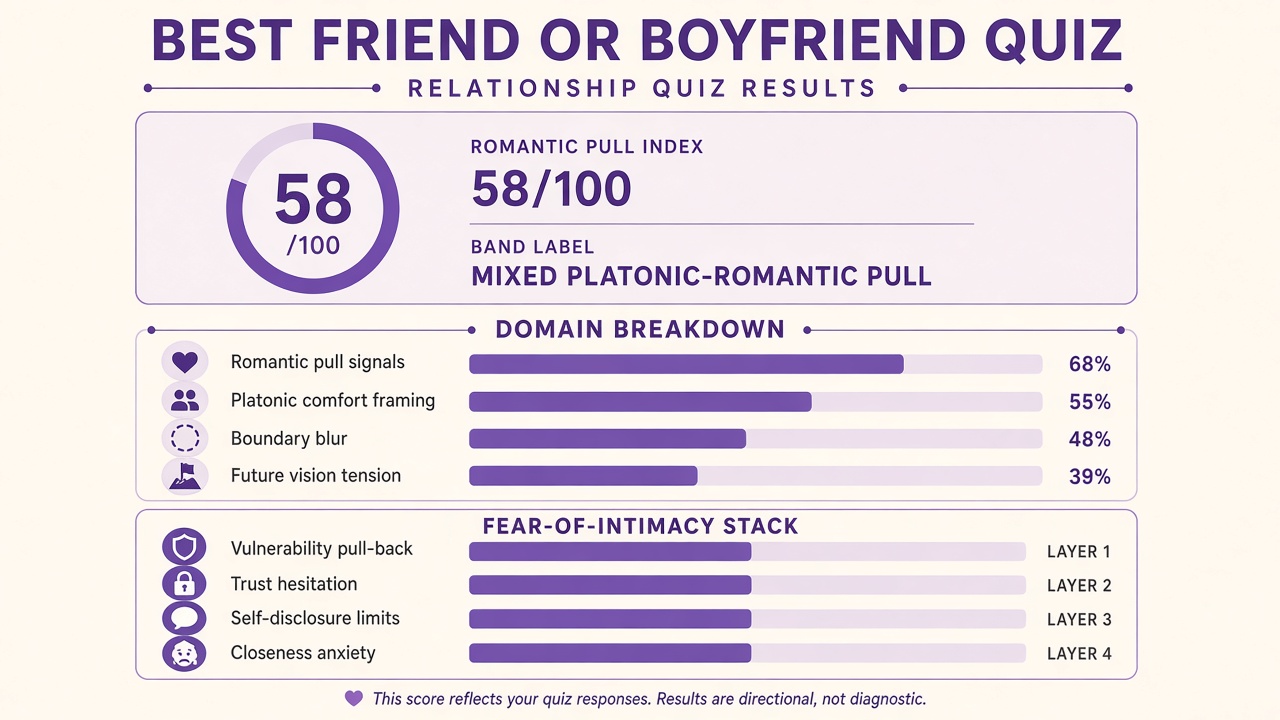
Results show Stronger Platonic Pull, Mixed Platonic-Romantic Pull, or Stronger Romantic Pull with pull domain bars and a fear-of-intimacy stack chart for reflection.
Take the best friend or boyfriend quiz
Rate 20 statements about platonic comfort versus romantic pull with this person. Your answers produce a romantic pull index from 0 to 100, a fear-of-intimacy stack index, four domain scores, and a band label for reflection or therapy conversation.
Opens in a focused modal. No account required. Results stay on screen.
What your romantic pull index means
Your romantic pull index is the normalized total across all 20 items on a 0 to 100 scale, with reverse scoring on platonic comfort items so higher scores mean stronger romantic boyfriend pull overall. The fear-of-intimacy stack index uses the same answers mapped to vulnerability, trust, disclosure, and closeness anxiety layers. Domain bars show endorsement rates so you can see whether butterflies and jealousy, sibling-like ease, couple habits, or partner vision drives your result most.
| Band | Index range | Typical reading |
|---|---|---|
| Stronger Platonic Pull | 0 to 35 | More best-friend comfort than romantic boyfriend pull on this screener |
| Mixed Platonic-Romantic Pull | 36 to 65 | Blend of deep friendship and romantic curiosity; worth naming if persistent |
| Stronger Romantic Pull | 66 to 100 | Frequent dating curiosity, jealousy, boundary blur, or partner vision with this person |
What your platonic vs romantic pull report looks like
After all 20 items, you get a romantic pull index from 0 to 100, a band label, four pull domain bars, and a fear-of-intimacy stack chart with vulnerability pull-back, trust hesitation, self-disclosure limits, and closeness anxiety layers. Percentages reflect how you experience the bond, not a verdict about whether you should date.
What this quiz can and cannot tell you
Can tell you
- How often romantic pull versus platonic comfort patterns showed up for you with this person
- A romantic pull index and fear-of-intimacy stack index with domain bars
- Which pull domain or intimacy stack layer feels strongest in your current experience
- A starting point for therapy conversation about feelings, labels, and fear of losing the friendship
Cannot tell you
- Whether they feel the same without their side of the story
- Whether you should confess, stay friends, or date without your own judgment
- Whether you have an attachment disorder or any clinical diagnosis
- What outcome confession will have without honest dialogue and trusted guidance
Friendship, romance, and the fear-of-intimacy stack
Psychologist Beverley Fehr (1996) described friendship as a voluntary bond built on mutual affection, trust, and reciprocity. Researchers Elaine Hatfield and Ellen Berscheid (1969) distinguished passionate attraction from companionate warmth, a split many people feel when a best friend also sparks dating curiosity. When couple rituals creep in, jealousy spikes during their dates, or you picture them meeting your family as a partner, the question is less about loyalty and more about which pull feels honest today.
The Quiz Hub built this best friend or boyfriend quiz as an original self-report screener inspired by those themes, not a reproduction of any single published scale. Readers often compare it to sibling tools on this site. Our do I have a crush on my friend quiz screens attraction spikes and boundary cues with a shorter item set. The am I in the friend zone quiz covers one-sided romantic mismatch when you want more than friendship. The are we friends quiz measures reciprocity and label ambiguity rather than your own romantic pull.
| The Quiz Hub test | What it adds |
|---|---|
| Do I have a crush on my friend quiz | Attraction and boundary cue index without four-domain pull breakdown |
| Am I in the friend zone quiz | One-sided romantic mismatch index: crush signals, partner talk, waiting hope |
| Are we friends quiz | Friendship clarity index: reciprocity, emotional mutuality, social recognition |
| Friends with benefits quiz | FWB clarity index: rules ambiguity, emotional crossover, exclusivity mismatch |
| Fear of intimacy quiz | FOIS-inspired avoidance index without platonic vs romantic pull domains |
| This best friend or boyfriend quiz | Romantic pull index 0 to 100 plus parallel fear-of-intimacy stack layers |
Sample item types include frequency ratings such as whether you feel jealous when they talk about someone they are dating, or whether you slip into couple rituals like good-night calls without a label. High boundary blur with high future vision tension often lands in Mixed or Stronger Romantic Pull bands. New partners, long distance, or major life changes can shift scores temporarily. Read how we review quizzes in our editorial policy or browse more tools on our relationships and dating hub.
Best friend or boyfriend quiz FAQ
What does the best friend or boyfriend quiz measure?
Twenty original frequency items ask how often romantic pull, platonic comfort, boundary blur, and future-as-partner vision show up when you think about one close person. Scores map to four pull domains plus a parallel fear-of-intimacy stack with vulnerability pull-back, trust hesitation, self-disclosure limits, and closeness anxiety layers. You receive a romantic pull index from 0 to 100 where higher scores mean stronger romantic boyfriend pull relative to platonic best-friend comfort on this screener, plus a band from Stronger Platonic Pull through Stronger Romantic Pull.
What is the romantic pull index?
The romantic pull index is a 0 to 100 score that averages your answers across all 20 items, with reverse scoring on platonic comfort items so higher totals mean more romantic pull signals overall. Lower bands suggest stronger best-friend framing. Mid bands reflect mixed feelings. Higher bands suggest frequent dating curiosity, jealousy, couple-like habits, or partner vision with this person.
What is the fear-of-intimacy stack on this quiz?
The fear-of-intimacy stack is a second results chart inspired by FOIS-style intimacy avoidance themes, adapted to best-friend versus boyfriend tension. Each of the 20 items also maps to one of four stack layers. The stack index summarizes how often you dodge feel talks, assume confession will end the friendship, edit romantic hope, or panic when connection feels couple-like.
How is this different from the am I in the friend zone quiz?
The am I in the friend zone quiz screens one-sided romantic mismatch when you want more than friendship but they may not. This best friend or boyfriend quiz measures your own pull toward platonic friendship versus romantic partnership with someone you already trust deeply, regardless of whether they are unavailable. It adds a fear-of-intimacy stack chart that the friend zone quiz does not include.
Can this quiz tell me whether we should date?
No. The romantic pull index describes self-reported pattern signals on this abbreviated screener. Deep platonic bonds can score in any band. Cultural differences, timing, or fear of change can raise scores without a clear answer. Only you plus honest dialogue can decide whether dating is worth the risk.
Who reviewed this content?
Dr. James Whitfield, PhD, reviewed the test framing and result explanations. See our editorial policy for review standards.
Reviewed by