What this attachment style quiz measures
This attachment style quiz estimates how often four adult attachment patterns show up when you think about romantic or close bonds. Twenty-four original frequency items group into secure, avoidant, anxious, and disorganized style indices from 0 to 100, with six questions per style. Each item also maps to a fear-of-intimacy stack layer so you can see whether vulnerability pull-back, trust hesitation, self-disclosure limits, or closeness anxiety rides alongside your primary style match.
Secure attachment
Comfort asking for comfort, repairing after conflict, and trusting that closeness will not erase your identity.
Avoidant attachment
Preferring solo problem-solving, feeling crowded by closeness, and editing needs to stay self-reliant.
Anxious attachment
Replaying conversations, scanning for fading interest, and seeking reassurance when a partner needs space.
Disorganized attachment
Wanting closeness one day and feeling trapped the next, especially after betrayal or chaotic bonds.
How it works
Three steps from first question to your attachment style report. Click Start Quiz to open the interactive quiz in a full-screen modal.
Answer 24 frequency items
Rate how often each closeness pattern shows up in romantic or close relationships, from Never to Very often. You click Next after each answer; nothing auto-advances.
Items map to four styles plus intimacy stack
Your answers accumulate style indices for secure, avoidant, anxious, and disorganized patterns, plus four fear-of-intimacy stack layers on parallel scoring.
View primary style and stack chart
Results show your strongest style match, secondary influence, four style bars, and a fear-of-intimacy stack index with layer breakdown.
Take the attachment style quiz
Rate 24 statements about closeness, trust, reassurance, and push-pull patterns. Your answers produce four attachment style indices from 0 to 100, a primary style match, and a fear-of-intimacy stack chart for reflection or therapy conversation.
Opens in a focused modal. No account required. Results stay on screen.
What your result means
Each attachment style index is the normalized total across its six items on a 0 to 100 scale, with reverse scoring on secure items so higher secure scores mean more secure-pattern endorsement. Your primary style is whichever index ranks highest; a secondary influence appears when the runner-up is close. The fear-of-intimacy stack index averages all 24 items on parallel intimacy-avoidance layers so you can see whether guarded closeness habits amplify your style result.
| Style index | Score range | Typical reading |
|---|---|---|
| Lower style match | 0 to 35 | Fewer items endorsed for that style on this screener; another style may rank higher |
| Moderate style match | 36 to 65 | Blend of that style with others; read secondary influence if scores are close |
| Higher style match | 66 to 100 | Frequent endorsement of that style's closeness habits; useful starting point for therapy or retakes |
What your attachment style report looks like
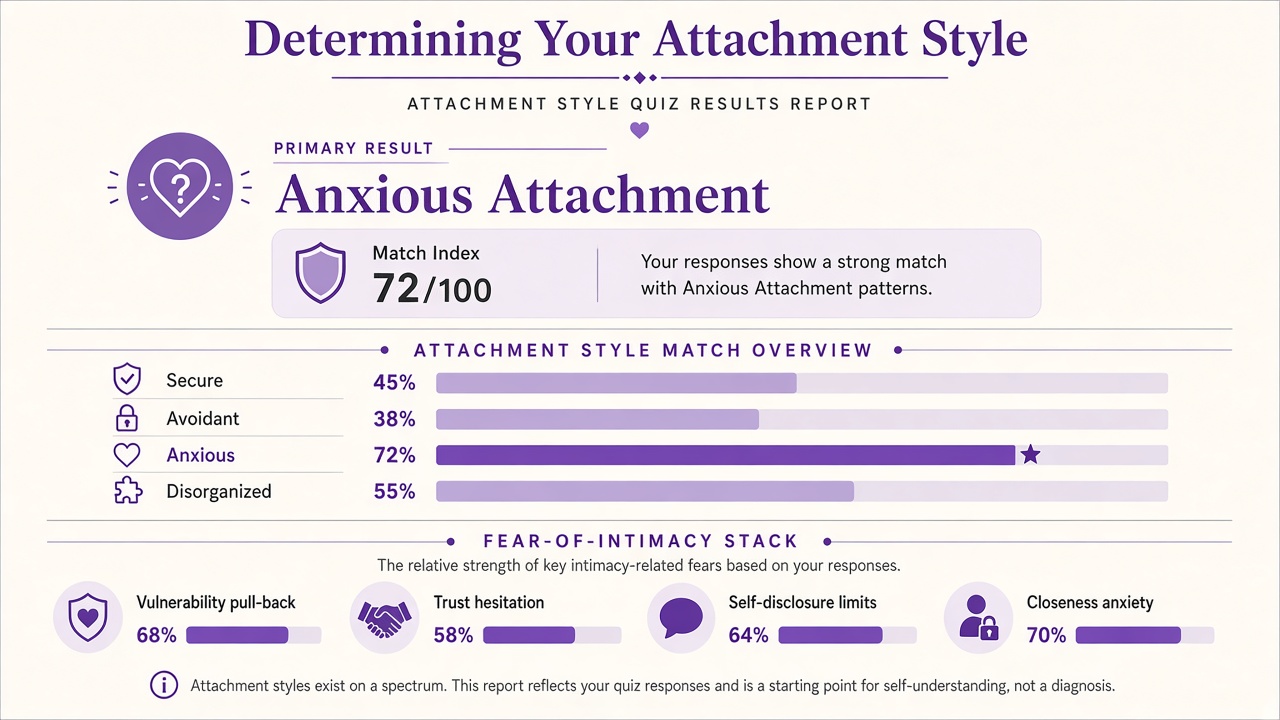
After all 24 items, you get a primary style match index from 0 to 100, a secondary influence label, four attachment style bars (secure, avoidant, anxious, disorganized), and a fear-of-intimacy stack chart with vulnerability pull-back, trust hesitation, self-disclosure limits, and closeness anxiety layers. Percentages reflect how you handle closeness, not a clinical verdict.
What this quiz can and cannot tell you
Can tell you
- How often secure, avoidant, anxious, or disorganized patterns showed up for you
- Four style indices from 0 to 100 plus a primary match and secondary influence
- A fear-of-intimacy stack chart showing which guarded closeness layer feels strongest
- A starting point for therapy conversation or retaking after a major relationship shift
Cannot tell you
- Whether you have an attachment disorder or any clinical diagnosis
- Whether your partner shares your style without their own honest input
- Whether your relationship can improve without mutual effort and support
- What treatment you need without a licensed clinician's evaluation
Adult attachment styles, ECR, and the intimacy stack
Psychologists Cindy Hazan and Phillip Shaver published adult attachment style research in 1987, extending Mary Ainsworth's infant attachment categories into romantic bonds. Later work by Brennan, Clark, and Shaver (1998) produced the Experiences in Close Relationships (ECR) scales measuring attachment anxiety and avoidance as continuous dimensions. Main and Solomon (1986) described disorganized attachment in children; adult research links fearful-avoidant patterns to unresolved loss or betrayal in close relationships.
The Quiz Hub built this attachment style quiz as an original self-report screener inspired by those frameworks, not a reproduction of the ECR-R or any published clinical instrument. Readers often compare it to sibling tools on this site. Our attachment style test screens anxiety and avoidance on two dimensions with a four-quadrant label. The fear of intimacy quiz measures intimacy avoidance frequency with FOIS-inspired domains. The Diane Poole Heller attachment quiz matches four named styles with repair-focused profiles.
| The Quiz Hub test | What it adds |
|---|---|
| Attachment style test | ECR-inspired anxiety and avoidance dimensions, not four named style indices plus intimacy stack |
| Fear of intimacy quiz | FOIS-inspired intimacy avoidance index, not four attachment style match scores |
| Diane Poole Heller attachment quiz | Repair-focused style profiles without parallel fear-of-intimacy stack chart |
| Relationship anxiety quiz | Reassurance seeking and jealousy scan worry, not full four-style scoring |
| Abandonment issues quiz | Abandonment fear index, not secure versus avoidant style match |
| This attachment style quiz | Four style indices 0 to 100 plus fear-of-intimacy stack for guarded closeness layers |
Sample item types include frequency ratings such as whether you trust that conflict can be repaired without the relationship ending, or whether you replay conversations to check whether your partner still cares. High anxious scores with high closeness anxiety on the stack often land together when reassurance hunger pairs with intimacy fear. Past betrayal, new relationships, and major stress can shift scores temporarily. Read how we review quizzes in our editorial policy or browse more tools on our personality psychology hub.
Attachment style quiz FAQ
What are the four attachment styles?
Adult attachment research commonly describes four patterns: secure (comfort with closeness and independence), avoidant (self-reliance and distance when intimacy feels pressured), anxious (strong investment with reassurance hunger), and disorganized or fearful-avoidant (push-pull closeness after hurt or chaos). This quiz scores each style from 0 to 100 on original frequency items. It is not a clinical assessment.
What does this attachment style quiz measure?
Twenty-four original frequency items ask how often secure, avoidant, anxious, and disorganized patterns show up in romantic or close relationships. Each item also maps to a fear-of-intimacy stack layer inspired by FOIS themes. You receive four style indices from 0 to 100, a primary style match, secondary influence, and a fear-of-intimacy stack chart.
What is the fear-of-intimacy stack on this quiz?
The fear-of-intimacy stack is a second results chart with four layers: vulnerability pull-back, trust hesitation, self-disclosure limits, and closeness anxiety. Each of the 24 items maps to one attachment style and one stack layer. The stack index summarizes how often guarded closeness habits appear alongside your primary style match.
How is this different from the attachment style test?
The attachment style test screens anxiety and avoidance on two ECR-inspired dimensions with a four-quadrant label. This quiz scores four named styles (secure, avoidant, anxious, disorganized) with six items each and adds a fear-of-intimacy stack chart. It uses relationship frequency wording rather than broad trait agreement items.
Can this quiz diagnose an attachment disorder?
No. Style indices describe self-reported closeness patterns on this abbreviated screener. Only a licensed clinician can evaluate attachment concerns through structured interviews. Online quizzes cannot confirm or deny a diagnosis.
Who reviewed this content?
Dr. James Whitfield, PhD, reviewed the test framing and result explanations. See our editorial policy for review standards.
Reviewed by