What this Tourette syndrome test measures
This Tourette syndrome test estimates how often you experience tic-related symptoms over the past month. It groups 21 self-report items into three domains that mirror motor movements, vocal sounds, and daily-life impact used in clinical tic assessment without using the full published Yale Global Tic Severity Scale.
Motor tics
Sudden body movements such as blinking, head jerks, facial grimacing, touching, and whole-body tensing that feel hard to stop.
Vocal tics
Involuntary sounds or utterances such as throat clearing, grunting, echolalia, and blurted words that appear without planning.
Functional impairment
Social embarrassment, avoidance, concentration loss, sleep disruption, and time lost when tics interfere with routines.
One-month recall window
Items ask about frequency over the past month, matching the recall period clinicians often use when tracking tic severity over time.
How it works
Three steps from first question to your screening band. Click Start Test to open the interactive quiz in a full-screen modal.
Answer 21 frequency items
Rate each statement from Never to Very often. There is no timer and no auto-advance between items.
Items map to three domains
Your answers accumulate percentages for motor tics, vocal tics, and functional impairment based on seven items per domain.
View screening band and next steps
Results show a Lower, Moderate, or Elevated screening signal with domain bars, highlights, and professional referral guidance when appropriate.
Take the Tourette syndrome test
Rate 21 tic-related statements on a five-point frequency scale. Your answers produce an overall screening percentage, three domain scores, and plain-language next steps.
Opens in a focused modal. No account required. Results stay on screen.
What your result means
Your overall screening percentage is the average of motor tic, vocal tic, and impairment domain scores, each normalized to 0 through 100. The band groups that average into plain-language screening signals. Domain bars show whether movements, sounds, or daily impact drive your result.
| Screening band | Score range | Typical reading |
|---|---|---|
| Lower Screening Signal | 0 to 35% | Fewer frequent symptoms; occasional fidgeting or throat clearing may still occur |
| Moderate Screening Signal | 36 to 55% | Some frequent symptoms worth monitoring, especially if suppression feels exhausting |
| Elevated Screening Signal | 56 to 100% | Frequent symptoms that may warrant professional tic disorder evaluation |
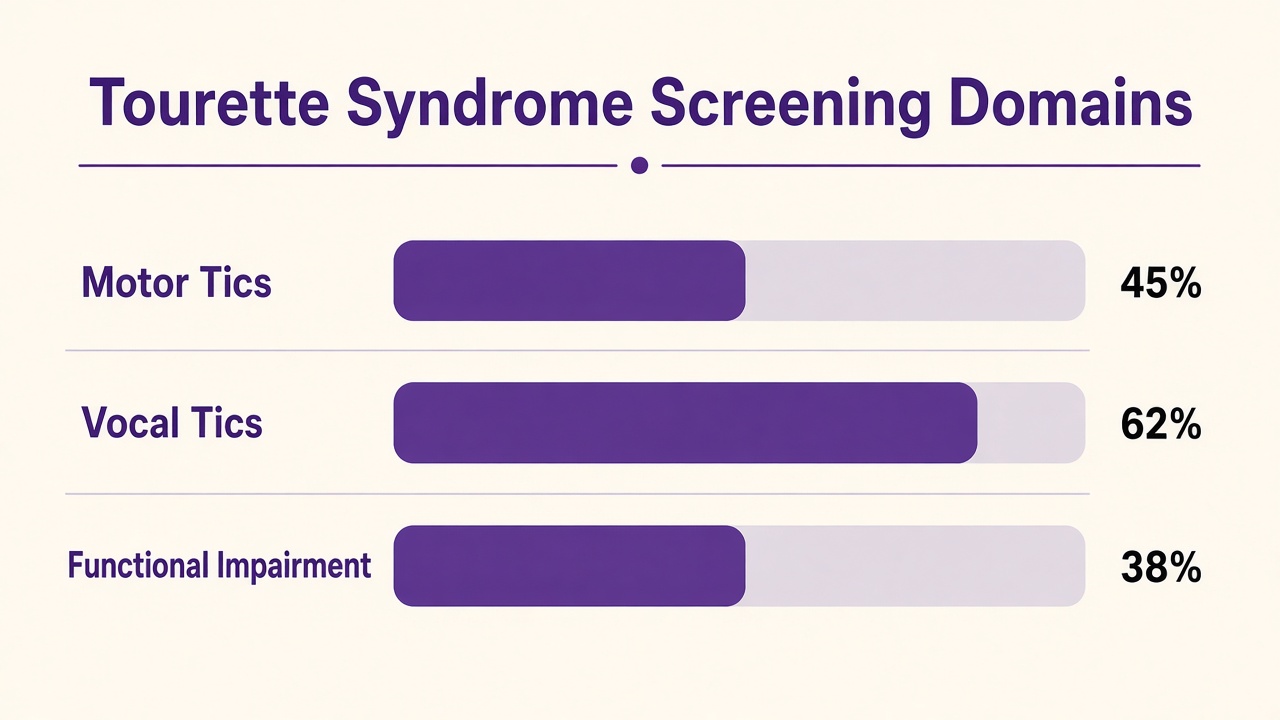
Motor, vocal, and impairment domains
The diagram below shows how domain scores appear in your results. A high motor tic score with moderate vocal tics might still land you in Moderate if your overall average sits between bands.
What this test can and cannot tell you
Can tell you
- Whether your self-reported symptoms lean mild, moderate, or frequent on this screener
- A screening percentage and three domain scores for motor tics, vocal tics, and impairment
- Which domain scores highest when symptoms are uneven
- A starting point for conversations with a clinician about tic disorder evaluation
Cannot tell you
- Whether you have Tourette syndrome, persistent tic disorder, or any other clinical condition
- Official YGTSS scores comparable to published research norms
- Whether you need CBIT therapy, medication, or school accommodations
- Symptom duration or tic-free intervals required for formal diagnosis
YGTSS and tic disorder screening research
In 1989, James Leckman and colleagues published the Yale Global Tic Severity Scale (YGTSS), a clinician-rated instrument for measuring tic number, frequency, intensity, complexity, and impairment. The scale separates motor and phonic tic severity and adds a functional impairment score. It remains widely used in research and specialty clinics when tracking tic disorder treatment response over time.
The Quiz Hub built this Tourette syndrome test as an abbreviated, plain-language screener inspired by YGTSS themes. It uses 21 original items grouped into motor tics, vocal tics, and impairment domains rather than the full clinician-rated structure. That trade-off favors readability for casual users while naming the Leckman et al. source honestly. The Tourette Association of America notes that tic disorders affect roughly 1 in 100 school-age children and that behavioral intervention for tics (CBIT) is an effective first-line treatment for many patients.
| The Quiz Hub test | What it adds |
|---|---|
| OCD test | Obsession and compulsion domain scores, not sudden tic movements or vocal tics |
| ADHD test | Inattention and hyperactivity domain scores, not premonitory tic urges |
| Autism test | Social communication and sensory patterns, not motor and vocal tic frequency |
| This Tourette syndrome test | Motor tic, vocal tic, and impairment domain scores with three-band screening signal |
Sample item: rating Often on jerking your head or shoulders raises your motor tic domain score. Rating Very often on avoiding social situations because others notice your sounds raises impairment. ADHD fidgeting, OCD rituals, and autism-related stimming can overlap with tic patterns, so clinicians rule out other causes during evaluation. Browse more screeners on our mental health and clinical hub or read how we review quizzes in our editorial policy.
Tourette syndrome test FAQ
What does this Tourette syndrome test measure?
This Tourette syndrome test measures self-reported frequency of motor tics, vocal tics, and functional impairment over the past month. Twenty-one items cover sudden movements, throat clearing, blurted sounds, social embarrassment, and daily disruption. Results show a screening band and three domain scores. It is not a clinical diagnosis.
Does an elevated screening result mean I have Tourette syndrome?
No. An elevated screening signal means your responses suggest frequent tic-related symptoms on this abbreviated screener. Only a licensed clinician can evaluate Tourette syndrome or persistent tic disorder through structured interviews and clinical assessment. Online tests cannot confirm or deny a diagnosis.
How is this related to the Yale Global Tic Severity Scale?
The Yale Global Tic Severity Scale (YGTSS) is a clinician-rated instrument developed by Leckman and colleagues for measuring tic number, frequency, intensity, complexity, and impairment. Our online screener uses 21 original plain-language items inspired by YGTSS themes, grouped into motor tics, vocal tics, and impairment domains with a one-month recall window. It is not the published YGTSS and is not validated for research or clinical use.
Can ADHD or OCD look like Tourette syndrome on a screener?
Yes. ADHD can involve fidgeting and impulsive vocalizations. OCD can involve repetitive movements or sounds driven by anxiety rather than premonitory urges. Autism-related stimming and anxiety-linked throat clearing also overlap with tic items. Clinicians rule out other causes during evaluation, which is why screening signals are starting points, not verdicts.
What should I do if I get an elevated screening signal?
Consider scheduling an evaluation with a neurologist, psychiatrist, or tic disorder specialist. Bring your result summary and describe when symptoms began, how they change across settings, and how much time suppression or recovery takes each day. Evidence-based treatments such as behavioral intervention for tics (CBIT) exist for tic disorders.
How long does the Tourette syndrome test take?
Most people finish in about 5 minutes. There are 21 items on a five-point frequency scale from Never to Very often. You can pause and return in the same browser session thanks to autosave.
Who reviewed this content?
Dr. Elena Vasquez, PhD, reviewed the test framing and result explanations. See our editorial policy for review standards.
Reviewed by