What this analog clock quiz measures
This analog clock quiz estimates how confidently you read wall-clock faces for hour, minute, AM/PM, and elapsed time tasks. Twenty original agree-disagree items follow skills taught in elementary time curricula and occupational therapy exercises for temporal reasoning. Each item maps to a fear-of-intimacy stack layer. A second results chart inspired by FOIS-style intimacy avoidance themes from Descutner and Thelen (1991), adapted to this topic. Your analog time-reading index averages these patterns into a 0 to 100 score.
Hour hand reading
Short-hand hour judgment including between-number positions.
Minute hand reading
Five-minute steps, quarter hours, and exact minute translation.
AM/PM judgment
Morning-evening context, noon/midnight, and planner use.
Elapsed time intervals
Duration between clock faces and crossing-the-hour problems.
How it works
Answer 20 agree-disagree items
Rate each agree-disagree statement from Strongly disagree to Strongly agree. You click Next after each answer.
Items map to domains and intimacy stack
Answers accumulate percentages for four primary domains plus four fear-of-intimacy stack layers.
View index, band, and charts
Results show Lower, Mixed, or Higher signal bands with domain bars and stack chart.
Take the analog clock quiz
Complete 20 items to receive your analog time-reading index, four domain bars, and fear-of-intimacy stack chart.
What your result means
Your analog time-reading index is normalized across all 20 items on a 0 to 100 scale. Domain bars show whether hour reading, minute increments, AM/PM judgment, or elapsed time drives your result most.
| Band | Index range | Typical reading |
|---|---|---|
| Lower Analog Time-Reading | 0 to 35 | Fewer endorsed knowledge items; gaps in analog clock recall are common without recent study |
| Mixed Analog Time-Reading | 36 to 65 | Blend of solid recall and fuzzy spots worth targeting before an exam |
| Higher Analog Time-Reading | 66 to 100 | Steady recall across domains; still not a substitute for proctored exams |
What your report looks like
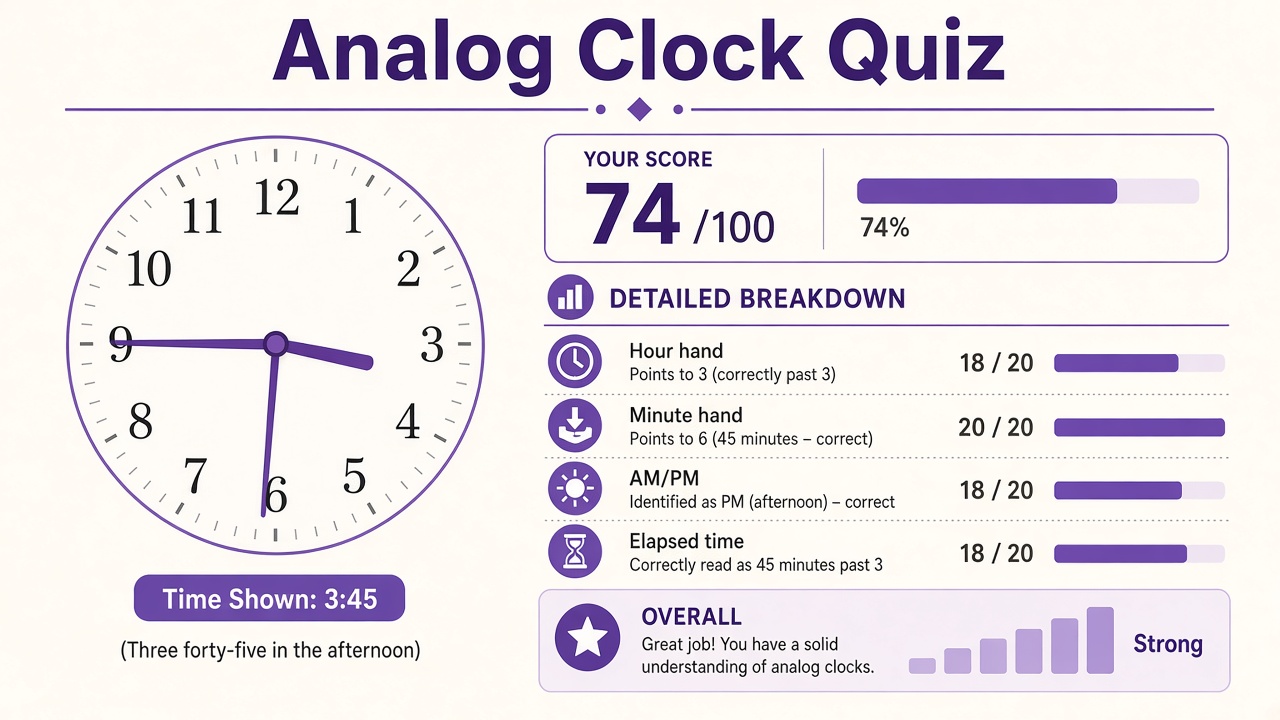
What this quiz can and cannot tell you
Can tell you
- How confidently you report analog clock skills on this screener
- An analog time-reading index with four domain bars plus intimacy stack
- Which time skill to practice with children or in daily scheduling
Cannot tell you
- Clinical diagnosis of dyscalculia or visual-spatial disorders
- Workplace time-management certification
- IQ score or general intelligence measurement
Analog clock skills, digital habits, and cognitive practice
Many classrooms still teach analog clocks because reading hands builds number-line and fraction thinking (quarter and half hours). Adults who grew up with smartphones may feel rusty on wall clocks even when daily scheduling works fine digitally. The Quiz Hub built this agree-disagree screener with index scoring rather than copying worksheet images from textbook publishers.
Pair with our am I good at math quiz for broader number confidence or cognitive reflection test for logic-trap skills on the IQ hub.
| Test | Focus |
|---|---|
| Am I good at math quiz | Math anxiety and fluency rather than clock faces |
| Cognitive reflection test | Logic traps rather than time reading |
| Shortest IQ test | Puzzle traps rather than temporal reasoning self-report |
Analog Clock Quiz FAQ
What does the analog clock quiz measure?
Twenty agree-disagree items on hour hand reading, minute increments, AM/PM judgment, and elapsed time with an analog time-reading index from 0 to 100 plus fear-of-intimacy stack bars.
Is this a dyscalculia test?
No. It is a self-report screener on clock-reading confidence, not a clinical diagnostic battery.
Why use agree-disagree items instead of clock pictures?
Items describe real-world clock habits and confidence patterns that correlate with practice needs. Picture drills remain useful alongside this index snapshot.
Can teachers use this with students?
Teachers may use it as a conversation starter with teens or adults. It is not normed for young children and cannot replace curriculum assessments.
How is this different from the math confidence quiz?
The math quiz targets arithmetic fluency and anxiety. This quiz focuses specifically on analog time-reading domains.
Who reviewed this content?
Dr. James Whitfield, PhD, reviewed the test framing and result explanations. See our editorial policy for review standards.
Reviewed by