What this math confidence quiz measures
This am I good at math quiz estimates how much arithmetic fluency, problem solving comfort, math anxiety, and academic performance confidence you report in everyday life. Twenty original agree-disagree items group into four domains inspired by Albert Bandura self-efficacy research (1977, 1997) and Elizabeth Hembree math anxiety themes (1990): arithmetic fluency, problem solving, math anxiety, and academic performance. Each item also maps to a fear-of-intimacy stack layer so you can see whether vulnerability pull-back, trust hesitation, self-disclosure limits, or closeness anxiety pairs with math guarding. Your math confidence index averages these patterns into a 0 to 100 score where higher numbers mean more confidence on this screener.
Arithmetic fluency
Mental math ease, tip and discount trust, and everyday number tasks without dread.
Problem solving
Multi-step puzzles, charts and data comfort, and practical conversion problems.
Math anxiety
Blanking under pressure, avoidance of math-heavy roles, and worry about being judged.
Academic performance
Past grades, classroom voice, growth mindset, and feedback from teachers or managers.
How it works
Three steps from first question to your math confidence report with fear-of-intimacy stack. Click Start Quiz to open the interactive quiz in a full-screen modal.
Answer 20 agree-disagree items
Rate each statement from Strongly disagree to Strongly agree. You click Next after each answer; nothing auto-advances.
Items map to math domains and intimacy stack
Your answers accumulate percentages for arithmetic fluency, problem solving, math anxiety, and academic performance, plus four fear-of-intimacy stack layers.
View band and dual charts
Results show Lower, Mixed, or Higher Math Confidence with domain bars and a fear-of-intimacy stack chart. Higher index means more self-reported math confidence on this screener.
Take the am I good at math quiz
Rate 20 statements about mental math ease, multi-step problems, anxiety under scrutiny, and whether past grades define you. Your answers produce a math confidence index from 0 to 100, a fear-of-intimacy stack index, four domain scores, and a band label for reflection or tutor conversation.
Opens in a focused modal. No account required. Results stay on screen.
What your math confidence result means
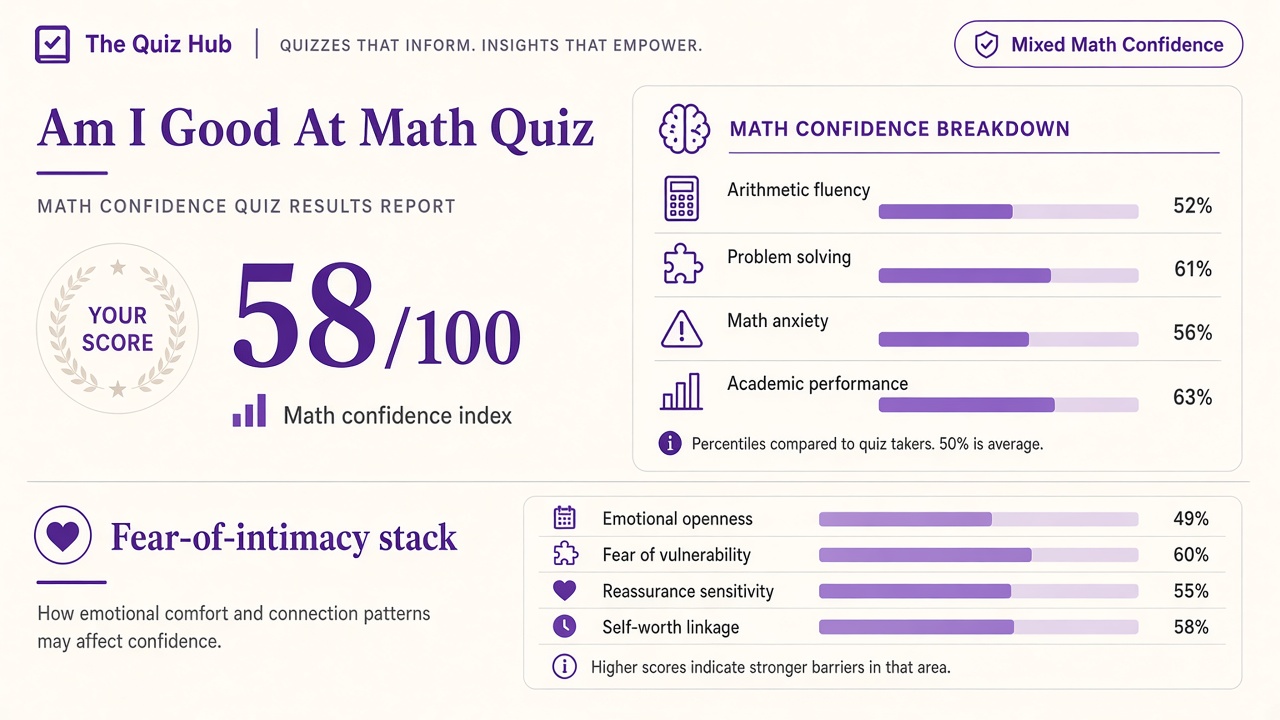
Your math confidence index is the normalized total across all 20 items on a 0 to 100 scale, with reverse scoring on anxiety and avoidance items so higher scores mean more confidence overall. The fear-of-intimacy stack index uses the same answers mapped to vulnerability, trust, disclosure, and closeness anxiety layers where higher stack scores mean more guarding patterns. Domain bars show endorsement rates so you can see whether arithmetic ease, problem solving, anxiety, or academic self-view drives your result most.
| Band | Index range | Typical reading |
|---|---|---|
| Lower Math Confidence | 0 to 35 | More stress, avoidance, or past-grade shame on this screener; one tough semester can still shape scores |
| Mixed Math Confidence | 36 to 65 | Blend of capable moments and anxiety habits; domain and stack charts show where guarding feels strongest |
| Higher Math Confidence | 66 to 100 | Steadier mental math ease, problem comfort, and lower reported anxiety on these items |
What your math confidence report looks like
After all 20 items, you get a math confidence index from 0 to 100, a band label, four math domain bars, and a fear-of-intimacy stack chart with vulnerability pull-back, trust hesitation, self-disclosure limits, and closeness anxiety layers. Percentages reflect how you report your own math habits, not a verdict on raw intelligence.
What this quiz can and cannot tell you
Can tell you
- How much arithmetic fluency, problem solving comfort, math anxiety, and academic confidence you report
- A math confidence index and fear-of-intimacy stack index with domain bars
- Which math domain or intimacy stack layer feels strongest in your current habits
- A starting point for tutoring, practice plans, or honest conversation with a teacher
Cannot tell you
- Your IQ score, Mensa eligibility, or placement into advanced math without formal testing
- Whether you will pass a specific exam or course without your own study context
- Whether your math ability is fixed or unlimited without practice evidence
- What career you should choose based on quiz scores alone
Math self-efficacy, anxiety research, and the fear-of-intimacy stack
Psychologist Albert Bandura published foundational work on self-efficacy in 1977, showing that belief in one's ability shapes persistence and performance even when raw skill varies. Elizabeth Hembree synthesized math anxiety research in 1990, linking negative emotional reactions to avoidance and underperformance in classroom settings. OECD PISA mathematical literacy reports describe how confidence and anxiety correlate with outcomes across countries without replacing individual tutoring needs.
The Quiz Hub built this am I good at math quiz as an original self-report screener inspired by those math confidence themes plus FOIS-style intimacy avoidance layers from Descutner and Thelen (1991), not a reproduction of any single published math anxiety scale. Readers often compare it to sibling tools on this site. Our shortest IQ test scores five logic traps rather than self-belief. The cognitive reflection test mixes trap accuracy with reflection habits. The check your IQ challenge targets viral trap performance plus speed confidence rather than classroom math anxiety.
| The Quiz Hub test | What it adds |
|---|---|
| Shortest IQ test | Five logic-trap puzzles, not agree-disagree math confidence or anxiety domains |
| Cognitive reflection test | CRT-style traps plus metacognition habits, not arithmetic fluency self-report |
| Brain test | General mental sharpness and engagement habits, not math-specific anxiety |
| Fear of intimacy quiz | General intimacy avoidance across closeness desire, not math confidence framing |
| One line challenge IQ | Spatial puzzle accuracy, not self-reported math classroom confidence |
| This math quiz | Math confidence index plus fear-of-intimacy stack for fluency, problem solving, anxiety, and academic self-view |
Sample item types include agree-disagree statements such as whether your mind goes blank when someone asks a math question out loud, or whether you believe you can improve with practice. High math anxiety with high vulnerability pull-back on the stack often lands in Lower or Mixed Math Confidence bands. Handling bills alone but freezing in meetings can split domain scores. Read how we review quizzes in our editorial policy or browse more tools on our IQ and cognitive hub.
Am I good at math quiz FAQ
What does the am I good at math quiz measure?
Twenty original agree-disagree items ask about arithmetic fluency, problem solving, math anxiety, and academic performance confidence. Each item also maps to a fear-of-intimacy stack layer: vulnerability pull-back, trust hesitation, self-disclosure limits, and closeness anxiety. You receive a math confidence index from 0 to 100 where higher scores mean more self-reported math confidence on this screener, plus a parallel stack index.
Does a higher math confidence index mean I have a high IQ?
No. On this screener, a higher index means you endorsed more items about mental math ease, practical problem solving, calm under numeric pressure, and belief that you can improve. Confidence and raw reasoning speed are related but not identical. This quiz cannot certify IQ, replace placement exams, or predict advanced coursework outcomes.
What is the fear-of-intimacy stack on this quiz?
The fear-of-intimacy stack is a second results chart inspired by FOIS-style intimacy avoidance themes from Descutner and Thelen (1991), adapted to math confidence framing. Each of the 20 items maps to one of four stack layers showing how closeness guarding may pair with math anxiety or public performance pressure: hiding vulnerability, testing trust, limiting disclosure, or worrying about social risk. Higher stack scores mean more avoidance patterns on these items.
How is this different from the shortest IQ test?
The shortest IQ test uses five original logic-trap multiple-choice puzzles with trap accuracy scoring. This am I good at math quiz uses agree-disagree self-report items about math confidence, anxiety, and classroom habits inspired by Bandura self-efficacy themes and Hembree math anxiety research, not puzzle traps.
How is this different from the cognitive reflection test?
The cognitive reflection test mixes five logic-trap items with ten Likert reflection habits and reports reflective trap accuracy plus a cognitive reflection index. This math quiz focuses on arithmetic fluency, problem solving comfort, math anxiety, and academic self-view with a fear-of-intimacy stack rather than CRT-style traps.
Can this quiz tell me whether I should change careers?
No. The math confidence index describes self-reported habits and beliefs on this abbreviated screener. Career fit depends on training, interest, and job requirements beyond quiz scores. Use tutors, placement tests, or career counseling for decisions that need formal evidence.
Who reviewed this content?
Dr. James Whitfield, PhD, reviewed the test framing and result explanations. See our editorial policy for review standards.
Reviewed by