What this three-letter amino acid quiz measures
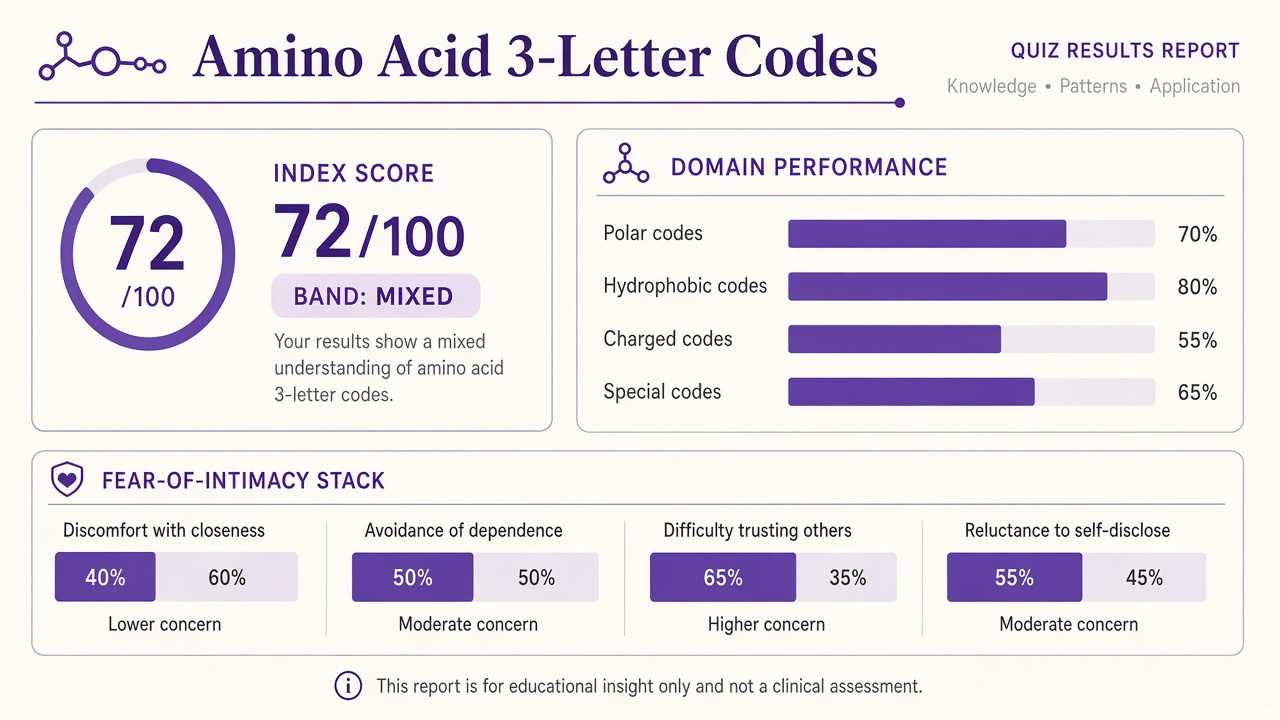
This amino acid 3 letter abbreviations quiz estimates how confidently you recall standard three-letter codes used in biochemistry and molecular biology. Twenty original agree-disagree items group into polar and neutral codes, hydrophobic codes, charged codes, and special aromatic codes following IUPAC-style abbreviations taught in Voet and Voet Biochemistry (2016) and Lehninger Principles of Biochemistry. Each item also maps to a fear-of-intimacy stack layer. A second results chart inspired by FOIS-style intimacy avoidance themes from Descutner and Thelen (1991), adapted to this topic. Your 3-letter code recall index averages these patterns into a 0 to 100 score where higher numbers mean more self-reported recall confidence on this screener.
Polar and neutral codes
Ser, Thr, Asn, Gln, Cys, and Tyr matches without peeking at a chart.
Hydrophobic codes
Ala, Val, Leu, Ile, Met, Phe, and Pro abbreviation recall under time pressure.
Charged codes
Lys, Arg, His, Asp, and Glu three-letter pairs and common confusions.
Special and aromatic codes
Gly uniqueness, Trp aromatic recall, and Phe versus Tyr code distinction.
How it works
Answer 20 agree-disagree items
Rate each agree-disagree statement from Strongly disagree to Strongly agree. You click Next after each answer.
Items map to domains and intimacy stack
Answers accumulate percentages for four primary domains plus four fear-of-intimacy stack layers.
View index, band, and charts
Results show Lower, Mixed, or Higher signal bands with domain bars and stack chart.
Take the amino acid 3 letter abbreviations quiz
Complete 20 items to receive your 3-letter code recall index, four domain bars, fear-of-intimacy stack chart, and band label for study planning.
What your result means
Your 3-letter code recall index is the normalized total across all 20 items on a 0 to 100 scale. Higher scores mean more agreement with recall-confidence items. Domain bars show which code family drives your result most. The fear-of-intimacy stack chart shows parallel closeness-guarding layers that sometimes pair with academic shame.
| Band | Index range | Typical reading |
|---|---|---|
| Lower 3-Letter Code Recall | 0 to 35 | Fewer endorsed knowledge items; gaps in three-letter abbreviation recall are common without recent study |
| Mixed 3-Letter Code Recall | 36 to 65 | Blend of solid recall and fuzzy spots worth targeting before an exam |
| Higher 3-Letter Code Recall | 66 to 100 | Steady recall across domains; still not a substitute for proctored exams |
What your report looks like
What this quiz can and cannot tell you
Can tell you
- How confidently you report recalling three-letter amino acid codes on this screener
- A 3-letter code recall index and four domain bars plus fear-of-intimacy stack
- Which code family (polar, hydrophobic, charged, special) feels strongest or weakest today
- A baseline before flashcard drills or an A&P exam review week
Cannot tell you
- Your official biochemistry course grade or licensing exam score
- Whether you can draw structures or predict pKa without other study tools
- Real-time proctored accuracy under timed lab practical conditions
- Permanent labels about your intelligence or career fit
IUPAC three-letter codes, biochemistry courses, and recall practice
Biochemistry textbooks such as Lehninger Principles of Biochemistry (8th ed., 2021) and Voet and Voet Biochemistry teach three-letter amino acid abbreviations as the bridge between full names and single-letter sequence notation. Students in nursing, pre-med, and MCAT prep often search amino acid 3 letter abbreviations quiz when flashcards feel random. The Quiz Hub built this as an original agree-disagree screener with domain bars and a parallel fear-of-intimacy stack, not a copy of any publisher test bank.
Sample items ask whether you instantly match Asn and Gln, confuse Leu with Ile codes, or recall Trp for aromatic positions. Compare sibling tests on our IQ and cognitive hub or read our editorial policy for review standards.
| Test | Focus |
|---|---|
| Amino acid quiz | Broader property and metabolism knowledge, not abbreviation recall alone |
| Single-letter code quiz | One-letter sequence notation with zero question overlap |
| Analog clock quiz | Time-reading confidence rather than biochemistry codes |
| Am I good at math quiz | Math confidence domains rather than amino acid recall |
Amino Acid 3 Letter Abbreviations Quiz FAQ
What does the amino acid 3 letter abbreviations quiz measure?
Twenty agree-disagree items ask about recall confidence for polar, hydrophobic, charged, and special three-letter codes. Each item maps to a fear-of-intimacy stack layer. You receive a 3-letter code recall index from 0 to 100 where higher scores mean more agreement on this screener. Study self-reflection only.
Does a high code recall index mean I will pass my biochemistry exam?
No. Higher scores mean you endorsed more recall-confidence items on this abbreviated screener. Proctored exams also test structures, pathways, and timed problems this quiz does not cover.
What is the fear-of-intimacy stack on this quiz?
A second results chart with vulnerability pull-back, trust hesitation, self-disclosure limits, and closeness anxiety layers adapted to study-habit framing. Higher stack scores may reflect hiding confusion in groups rather than asking questions aloud.
How is this different from the amino acid quiz?
The amino acid quiz covers broader property, essential amino acid, and metabolism knowledge. This quiz focuses specifically on three-letter abbreviation recall with different question stems.
How is this different from the single-letter code quiz?
The single-letter code quiz tests one-letter notation (A, R, W, etc.) with zero shared question text. Both use index 0-100 scoring with domain bars.
Who reviewed this content?
Dr. James Whitfield, PhD, reviewed the test framing and result explanations. See our editorial policy for review standards.
Reviewed by