What this single-letter amino acid quiz measures
This amino acid single letter code quiz estimates how confidently you translate one-letter symbols into amino acid names while reading sequences. Twenty original agree-disagree items group into nonpolar letters, polar letters, charged letters, and start/stop letter context following IUPAC single-letter notation used in UniProt and NCBI records. Each item maps to a fear-of-intimacy stack layer. A second results chart inspired by FOIS-style intimacy avoidance themes from Descutner and Thelen (1991), adapted to this topic. Your single-letter code recall index averages these patterns into a 0 to 100 score.
Nonpolar letters
A, V, L, I, M, F, P, W instant name matching in sequence strings.
Polar letters
S, T, N, Q, C, Y translation without a lookup table.
Charged letters
K, R, H, D, E positive and negative codes under time pressure.
Start and stop letters
M as translation start and reading annotated sequence termini.
How it works
Answer 20 agree-disagree items
Rate each agree-disagree statement from Strongly disagree to Strongly agree. You click Next after each answer.
Items map to domains and intimacy stack
Answers accumulate percentages for four primary domains plus four fear-of-intimacy stack layers.
View index, band, and charts
Results show Lower, Mixed, or Higher signal bands with domain bars and stack chart.
Take the amino acid single letter code quiz
Complete 20 items to receive your single-letter code recall index, domain bars, and fear-of-intimacy stack chart.
What your result means
Your single-letter code recall index is normalized across all 20 items on a 0 to 100 scale. Domain bars highlight whether nonpolar, polar, charged, or start/stop context drives your result.
| Band | Index range | Typical reading |
|---|---|---|
| Lower Single-Letter Code Recall | 0 to 35 | Fewer endorsed knowledge items; gaps in single-letter notation recall are common without recent study |
| Mixed Single-Letter Code Recall | 36 to 65 | Blend of solid recall and fuzzy spots worth targeting before an exam |
| Higher Single-Letter Code Recall | 66 to 100 | Steady recall across domains; still not a substitute for proctored exams |
What your report looks like
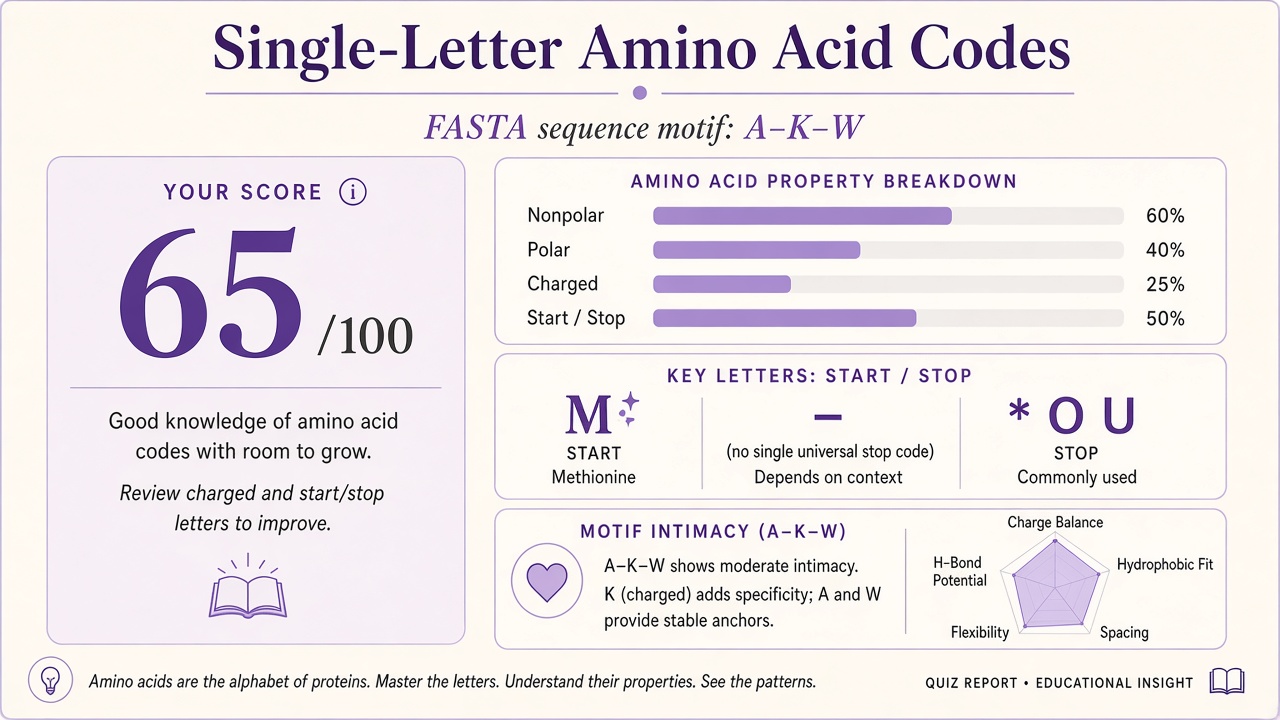
What this quiz can and cannot tell you
Can tell you
- How confidently you report reading single-letter amino acid codes
- A single-letter code recall index with four domain bars plus intimacy stack
- Which letter family to drill before opening sequence alignment homework
Cannot tell you
- Certified bioinformatics pipeline skills or programming ability
- Guaranteed MCAT or USMLE score improvements from this quiz alone
- Three-letter code recall covered by our separate abbreviations quiz
Single-letter notation in sequence databases and study practice
UniProt and NCBI GenBank display proteins using single-letter IUPAC codes so researchers scan motifs quickly. Biochemistry students often learn three-letter codes first, then struggle when FASTA files use one letter per residue. The Quiz Hub built this screener with zero question overlap against our three-letter abbreviations quiz.
Pair with the amino acid quiz for property knowledge or the analog clock quiz for a non-biology cognitive break on our IQ hub.
| Test | Focus |
|---|---|
| 3-letter abbreviations quiz | Three-letter codes (Ser, Lys) with different questions |
| Amino acid quiz | Property and metabolism knowledge rather than letter speed |
| Analog clock quiz | Analog time reading instead of sequence letters |
Amino Acid Single Letter Code Quiz FAQ
What does the single-letter code quiz measure?
Twenty agree-disagree items on nonpolar, polar, charged, and start/stop letter recall with a single-letter code recall index from 0 to 100 and fear-of-intimacy stack bars.
Is this the same as the three-letter abbreviations quiz?
No. Question stems focus on one-letter FASTA-style notation with zero shared text against the three-letter quiz.
Does high recall mean I am ready for bioinformatics work?
No. Reading letters quickly is one skill. Pipelines also require databases, alignment algorithms, and programming practice.
Why include a fear-of-intimacy stack on a biochemistry quiz?
Parallel stack layers show whether hiding confusion in study groups pairs with lower recall confidence on these self-report items.
Who reviewed this content?
Dr. James Whitfield, PhD, reviewed the test framing and result explanations. See our editorial policy for review standards.
How often should I retake this quiz?
Retake after a week of sequence-reading drills to see whether domain bars shift. Spaced review beats one cram session.
Reviewed by