What this Ambivalence Toward Men Inventory measures
This Ambivalence Toward Men Inventory estimates how often mixed attitudes toward men show up in your relationships. Twenty-two original frequency items group into four domains drawn from William Ickes Ambivalence Toward Men Inventory research: favorable men attitudes, unfavorable men attitudes, ambivalent conflict, and relational caution. Each item also maps to a fear-of-intimacy stack layer. Your AMI ambivalence index averages these patterns into a 0 to 100 score where higher numbers mean more ambivalence signals on this screener.
Favorable men attitudes
Warmth, respect, and attraction toward men you know or date
Unfavorable men attitudes
Irritation, mistrust, or disappointment toward men as a group
Ambivalent conflict
Mixed signals where you want closeness and pull away in the same week
Relational caution
Hesitation to trust, commit, or open up with male partners
How it works
Three steps from first question to your AMI ambivalence report with domain bars and fear-of-intimacy stack.
Answer 22 frequency items
Rate how often each attitude pattern shows up when you think about men in dating or daily life, from Never to Almost always. You click Next after each answer; nothing auto-advances.
Items map to AMI domains and intimacy stack
Your answers accumulate percentages for favorable attitudes, unfavorable attitudes, ambivalent conflict, and relational caution, plus four fear-of-intimacy stack layers.
View band and dual charts
Results show Lower, Mixed, or Higher AMI Ambivalence with domain bars and a fear-of-intimacy stack chart. Higher index means stronger self-reported ambivalence on this screener.
Take the Ambivalence Toward Men Inventory
Rate 22 frequency statements about attitudes toward men. Your answers produce an AMI ambivalence index from 0 to 100, a fear-of-intimacy stack index, four domain scores, and a band label for self-reflection.
Opens in a focused modal. No account required. Results stay on screen.
What your AMI ambivalence result means
Your AMI ambivalence index is the normalized total across all 22 items on a 0 to 100 scale. The fear-of-intimacy stack index uses inverted scoring on the same answers so higher stack scores mean more closeness-guarding patterns on these items.
| Band | Index range | Typical reading |
|---|---|---|
| Lower AMI Ambivalence | 0 to 35 | Fewer unfavorable, conflict, and caution signals toward men |
| Mixed AMI Ambivalence | 36 to 65 | Blend of favorable and guarded attitudes; domain chart shows strongest pattern |
| Higher AMI Ambivalence | 66 to 100 | Frequent unfavorable, conflict, or caution signals toward men |
What your AMI report looks like
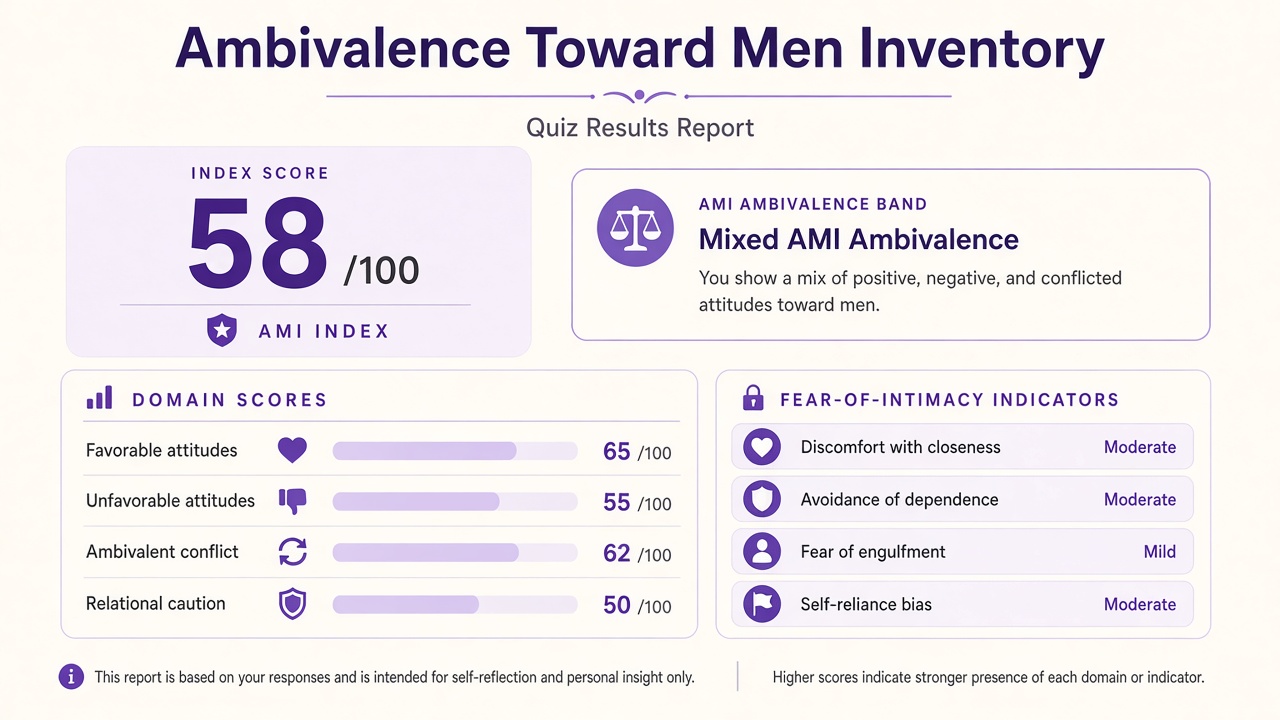
After all 22 items, you get an AMI ambivalence index from 0 to 100, a band label, four domain bars, and a fear-of-intimacy stack chart with vulnerability pull-back, trust hesitation, self-disclosure limits, and closeness anxiety layers.
What this quiz can and cannot tell you
Can tell you
- How often favorable, unfavorable, conflict, and caution patterns showed up toward men in your self-report
- An AMI ambivalence index and fear-of-intimacy stack index with domain bars
- Which AMI domain feels strongest in your current dating or friendship habits
- A starting point for therapy conversation about mixed feelings toward men
Cannot tell you
- Whether every man you meet will behave a certain way without their own context
- Whether you have internalized misandry, trauma, or normal caution from one screener
- Whether ambivalence will block every future relationship
- What treatment you need without a licensed clinician evaluation
Ickes AMI research, mixed attitudes, and the fear-of-intimacy stack
Psychologist William Ickes developed the Ambivalence Toward Men Inventory to measure simultaneous positive and negative attitudes toward men, especially in heterosexual dating contexts. His work showed that ambivalence can predict relationship stress even when individual men behave respectfully, because mixed expectations shape how people interpret ordinary partner behavior.
The Quiz Hub built this inventory as an original frequency screener inspired by AMI themes, not a reproduction of the published instrument. Our Ambivalence Toward Men Scale uses a separate 20-item short form with distinct questions. The fear of intimacy quiz screens general closeness avoidance without men-specific attitude domains.
| The Quiz Hub test | What it adds |
|---|---|
| Ambivalence Toward Men Scale | 20-item AMI short form with distinct questions, not this 22-item inventory |
| Fear of intimacy quiz | General intimacy avoidance without men-specific attitude domains |
| Attachment style test | Anxiety and avoidance dimensions across closeness, not AMI ambivalence frequency |
| Relationship anxiety quiz | Reassurance seeking and jealousy scan, not attitudes toward men as a group |
| This quiz | Full 22-item AMI ambivalence index plus fear-of-intimacy stack for favorable, unfavorable, conflict, and caution domains |
Sample item types include frequency ratings such as whether you want closeness with a man and then feel trapped when he responds warmly, or whether you assume men will disappoint you if you rely on them emotionally. High ambivalent conflict with high vulnerability pull-back on the stack often lands in Mixed bands when mixed signals guard emotional openness. Read our editorial policy or browse the relationships and dating tests hub.
Ambivalence Toward Men Inventory FAQ
What is the Ambivalence Toward Men Inventory?
The Ambivalence Toward Men Inventory (AMI) is a research line developed by William Ickes to measure mixed positive and negative attitudes toward men. This Quiz Hub screener uses 22 original frequency items across four domains plus a fear-of-intimacy stack chart. It is not the published clinical instrument.
What does the AMI ambivalence index measure?
Twenty-two frequency items ask how often favorable attitudes, unfavorable attitudes, ambivalent conflict, and relational caution show up when you think about men. You receive an AMI ambivalence index from 0 to 100 where higher scores mean more ambivalence signals on this screener.
How is this different from the AMI short-form scale?
The Ambivalence Toward Men Scale uses 20 distinct frequency items in a shorter bank. This inventory uses 22 items with zero question text overlap. Both map to AMI-inspired domains and include a fear-of-intimacy stack chart.
Can this quiz diagnose misandry or trauma?
No. The AMI ambivalence index describes self-reported attitude patterns on this abbreviated screener. Only a licensed clinician can evaluate trauma, attachment, or related concerns through structured interviews.
What is the fear-of-intimacy stack on this quiz?
The fear-of-intimacy stack is a second results chart inspired by FOIS-style intimacy avoidance themes, adapted to AMI framing. Higher stack scores may reflect using ambivalence toward men to guard emotional vulnerability in relationships.
Who reviewed this content?
Dr. Elena Vasquez, reviewed the test framing and result explanations. See our editorial policy for review standards.
Reviewed by