What this AMI short-form scale measures
This Ambivalence Toward Men Scale uses twenty original frequency items across four domains inspired by William Ickes AMI research. Items ask about the past month so the short form catches recent push-pull patterns toward men. Your AMI short-form ambivalence index averages these domains into a 0 to 100 score.
Favorable men attitudes
Appreciation, trust, and warmth toward men in your life
Unfavorable men attitudes
Frustration, skepticism, or disappointment toward men broadly
Ambivalent conflict
Push-pull cycles where attraction and doubt arrive together
Relational caution
Slow trust, guarded commitment, and emotional testing with men
How it works
Three steps from first question to your AMI short-form report.
Answer 20 frequency items
Rate how often each pattern showed up in the past month, from Never to Almost always.
Items map to AMI domains and intimacy stack
Your answers accumulate four AMI domain percentages plus fear-of-intimacy stack layers.
View band and dual charts
Results show Lower, Mixed, or Higher AMI Short-Form Ambivalence with domain and stack charts.
Take the Ambivalence Toward Men Scale
Rate 20 frequency statements about attitudes toward men in the past month. Get an AMI short-form ambivalence index, intimacy stack index, and domain bars.
Opens in a focused modal. No account required. Results stay on screen.
What your AMI short-form result means
Your AMI short-form ambivalence index is normalized across all 20 items on a 0 to 100 scale. The fear-of-intimacy stack uses inverted scoring on the same answers.
| Band | Index range | Typical reading |
|---|---|---|
| Lower AMI Short-Form Ambivalence | 0 to 35 | Fewer ambivalence signals on the 20-item short form |
| Mixed AMI Short-Form Ambivalence | 36 to 65 | Blend of favorable and guarded attitudes on short form |
| Higher AMI Short-Form Ambivalence | 66 to 100 | Frequent ambivalence signals on 20-item short form |
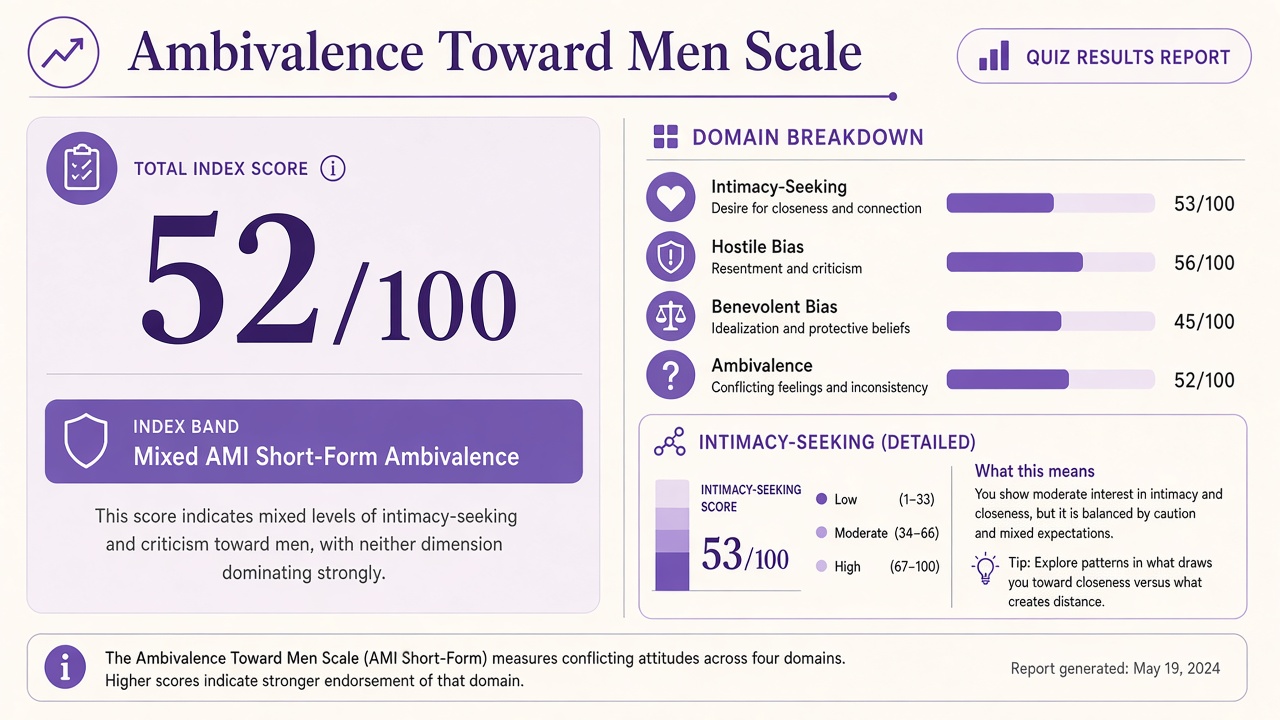
What your AMI short-form report looks like
After 20 items, you get an AMI short-form ambivalence index, band label, four domain bars, and a fear-of-intimacy stack chart.
What this quiz can and cannot tell you
Can tell you
- Recent ambivalence patterns toward men in the past month
- AMI short-form index and fear-of-intimacy stack with domain bars
- Which domain feels strongest in your current habits
Cannot tell you
- Whether every man will behave a certain way
- Clinical diagnosis of trauma or misandry from one screener
- Long-term prediction without retakes over time
AMI short form, Ickes research, and recent-month framing
William Ickes developed AMI measures to capture mixed attitudes toward men that predict relationship friction. Short forms help track recent shifts after dating changes, therapy, or major life events without repeating long inventories every week.
This scale uses distinct questions from our 22-item AMI inventory. The fear of intimacy quiz screens general closeness avoidance without men-specific domains.
| The Quiz Hub test | What it adds |
|---|---|
| AMI inventory (22 items) | Full inventory with distinct 22-item bank, not this short form |
| Fear of intimacy quiz | General intimacy avoidance without men-specific domains |
| Attachment style test | Anxiety and avoidance across closeness |
| This quiz | 20-item AMI short form with past-month frequency framing plus fear-of-intimacy stack |
Sample items ask whether you texted a man warmly and then regretted showing interest, or whether you kept conversations light to avoid depending on him. Read our editorial policy or browse the relationships and dating hub.
Ambivalence Toward Men Scale FAQ
What is the Ambivalence Toward Men Scale?
A 20-item short-form screener inspired by William Ickes AMI research with distinct questions from the 22-item inventory. It uses past-month frequency items and maps to four domains plus a fear-of-intimacy stack.
How is the short form different from the AMI inventory?
The inventory has 22 items with zero text overlap. The short form has 20 items focused on the past month for quicker retakes. Both produce 0 to 100 ambivalence indices.
Can this quiz diagnose me?
No. The index describes self-reported attitude patterns for self-reflection only.
What is the fear-of-intimacy stack?
A second chart with vulnerability pull-back, trust hesitation, self-disclosure limits, and closeness anxiety layers adapted to AMI framing.
Who reviewed this content?
Dr. Elena Vasquez, reviewed the test framing and result explanations. See our editorial policy for review standards.
Reviewed by