What this am I trans quiz measures
This am I trans quiz estimates patterns across six trans identity reflection domains. Twenty-four original Likert items group into dysphoria and euphoria signals, disconnect from assigned gender, transition desire, trans community resonance, fear versus relief when imagining authentic gender, and trans identity recognition. Results show a reflection index and domain bars with reflective bands. No quiz can name your gender for you.
Dysphoria and euphoria
Relief or joy imagining another gender versus distress about assigned-gender body signals.
Assigned gender disconnect
How much your inner self diverges from the gender assigned at birth.
Transition desire
Curiosity about social or medical transition steps without prescribing any path.
Trans community resonance
Sense of belonging when engaging with trans stories, peers, and community spaces.
Authentic gender imagery
Fear versus relief when picturing living openly as your authentic gender.
Trans identity recognition
Whether trans language and being gendered correctly feel like they fit your experience.
How it works
Three steps from first question to your trans identity reflection snapshot. Click Start Quiz to open the interactive modal.
Rate 24 reflection statements
Answer from Strongly disagree to Strongly agree. There is no timer and no auto-advance between items.
Items map to six domains
Your answers accumulate percentages for dysphoria, disconnect, transition desire, community resonance, authentic imagery, and identity recognition.
View reflection index and band
Results show Low Trans Identity Signals, Mixed Gender Questioning, or Stronger Trans Identity Signals bands with domain bars and affirming next steps.
Take the am I trans quiz
Rate 24 reflection statements about dysphoria, assigned gender disconnect, transition curiosity, trans community pull, authentic gender imagery, and trans identity language on a five-point agreement scale. Your answers produce a reflection index, six domain scores, and a reflective band with plain-language next steps.
Opens in a focused modal. No account required. Results stay on screen.
What your result means
Your reflection index is the average of all six domain scores, each normalized to 0 through 100. Higher percentages mean more frequent agreement with dysphoria, disconnect, transition curiosity, community resonance, authentic gender relief, and trans identity language items (and less frequent agreement with reverse-scored alignment items). Domain bars show whether dysphoria, disconnect, transition desire, community resonance, authentic imagery, or identity recognition drives your band.
| Reflective band | Score range | Typical reading |
|---|---|---|
| Low Trans Identity Signals | 0 to 35% | Fewer trans identity reflection signals on these items right now |
| Mixed Gender Questioning | 36 to 65% | Blend of alignment and trans questioning signals across domains |
| Stronger Trans Identity Signals | 66 to 100% | Stronger dysphoria, disconnect, or trans language signals; still not a prescribed label |
Six-domain trans identity reflection chart
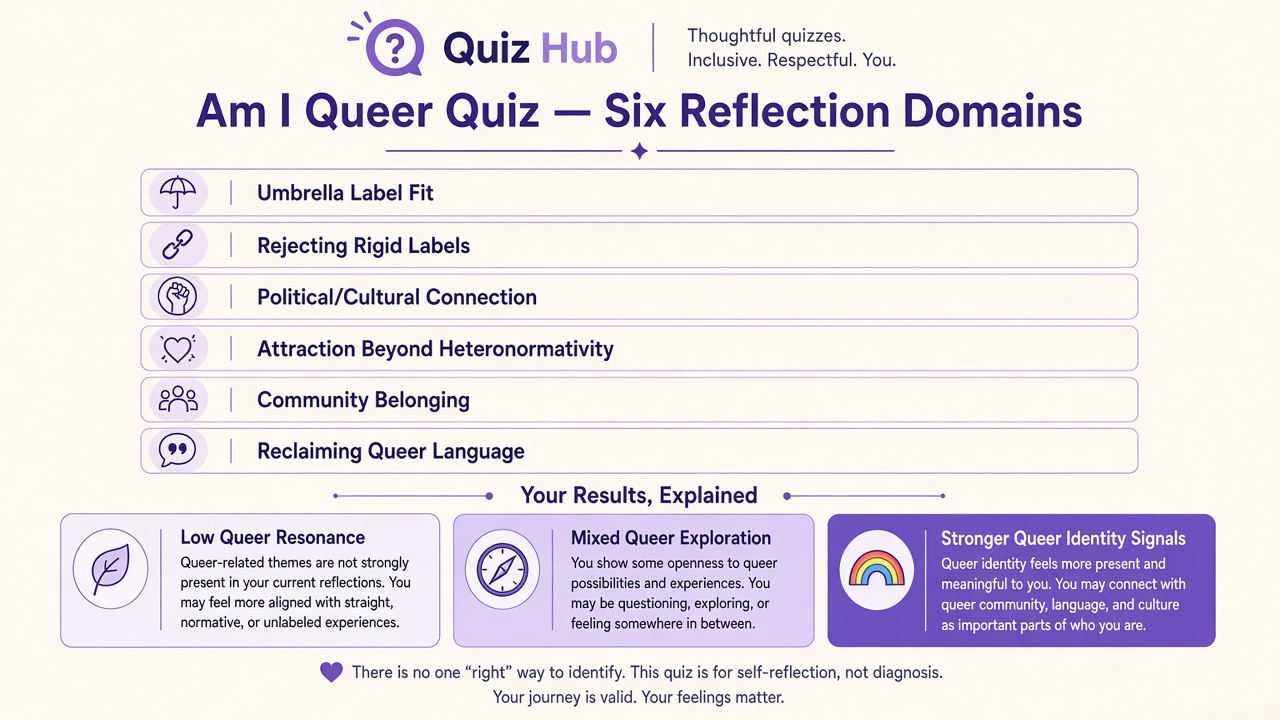
The diagram below shows how domain scores appear in your results. High community resonance with moderate dysphoria, for example, can still land you in Mixed Gender Questioning if your overall reflection index sits between bands.
What this am I trans quiz can and cannot tell you
Can tell you
- Whether your self-reported patterns lean toward lower, mixed, or stronger trans identity signals on this screener
- A reflection index and six domain scores for journaling and self-reflection
- Which domain bar scores highest when gender feelings feel layered or situational
- A starting vocabulary before you talk with trusted people or affirming counselors
Cannot tell you
- Whether you are cisgender, transgender, non-binary, genderfluid, or any other gender label
- Whether you should transition, come out, change your name, or pursue medical care
- Clinical scores from validated gender dysphoria inventories or diagnostic tools
- Whether questioning is a phase you must resolve on a deadline
Trans identity reflection and self-understanding
The World Professional Association for Transgender Health (WPATH) Standards of Care (8th edition, 2022) emphasize that gender identity is self-defined and that access to affirming care should follow individual needs rather than gatekeeping quizzes. Psychologist Sandra Bem's gender schema theory described how people process gender-related information and how that processing can feel automatic or strained. The Quiz Hub built this am I trans quiz as a compassionate reflection tool inspired by those ideas, not as a clinical gender dysphoria inventory.
Twenty-four original items ask about dysphoria and euphoria, disconnect from birth assignment, curiosity about social or medical transition steps, resonance with trans community stories, fear versus relief when imagining authentic gender, and whether trans language fits your experience. That framework helps organize mixed feelings before you decide what language fits. For a broader gender map, try our gender identity test. For non-binary reflection items, browse our planned non-binary test. For attraction patterns separate from gender, try our sexuality test.
| The Quiz Hub test | What it adds |
|---|---|
| Gender identity test | Broader six-domain gender reflection across alignment, pronouns, and expression |
| Non-binary test (planned) | Non-binary and genderfluid reflection framing |
| Sexuality test | Attraction patterns across genders when orientation and gender feel intertwined |
| Sexual orientation test | Orientation reflection across men, women, and non-binary people |
| This am I trans quiz | 24 items with six trans-focused domains, reflection index, and non-prescriptive reflective bands |
Sample item: agreeing that you feel seen when you read trans memoirs raises your trans community resonance bar. Agreeing that your assigned gender label still fits your inner self lowers your reflection index through a reverse-scored disconnect item. Cultural safety, religious pressure, and privacy concerns can keep scores moderate even when feelings are strong. Read how we review quizzes in our editorial policy or browse more tests on our sexuality and LGBTQ+ hub.
Am I trans quiz FAQ
What does this am I trans quiz measure?
This am I trans quiz measures self-reported patterns across six reflection domains: dysphoria and euphoria signals, disconnect from assigned gender, transition desire, trans community resonance, fear versus relief when imagining authentic gender, and trans identity recognition. Twenty-four Likert items produce a reflection index, six domain bars, and a reflective band such as Low Trans Identity Signals, Mixed Gender Questioning, or Stronger Trans Identity Signals. It cannot determine your gender or assign identity labels.
Can an online am I trans quiz tell me if I am transgender?
No. No online quiz can know your gender identity with certainty or prescribe a label you must adopt. This screener organizes your self-report into domains and bands for reflection. Affirming conversation, time, and lived experience matter more than any score. Only you define your gender.
What if my result shows Mixed Gender Questioning?
Mixed Gender Questioning means your answers suggest a blend of alignment and trans questioning signals across domains without one clear story dominating. That is a valid place to be. Middle reflection scores do not mean you are confused or wrong. They can reflect situational gender feelings, privacy, or simply not focusing on labels yet.
How is this different from a gender identity test?
A gender identity test covers broader alignment, pronoun comfort, and social expression across assigned gender themes. This am I trans quiz narrows toward trans-specific reflection: dysphoria and euphoria, disconnect from birth assignment, transition curiosity, trans community pull, and trans identity language. Pair both when you want a wider map plus a trans-focused angle.
Is this am I trans quiz affirming for trans and questioning readers?
Yes. Results treat all gender positions as valid, avoid prescriptive transition outcomes, and mention trans and non-binary resources affirmingly. Limits include crisis links for youth distress, including The Trevor Project. This quiz is not a substitute for gender-affirming care.
Who reviewed this content?
Dr. Morgan Chen, PhD, reviewed the test framing and result explanations. See our editorial policy for review standards.
Reviewed by