What this sexual orientation test measures
This sexual orientation test estimates how much you agree with reflection statements across five domains that researchers and clinicians often treat separately. Twenty-four original Likert items group into gendered attraction, romantic vs sexual layers, and label comfort. Results show domain bars and orientation bands, not a forced gay-or-straight verdict. Sexuality is multidimensional, and your answers may shift with experience.
Attraction to men
Romantic, emotional, and sexual pull toward men as you report it today on this screener.
Attraction to women
Romantic, emotional, and sexual pull toward women without assuming your current relationship status.
Attraction to non-binary people
Interest toward non-binary and gender-diverse partners, separate from binary-only framing.
Romantic vs sexual distinction
Whether romantic and sexual attraction align, split, or need different words for you.
Identity label comfort
How settled you feel naming your orientation with current vocabulary and social safety.
How it works
Three steps from first question to your orientation reflection snapshot. Click Start Quiz to open the interactive modal.
Reflect on 24 statements
Answer how true each item feels from Not true for me to Very true for me. There is no timer and no auto-advance.
Items map to five domains
Your answers accumulate percentages for men, women, non-binary attraction, romantic vs sexual distinction, and label comfort.
View index, bars, and band
Results show an orientation reflection index, ranked domain bars, and a band with affirming next steps. No diagnostic label is assigned.
Take the sexual orientation test
Rate 24 orientation reflection statements on a five-point truth scale. Your answers produce an orientation reflection index, five domain scores, and a reflective band with plain-language next steps. Affirming language only.
Opens in a focused modal. No account required. Results stay on screen.
What your result means
Your orientation reflection index is the normalized average across all 24 items on a 0 through 100 scale. Domain bars show each theme separately so a high women bar can coexist with moderate men and non-binary bars. Bands combine the index with spread across gendered attraction domains: Broad Exploration when peaks are low or flat, Mixed Attraction Pattern when multiple domains pull similarly, Clearer Orientation Lean when one domain leads with a wider gap.
| Orientation band | Typical pattern | Plain-language read |
|---|---|---|
| Broad Exploration | Lower index or even moderate attraction bars | Still exploring patterns or label comfort without one strong peak |
| Mixed Attraction Pattern | Two or more attraction domains score similarly | Meaningful pull across genders or unfinished label clarity |
| Clearer Orientation Lean | Higher index with one leading attraction domain | Clearer lean today, still your choice whether to name it publicly |
Five orientation reflection domains
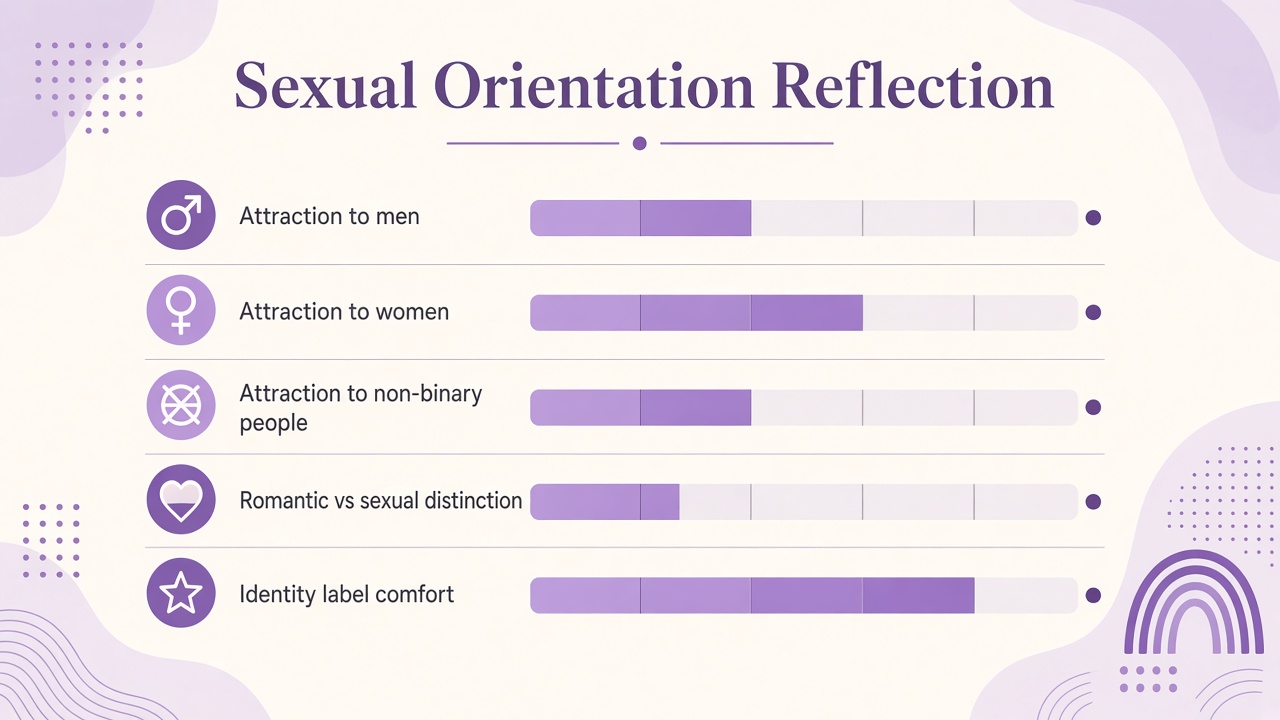
The diagram below shows how domain scores appear in your results. High romantic vs sexual distinction with mixed gendered bars, for example, can still land you in Mixed Attraction Pattern even when one attraction bar leads slightly.
What this quiz can and cannot tell you
Can tell you
- How your self-reported attraction patterns distribute across men, women, and non-binary domains on this screener
- Whether romantic and sexual items suggest alignment or a split for you today
- How comfortable you feel with orientation labels in your current answers
- A starting band and domain bars before you choose language, timing, or disclosure
Cannot tell you
- Whether you are definitively gay, bi, straight, pan, ace, or any other identity
- Whether you must come out, use a label, or stay private
- Whether past behavior or one relationship defines your whole orientation
- Whether you need therapy, medical care, or community support (only you and professionals decide that)
Why sexuality reflection needs more than one question
Sex researcher Alfred Kinsey argued in the 1940s that orientation is better understood as a continuum than a binary switch. Later work by Lisa M. Diamond on sexual fluidity showed that women's attractions and identities can shift across years without invalidating earlier experiences. Contemporary models from the American Psychological Association treat orientation as including emotional, romantic, and sexual components that do not always align. The Quiz Hub built this sexual orientation test to mirror that multidimensional view with separate domain bars rather than a single gay-or-straight score.
Twenty-four original items ask about attraction to men, women, and non-binary people, whether romantic and sexual layers split for you, and how comfortable you feel with labels right now. That structure helps when a crush quiz or relationship test answers a different question about one person or couple health. Planned sibling tests such as sexuality-test, am-i-gay-test, am-i-bisexual-quiz, and am-i-lesbian-quiz will narrow specific label intents; this page stays the broad reflection entry point. For attachment anxiety that can color how you read attraction, try our attachment style test. For dating readiness before identity work, browse our am I ready for a relationship quiz.
| The Quiz Hub test | What it adds |
|---|---|
| Attachment style test | Anxiety and avoidance patterns in close bonds that can shape how attraction feels |
| Am I ready for a relationship quiz | Emotional availability, healing, time, and clarity before dating |
| Relationship test | Partnership health across trust, intimacy, repair, and respect for existing couples |
| Crush quiz | Intensity signals toward one person rather than orientation patterns across genders |
| This sexual orientation test | 24 reflection items with index, five domain bars, and three orientation bands |
Sample item: answering Very true for me on noticing appeal toward women raises your attraction to women bar. Answering Very true for me on avoiding labels because none feel precise lowers your identity label comfort score through a reverse-scored item. Mixed bars are common and do not mean you are confused in a negative sense. Read how we review quizzes in our editorial policy or browse more tests on our relationships and dating hub while the sexuality and LGBTQ+ hub grows.
Sexual orientation test FAQ
What does this sexual orientation test measure?
This sexual orientation test measures how much you agree with 24 reflection items across five domains: attraction to men, attraction to women, attraction to non-binary people, romantic vs sexual distinction, and identity label comfort. Results show an orientation reflection index, five domain bars, and a band such as Broad Exploration, Mixed Attraction Pattern, or Clearer Orientation Lean. It is not a diagnostic tool.
Can this quiz tell me if I am gay, bi, or straight?
No quiz can assign a permanent label or replace your own judgment. This screener maps self-reported attraction patterns into reflective bands and domain bars. You may see a clearer lean in one gendered attraction domain, mixed pull across domains, or broad exploration with few peaks. Sexuality is multidimensional, and only you choose words that feel accurate and safe.
What if my result shows Broad Exploration?
Broad Exploration means your answers suggest you are still sorting attraction patterns, label comfort, or both, without one strong peak across gendered domains. That is common during questioning, after life changes, or when labels feel premature. It is a snapshot for reflection, not proof that you must decide today or that you will never feel clearer later.
How is romantic vs sexual distinction scored?
Five items ask whether romantic and sexual attraction usually align, whether you have felt one without the other, and whether separate language helps describe your experience. Higher scores on this domain suggest you notice a split or use split language more often. Lower scores suggest alignment for you. Both patterns are valid and can coexist with any attraction domain bar.
How is this different from a crush quiz or relationship test?
Crush and relationship quizzes focus on one person, partner behavior, or couple health. This sexual orientation test asks about attraction patterns toward men, women, and non-binary people, plus label comfort and romantic vs sexual layers. Pair our attachment style test if you want anxiety and avoidance patterns in close bonds rather than orientation reflection.
Who reviewed this content?
Dr. Morgan Chen, PhD, reviewed the test framing and result explanations. See our editorial policy for review standards.
Reviewed by