What this laziness habit quiz measures
This am I lazy quiz estimates how often task procrastination, motivation waiting, comfort seeking, and responsibility deferral patterns show up in how you report handling daily effort. Twenty original frequency items group into four domains inspired by procrastination research from Piers Steel on temporal motivation theory and Timothy Pychyl on task avoidance: task procrastination, motivation waiting, comfort seeking, and responsibility deferral. Each item also maps to a fear-of-intimacy stack layer so you can see whether vulnerability pull-back, trust hesitation, self-disclosure limits, or closeness anxiety pairs with avoiding effortful tasks. Your laziness habit index averages these patterns into a 0 to 100 score where higher numbers mean more avoidant habits on this screener.
Task procrastination
Last-minute delays, half-finished tasks, avoided appointments, and slow replies to difficult messages.
Motivation waiting
Waiting for inspiration, pushing starts to tomorrow, needing deadline panic, and holding out for perfect conditions.
Comfort seeking
Scrolling over quick tasks, easy-option defaults, staying put when movement would help, and skipping exercise for ease.
Responsibility deferral
Assuming others will fix shared problems, letting team loads pile up, avoiding follow-through roles, and dropping commitments quietly.
How it works
Three steps from first question to your laziness habit report with fear-of-intimacy stack. Click Start Quiz to open the interactive quiz in a full-screen modal.
Answer 20 frequency items
Rate how often each pattern shows up in how you handle tasks and effort, from Never to Almost always. You click Next after each answer; nothing auto-advances.
Items map to laziness domains and intimacy stack
Your answers accumulate percentages for task procrastination, motivation waiting, comfort seeking, and responsibility deferral, plus four fear-of-intimacy stack layers.
View band and dual charts
Results show Lower, Mixed, or Higher Laziness Habits with domain bars and a fear-of-intimacy stack chart. Higher index means more avoidant habits on this screener.
Take the am I lazy quiz
Rate 20 statements about how you handle tasks and daily effort. Your answers produce a laziness habit index from 0 to 100, a fear-of-intimacy stack index, four domain scores, and a band label for reflection or therapy conversation.
Opens in a focused modal. No account required. Results stay on screen.
What your laziness habit result means
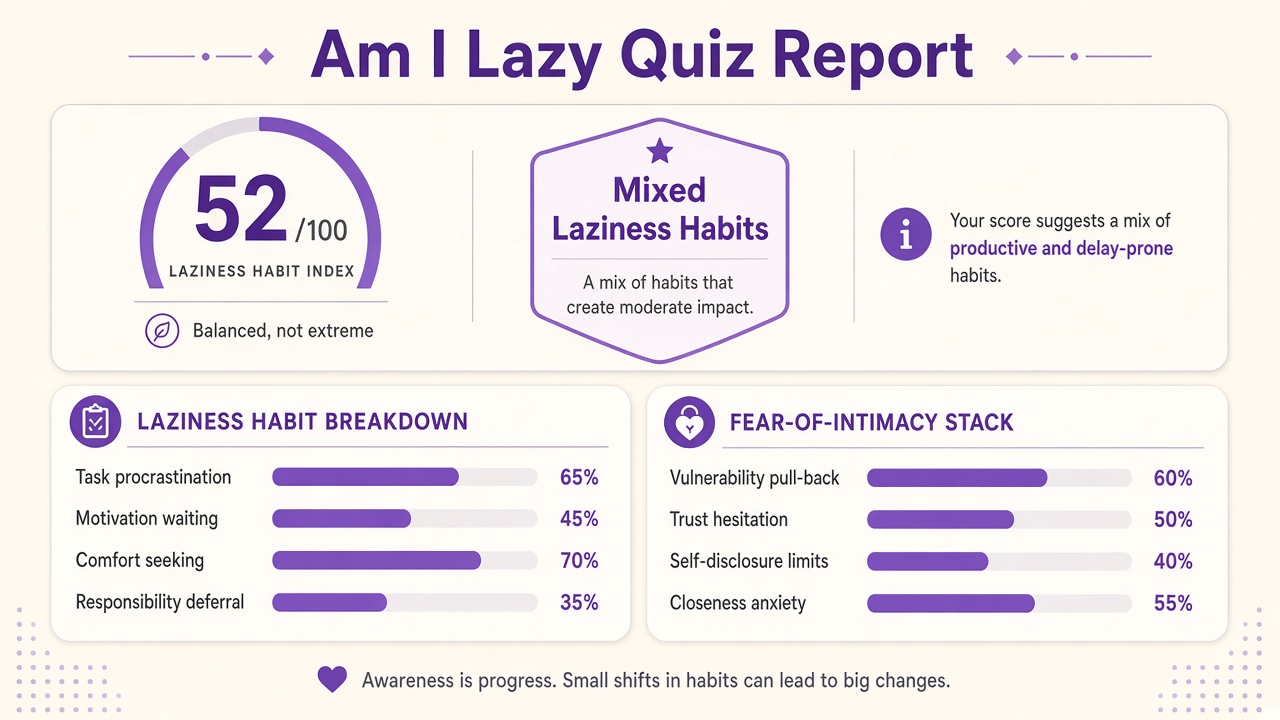
Your laziness habit index is the normalized total across all 20 items on a 0 to 100 scale, with reverse scoring on follow-through items so higher scores mean more avoidant habits overall. The fear-of-intimacy stack index uses the same answers mapped to vulnerability, trust, disclosure, and closeness anxiety layers where higher stack scores mean more avoidance patterns. Domain bars show endorsement rates so you can see whether task procrastination, motivation waiting, comfort seeking, or responsibility deferral drives your result most.
| Band | Index range | Typical reading |
|---|---|---|
| Lower Laziness Habits | 0 to 35 | Fewer avoidant habits; fatigue or ADHD can still mimic laziness without high scores here |
| Mixed Laziness Habits | 36 to 65 | Blend of follow-through and delay habits; domain and stack charts show where you guard closeness or effort |
| Higher Laziness Habits | 66 to 100 | Frequent procrastination, motivation waiting, comfort-first choices, or shared-task deferral on this screener |
What your laziness habit report looks like
After all 20 items, you get a laziness habit index from 0 to 100, a band label, four laziness domain bars, and a fear-of-intimacy stack chart with vulnerability pull-back, trust hesitation, self-disclosure limits, and closeness anxiety layers. Percentages reflect how you report handling tasks, not a verdict on your worth.
What this quiz can and cannot tell you
Can tell you
- How often task procrastination, motivation waiting, comfort seeking, and responsibility deferral patterns showed up in your self-report
- A laziness habit index and fear-of-intimacy stack index with domain bars
- Which laziness domain or intimacy stack layer feels strongest in your current habits
- A starting point for therapy conversation about follow-through, burnout, and shared responsibility
Cannot tell you
- Whether you have ADHD, depression, or burnout without clinical evaluation
- Whether every partner or boss sees you as lazy without their side of the story
- Whether rest and recovery are the same as chronic avoidance
- What specific changes others want without honest conversation and trusted guidance
Laziness habits, procrastination loops, and the fear-of-intimacy stack
Psychologist Piers Steel meta-analyzed decades of procrastination research and found that delay often reflects low expectancy, low value, impulsiveness, or distant deadlines rather than a fixed lazy personality. Timothy Pychyl emphasizes that task avoidance frequently protects against anxiety, shame, or perfectionism in the moment even when it costs more later. In relationships and shared loads, deferring responsibility can feel like rest to you and like unfairness to others, especially when the same pattern repeats without repair.
The Quiz Hub built this am I lazy quiz as an original self-report screener inspired by those procrastination themes plus FOIS-style intimacy avoidance layers from Descutner and Thelen (1991), not a reproduction of any single published laziness scale. Readers often compare it to sibling tools on this site. Our self-sabotage quiz screens undermining success and fear-of-failure loops rather than comfort-first deferral. The focus test measures attention strain and distractibility rather than task avoidance habits. The do I have ADHD quiz covers executive function symptom frequency rather than general laziness framing.
| The Quiz Hub test | What it adds |
|---|---|
| Self-sabotage quiz | Fear-of-failure loops and undermining success, not comfort-first deferral habits |
| Focus test | Attention strain and concentration gaps, not motivation waiting or shared-task deferral |
| Do I have ADHD quiz | Executive function symptom frequency with clinical framing, not general laziness habits |
| Fear of intimacy quiz | General intimacy avoidance across vulnerability and trust, not task avoidance habits |
| Am I boring quiz | Social dullness and flat engagement, not procrastination or comfort-first task habits |
| This lazy quiz | Laziness habit index plus fear-of-intimacy stack for procrastination, motivation waiting, comfort seeking, and deferral |
Sample item types include frequency ratings such as whether you wait until you feel inspired before beginning work you already committed to, or whether you assume someone else will notice and fix a shared problem before you step in. High task procrastination with high closeness anxiety on the stack often lands in Mixed or Higher Laziness Habits bands. Reliable follow-through at work with deferred home chores can split domain scores. Read how we review quizzes in our editorial policy or browse more tools on our personality psychology hub.
Am I lazy quiz FAQ
What does the am I lazy quiz measure?
Twenty original frequency items ask how often task procrastination, motivation waiting, comfort seeking, or responsibility deferral patterns show up in how you report handling daily effort. Each item also maps to a fear-of-intimacy stack layer: vulnerability pull-back, trust hesitation, self-disclosure limits, and closeness anxiety. You receive a laziness habit index from 0 to 100 where higher scores mean more avoidant habits on this screener, plus a parallel stack index.
Does a higher laziness habit index mean I am a bad person?
No. On this screener, a higher index means you endorsed more last-minute delays, waiting for inspiration, comfort-first choices, or shared-task deferral items. Fatigue, depression, ADHD, and burnout can mimic laziness without reflecting character. This quiz cannot prove how every partner or boss experiences you or replace evaluation for clinical conditions.
What is the fear-of-intimacy stack on this quiz?
The fear-of-intimacy stack is a second results chart inspired by FOIS-style intimacy avoidance themes from Descutner and Thelen (1991), adapted to laziness habit framing. Each of the 20 items maps to one of four stack layers showing how closeness guarding may pair with avoiding effortful tasks: hiding vulnerability, testing trust, limiting disclosure, or worrying about being too close. Higher stack scores mean more avoidance patterns on these items.
How is this different from the self-sabotage quiz?
The self-sabotage quiz uses frequency items about undermining success, procrastination tied to fear of failure, and self-defeating loops from clinical psychology themes. This am I lazy quiz focuses on procrastination, motivation waiting, comfort seeking, and responsibility deferral with a parallel fear-of-intimacy stack chart in one report.
How is this different from the focus test?
The focus test measures attention strain, distractibility, and concentration gaps with symptom-style items. This lazy quiz focuses on how often you delay tasks, wait for motivation, choose comfort, or defer shared responsibility, plus fear-of-intimacy stack layers that may explain why effort feels risky.
Can this quiz tell me if I have ADHD or depression?
No. The laziness habit index describes self-reported avoidance patterns on this abbreviated screener. ADHD, depression, and burnout can all increase delay and shutdown without meaning you are lazy by character. Only a licensed clinician can evaluate those conditions after a full assessment.
Who reviewed this content?
Dr. James Whitfield, PhD, reviewed the test framing and result explanations. See our editorial policy for review standards.
Reviewed by