
What this social dullness quiz measures
This am I boring quiz estimates how often conversation flatness, low curiosity, predictable routines, and low expressiveness patterns show up in how you report behaving around others. Twenty original frequency items group into four domains inspired by interpersonal communication research from Arthur Aron on self-expansion in relationships and Mark Leary on interpersonal rejection sensitivity: conversation flatness, low curiosity, predictable routines, and low expressiveness. Each item also maps to a fear-of-intimacy stack layer so you can see whether vulnerability pull-back, trust hesitation, self-disclosure limits, or closeness anxiety pairs with playing it safe socially. Your social dullness index averages these patterns into a 0 to 100 score where higher numbers mean more dull habits on this screener.
Conversation flatness
Safe small talk, short answers, skipping opinions, and choosing expected topics over what you care about.
Low curiosity
Missing follow-ups, letting talk die, waiting for others to carry conversation, and retreating to your phone.
Predictable routines
Repeating hobbies and anecdotes, avoiding new activities, and defaulting to the same plans every time.
Low expressiveness
Flat reactions, neutral faces, toned-down enthusiasm, and matching low energy when others celebrate.
How it works
Three steps from first question to your social dullness report with fear-of-intimacy stack. Click Start Quiz to open the interactive quiz in a full-screen modal.
Answer 20 frequency items
Rate how often each pattern shows up in how you show up socially, from Never to Almost always. You click Next after each answer; nothing auto-advances.
Items map to dullness domains and intimacy stack
Your answers accumulate percentages for conversation flatness, low curiosity, predictable routines, and low expressiveness, plus four fear-of-intimacy stack layers.
View band and dual charts
Results show Lower, Mixed, or Higher Social Dullness with domain bars and a fear-of-intimacy stack chart. Higher index means more dull habits on this screener.
Take the am I boring quiz
Rate 20 statements about how you show up in social settings. Your answers produce a social dullness index from 0 to 100, a fear-of-intimacy stack index, four domain scores, and a band label for reflection or therapy conversation.
Opens in a focused modal. No account required. Results stay on screen.
What your social dullness result means
Your social dullness index is the normalized total across all 20 items on a 0 to 100 scale, with reverse scoring on engaged items so higher scores mean more dull habits overall. The fear-of-intimacy stack index uses the same answers mapped to vulnerability, trust, disclosure, and closeness anxiety layers where higher stack scores mean more avoidance patterns. Domain bars show endorsement rates so you can see whether conversation flatness, low curiosity, predictable routines, or low expressiveness drives your result most.
| Band | Index range | Typical reading |
|---|---|---|
| Lower Social Dullness | 0 to 35 | Fewer dull habits; introversion or fatigue can still read as flat to some listeners |
| Mixed Social Dullness | 36 to 65 | Blend of engaging moments and flat habits; domain and stack charts show where you guard closeness |
| Higher Social Dullness | 66 to 100 | Frequent safe small talk, few follow-ups, routine loops, or muted reactions on this screener |
What your social dullness report looks like
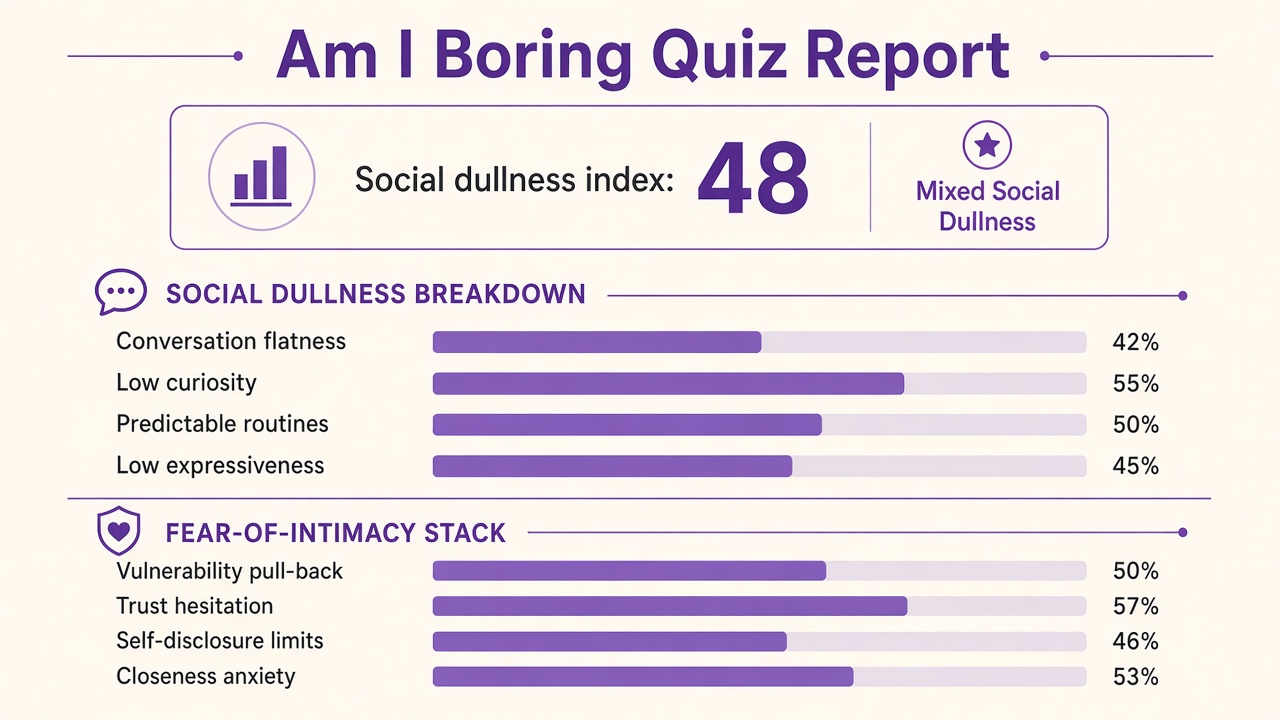
After all 20 items, you get a social dullness index from 0 to 100, a band label, four dullness domain bars, and a fear-of-intimacy stack chart with vulnerability pull-back, trust hesitation, self-disclosure limits, and closeness anxiety layers. Percentages reflect how you report showing up socially, not a verdict on your worth.
What this quiz can and cannot tell you
Can tell you
- How often conversation flatness, low curiosity, predictable routines, and low expressiveness patterns showed up in your self-report
- A social dullness index and fear-of-intimacy stack index with domain bars
- Which dullness domain or intimacy stack layer feels strongest in your current habits
- A starting point for therapy conversation about social engagement, curiosity, and group energy
Cannot tell you
- Whether every friend finds you dull without their side of the story
- Whether you are unlikable, awkward, or a bad partner
- Whether quiet introversion is the same as boring behavior
- What specific changes others want without honest conversation and trusted guidance
Social dullness, curiosity habits, and the fear-of-intimacy stack
Psychologist Arthur Aron showed that relationships grow when people share new experiences and expand each other's worlds, while flat routines can signal low investment even when care is present. Mark Leary's work on rejection sensitivity helps explain why some people play it safe with opinions, follow-ups, or visible enthusiasm when closeness feels risky. In groups, safe small talk, missing questions, or muted reactions can feel comfortable to the speaker and underwhelming to listeners, especially when the same pattern repeats without repair.
The Quiz Hub built this am I boring quiz as an original self-report screener inspired by those interpersonal themes plus FOIS-style intimacy avoidance layers from Descutner and Thelen (1991), not a reproduction of any single published dullness scale. Readers often compare it to sibling tools on this site. Our am I annoying quiz screens talk-over, oversharing, and spotlight habits rather than flat engagement. The ambivert test measures introversion versus extraversion on a trait spectrum. The am I lonely quiz covers emotional isolation and connection deficit rather than conversational flatness.
| The Quiz Hub test | What it adds |
|---|---|
| Am I annoying quiz | Conversational friction and attention seeking, not flat curiosity or muted reactions |
| Ambivert test | Introversion versus extraversion trait placement, not frequency-based dullness patterns |
| Am I lonely quiz | Emotional isolation and connection deficit, not safe small talk habits |
| Fear of intimacy quiz | General intimacy avoidance across vulnerability and trust, not social dullness habits |
| Am I weird quiz | Quirky self-image and social fit, not frequency-based flat engagement patterns |
| This boring quiz | Social dullness index plus fear-of-intimacy stack for flat talk, curiosity, routines, and expressiveness |
Sample item types include frequency ratings such as whether you forget to ask follow-up questions after someone shares news, or whether you respond with flat reactions when friends share exciting updates. High conversation flatness with high closeness anxiety on the stack often lands in Mixed or Higher Social Dullness bands. Warmth in close friendships with safe small talk at parties can split domain scores. Read how we review quizzes in our editorial policy or browse more tools on our personality psychology hub.
Am I boring quiz FAQ
What does the am I boring quiz measure?
Twenty original frequency items ask how often conversation flatness, low curiosity, predictable routines, or low expressiveness patterns show up in how you report behaving in social settings. Each item also maps to a fear-of-intimacy stack layer: vulnerability pull-back, trust hesitation, self-disclosure limits, and closeness anxiety. You receive a social dullness index from 0 to 100 where higher scores mean more dull habits on this screener, plus a parallel stack index.
Does a higher social dullness index mean I am unlikable?
No. On this screener, a higher index means you endorsed more safe small talk, few follow-ups, routine loops, or flat reaction items. Many quiet, thoughtful people score high without intending harm. Introversion and low social energy are not the same as being boring. This quiz cannot prove how every friend experiences you or replace honest feedback from people who know you.
What is the fear-of-intimacy stack on this quiz?
The fear-of-intimacy stack is a second results chart inspired by FOIS-style intimacy avoidance themes from Descutner and Thelen (1991), adapted to social dullness framing. Each of the 20 items maps to one of four stack layers showing how closeness guarding may pair with flat social habits: hiding vulnerability, testing trust, limiting disclosure, or worrying about being too close. Higher stack scores mean more avoidance patterns on these items.
How is this different from the am I annoying quiz?
The am I annoying quiz uses frequency items about conversational habits, boundary pushing, negativity drain, and attention seeking from interpersonal communication research themes. This am I boring quiz focuses on flat engagement, low curiosity, predictable routines, and muted reactions with a parallel fear-of-intimacy stack chart in one report.
How is this different from the ambivert test?
The ambivert test measures where you fall on introversion versus extraversion with trait-style items. This boring quiz focuses on how often dull social habits show up in conversation and group settings, plus fear-of-intimacy stack layers that may explain why you play it safe.
Can this quiz tell me if my friends secretly find me dull?
No. The social dullness index describes self-reported patterns on this abbreviated screener. Mood, context, and relationship history all shape how habits land. Only people in your life can tell you how your presence feels, ideally through honest conversation.
Who reviewed this content?
Dr. James Whitfield, PhD, reviewed the test framing and result explanations. See our editorial policy for review standards.
Reviewed by
