
What this am I immature quiz measures
This am I immature quiz estimates how often emotionally immature habit patterns show up in your self-report. Twenty-two original frequency items group into four domains drawn from emotional maturity and accountability themes in books such as Lindsay Gibson's work on emotionally immature adults and Pauline Young-Eisendrath's writing on emotional adulthood: emotional regulation gaps, responsibility avoidance, empathy deficits, and impulse comfort seeking. Each item also maps to a fear-of-intimacy stack layer so you can see whether vulnerability pull-back, trust hesitation, self-disclosure limits, or closeness anxiety rides alongside immature conflict habits. Your emotional immaturity index averages these patterns into a 0 to 100 score where higher numbers mean more frequent endorsement.
Emotional regulation gaps
Snapping under stress, shutting down, sulking for reassurance, sarcasm instead of honesty, and fights that outpace cooling off.
Responsibility avoidance
Blaming others first, excuse-making, delayed follow-through, leaving emotional cleanup to others, and rewriting events.
Empathy deficits
Centering your story, dismissing upset, impatience with support needs, and assuming your mood sets the room.
Impulse and comfort seeking
Distraction over discomfort, ghosting heavy plans, resentful yeses, and fun-now choices that create tomorrow problems.
How it works
Three steps from first question to your emotional immaturity report with fear-of-intimacy stack. Click Start Quiz to open the interactive quiz in a full-screen modal.
Answer 22 frequency items
Rate how often each habit shows up, from Never to Almost always. You click Next after each answer; nothing auto-advances.
Items map to immaturity domains and intimacy stack
Your answers accumulate percentages for regulation gaps, responsibility avoidance, empathy deficits, and impulse comfort seeking, plus four fear-of-intimacy stack layers.
View band, domain bars, and stack chart
Results show Lower, Mixed, or Higher Emotional Immaturity Signals with domain bars, stack layers, and reflection prompts.
Take the am I immature quiz
Rate 22 statements about regulation, accountability, empathy, and impulse habits. Your answers produce an emotional immaturity index from 0 to 100, four domain scores, a fear-of-intimacy stack chart, and a band label for reflection.
Opens in a focused modal. No account required. Results stay on screen.
What your emotional immaturity result means
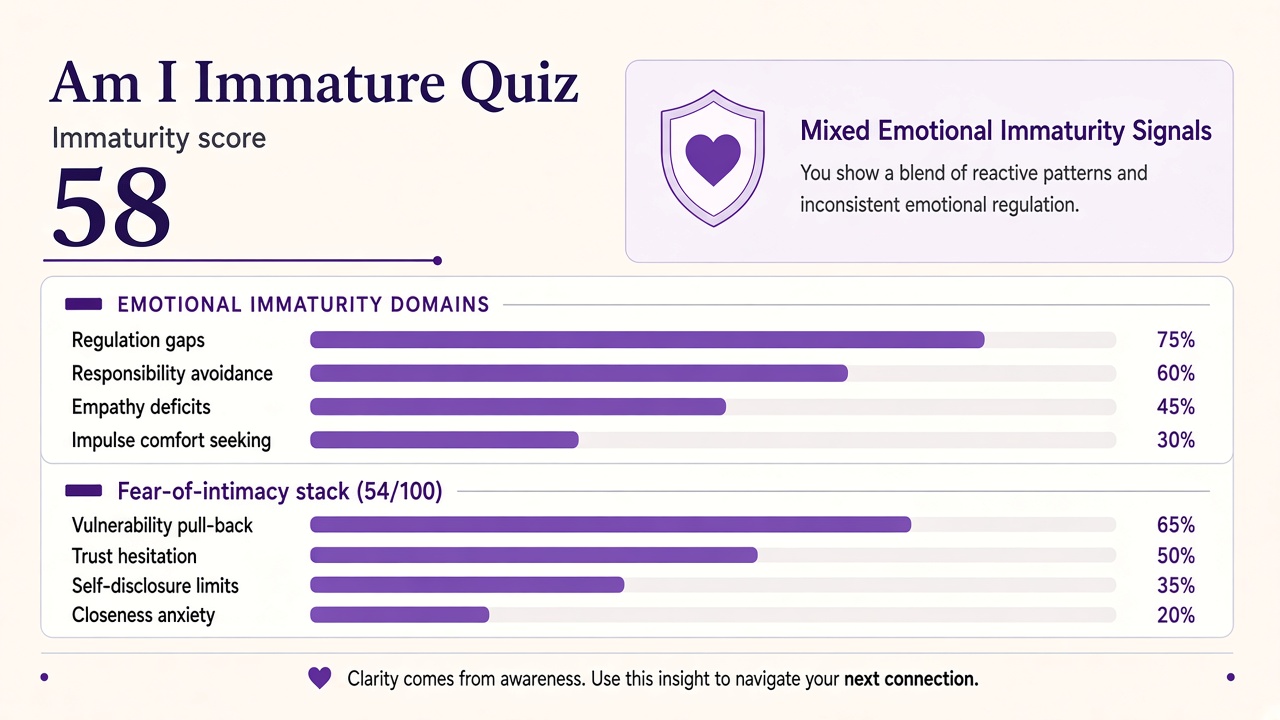
Your emotional immaturity index is the normalized total across all 22 items on a 0 to 100 scale. Higher scores mean more frequent endorsement of regulation gaps, responsibility avoidance, empathy strain, and impulse comfort seeking items on this screener. Domain bars show endorsement rates so you can see whether snapping, blame shifting, empathy strain, or comfort-first choices drives your result most. The fear-of-intimacy stack chart shows parallel layers for vulnerability pull-back, trust hesitation, self-disclosure limits, and closeness anxiety when immature habits include guarded closeness.
| Band | Index range | Typical reading |
|---|---|---|
| Lower Emotional Immaturity Signals | 0 to 35 | Fewer immature habit signals; normal stress reactions can still score here |
| Mixed Emotional Immaturity Signals | 36 to 65 | Blend of ordinary strain and recurring accountability or regulation gaps; domain and stack charts show where you struggle most |
| Higher Emotional Immaturity Signals | 66 to 100 | Frequent snapping, blame shifting, empathy strain, or comfort-first impulses; check stack if closeness feels guarded too |
What your immaturity report looks like
After all 22 items, you get an emotional immaturity index from 0 to 100, a band label, four domain bars for regulation gaps, responsibility avoidance, empathy deficits, and impulse comfort seeking, plus a fear-of-intimacy stack chart with vulnerability, trust, disclosure, and closeness anxiety layers.
What this quiz can and cannot tell you
Can tell you
- How often emotionally immature habit patterns showed up in this self-report screener
- An emotional immaturity index and four domain bars for regulation, accountability, empathy, and impulse habits
- A fear-of-intimacy stack showing which closeness-guarding layer feels strongest
- A starting point for therapy, coaching, or comparing with sibling tests
Cannot tell you
- Whether you are permanently immature or a bad person
- Whether conflict habits are rooted in trauma, ADHD, or personality without professional context
- Whether partners or friends agree with your self-view
- What treatment you need without licensed professional guidance
Emotional immaturity, accountability, and intimacy guarding
People search am I immature when conflict leaves them wondering whether they snap too fast, dodge apologies, or center their comfort while someone else is hurting. Psychologist Lindsay Gibson popularized emotionally immature adult as language for adults who struggle with empathy, accountability, and emotional depth even when they are smart or successful. Pauline Young-Eisendrath writes about emotional adulthood as the capacity to tolerate discomfort, own your part, and stay curious about impact.
The Quiz Hub built this am I immature quiz as an original self-report screener inspired by those themes plus FOIS-style intimacy avoidance layers, not a reproduction of any single published instrument. Readers often compare it to sibling tools on this site. Our maturity test scores five broader maturity domains across 42 agree-disagree items without an intimacy stack. The emotionally immature parents quiz screens family-of-origin impact rather than your own habits. The fear of intimacy quiz measures general vulnerability pull-back across closeness, not regulation gaps or blame shifting.
| The Quiz Hub test | What it adds |
|---|---|
| Maturity test | 42-item maturity inventory across regulation, responsibility, impulse control, empathy, and perspective without intimacy stack chart |
| Emotionally immature parents quiz | Family-of-origin parental immaturity impact index, not self-habit framing |
| Fear of intimacy quiz | General intimacy avoidance across vulnerability and trust, not accountability or empathy deficit domains |
| Am I emotionally unstable quiz | Mood volatility and dysregulation screener without immaturity accountability framing |
| Self-sabotage quiz | Undermining success and relationship patterns, not immature conflict habits |
| This am I immature quiz | Emotional immaturity index plus fear-of-intimacy stack for regulation gaps, responsibility avoidance, empathy deficits, and impulse comfort seeking |
Sample item types include frequency ratings such as whether you shut down instead of naming what upset you, or whether you make excuses instead of apologizing when you clearly messed up. High regulation gaps with high closeness anxiety on the stack often lands in Mixed or Higher Emotional Immaturity Signals bands. Strong accountability with selective impulse comfort can score in Lower Emotional Immaturity Signals even when friends still want more repair after conflict. Read how we review quizzes in our editorial policy or browse more tools on our personality psychology hub.
Am I immature quiz FAQ
What does emotionally immature mean in everyday life?
Therapists and authors such as Lindsay Gibson describe emotional immaturity as difficulty regulating feelings, avoiding accountability, centering your own comfort, and struggling to stay curious when others are upset. It is a habit pattern, not a fixed insult. This am I immature quiz measures self-reported frequency on those themes plus a parallel fear-of-intimacy stack.
What does this am I immature quiz measure?
Twenty-two original frequency items ask how often you notice snapping under stress, dodging accountability, empathy strain, or comfort-first impulses. Scores map to four emotional immaturity domains plus a parallel fear-of-intimacy stack with vulnerability pull-back, trust hesitation, self-disclosure limits, and closeness anxiety layers. You receive an emotional immaturity index from 0 to 100 where higher scores mean more immature habit signals on this screener, plus a stack index for intimacy guarding patterns.
What is the fear-of-intimacy stack on this quiz?
The fear-of-intimacy stack is a second results chart inspired by FOIS-style intimacy avoidance themes, adapted to emotional immaturity framing. Each of the 22 items also maps to one of four stack layers: vulnerability pull-back, trust hesitation, self-disclosure limits, and closeness anxiety. The stack index summarizes how often guarded closeness rides alongside regulation gaps or blame shifting.
How is this different from the maturity test?
The maturity test uses 42 agree-disagree items across five broader maturity domains without a fear-of-intimacy stack chart. This am I immature quiz uses 22 how-often frequency items focused on conflict habits, accountability, empathy strain, and impulse comfort seeking, plus a dual-chart report with intimacy stack layers.
Can this quiz tell me if I am emotionally immature forever?
No. Emotional habits can change with feedback, therapy, and practice. This screener describes pattern signals you notice right now, not a permanent label or diagnosis. Treat results as a starting point for reflection, not proof of character.
Who reviewed this content?
Dr. James Whitfield, PhD, reviewed the test framing and result explanations. See our editorial policy for review standards.
Reviewed by
