What this friendship jealousy quiz measures
This am I jealous of my friend quiz estimates how often jealous comparison and replacement patterns show up in your feelings toward one friend and how they may connect to adult closeness habits. Twenty original frequency items group into four jealousy domains inspired by envy research from Richard H. Smith and Sung Hwan Kim (2007): comparison envy, replacement fear, possessive attachment, and competitive resentment. Each item also maps to a fear-of-intimacy stack layer so you can see whether vulnerability pull-back, trust hesitation, self-disclosure limits, or closeness anxiety feels strongest. Your friendship jealousy index averages these patterns into a 0 to 100 score with plain-language bands.
Comparison envy
Sting when they win, lifestyle comparisons after hangouts, mood drops during their good news, and social scrolling for status gaps.
Replacement fear
Panic about new close friends, third-wheel feelings, assuming they prefer others, and anxiety when they rave about someone else.
Possessive attachment
Wanting to be their only best friend, checking who they are with, hurt when they prioritize others, and subtle guilt trips.
Competitive resentment
Mental scoreboards, replaying happier moments with others, secret schadenfreude, and resenting their social ease.
How it works
Three steps from first question to your friendship jealousy report with fear-of-intimacy stack. Click Start Quiz to open the interactive quiz in a full-screen modal.
Answer 20 frequency items
Rate how often each jealous feeling and closeness habit shows up when you think about this friend, from Never to Almost always. You click Next after each answer; nothing auto-advances.
Items map to jealousy domains and intimacy stack
Your answers accumulate percentages for comparison envy, replacement fear, possessive attachment, and competitive resentment, plus four fear-of-intimacy stack layers.
View band and dual charts
Results show Lower, Mixed, or Higher Friendship Jealousy with jealousy domain bars and a fear-of-intimacy stack chart. Higher bands include crisis resources.
Take the am I jealous of my friend quiz
Rate 20 statements about your feelings toward this friend. Your answers produce a friendship jealousy index from 0 to 100, a fear-of-intimacy stack index, four domain scores, and a band label for reflection or therapy conversation.
Opens in a focused modal. No account required. Results stay on screen.
What your result means
Your friendship jealousy index is the normalized total across all 20 items on a 0 to 100 scale, with reverse scoring on secure items so higher scores mean more jealous patterns overall. The fear-of-intimacy stack index uses the same answers mapped to vulnerability, trust, disclosure, and closeness anxiety layers. Domain bars show endorsement rates so you can see whether comparison envy, replacement fear, possessiveness, or competitive resentment drives your result most.
| Band | Index range | Typical reading |
|---|---|---|
| Lower Friendship Jealousy | 0 to 35 | Fewer jealous patterns on this screener; normal missing them or brief envy after their win may still appear |
| Mixed Friendship Jealousy | 36 to 65 | Blend of genuine care and jealous habits; worth tracking if persistent across seasons |
| Higher Friendship Jealousy | 66 to 100 | Frequent comparison envy, replacement fear, possessiveness, or scorekeeping; professional support may help |
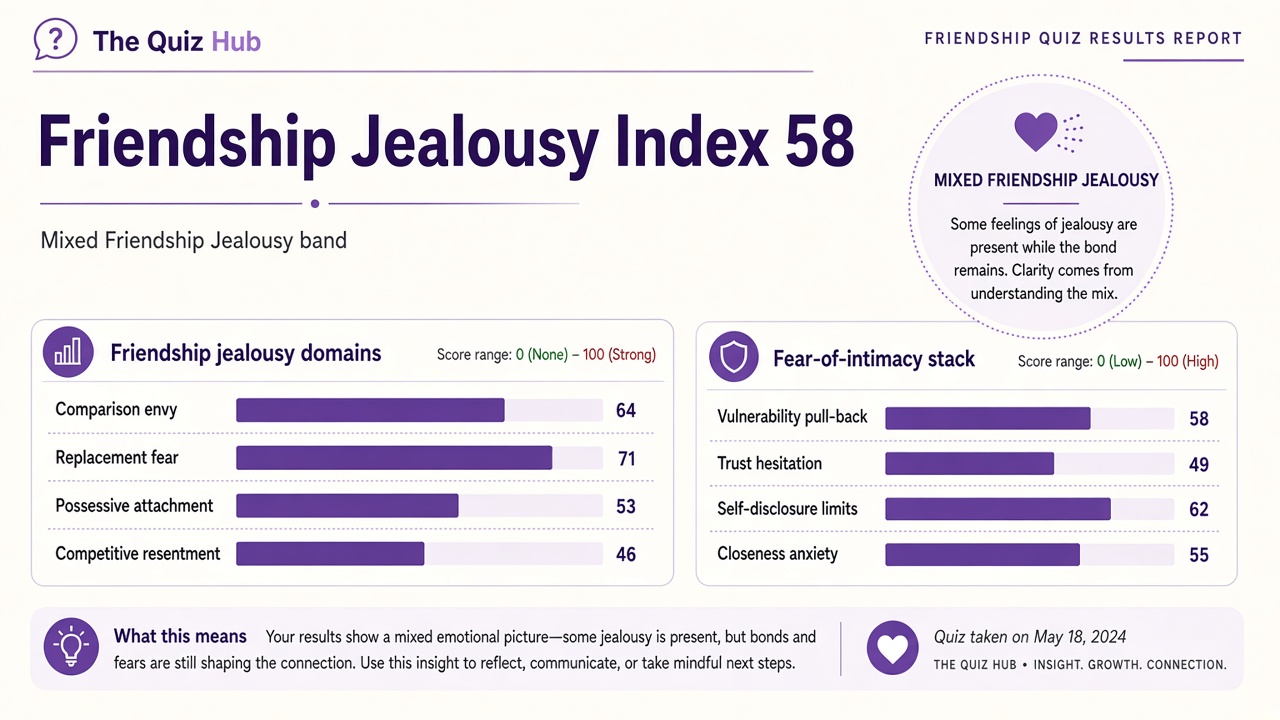
What your friendship jealousy report looks like
After all 20 items, you get a friendship jealousy index from 0 to 100, a band label, four jealousy domain bars, and a fear-of-intimacy stack chart with vulnerability pull-back, trust hesitation, self-disclosure limits, and closeness anxiety layers. Percentages reflect how you experience envy and closeness with this friend, not a verdict about their loyalty.
What this quiz can and cannot tell you
Can tell you
- How often jealous comparison and replacement patterns showed up for you with this friend
- A friendship jealousy index and fear-of-intimacy stack index with domain bars
- Which jealousy domain or intimacy stack layer feels strongest in your current experience
- A starting point for therapy conversation about envy, self-worth, and adult closeness patterns
Cannot tell you
- Whether you have an attachment disorder or any clinical diagnosis
- Whether your friend is disloyal without their side of the story
- Whether the friendship should end without your own judgment and professional support
- What treatment you need without a licensed clinician's evaluation
Friend envy, replacement fear, and the fear-of-intimacy stack
Psychologists Richard H. Smith and Sung Hwan Kim (2007) describe envy as a painful mix of inferiority and resentment that can surface even in close friendships when one person gains status, romance, or attention the other wanted. Friendship researchers note that replacement fear spikes during life transitions: new partners, job wins, or a friend group reshuffle after a move. Jealous patterns can push you to edit what you share, pull back after their good news, or keep score in the friendship, habits that may raise fear-of-intimacy stack scores in romantic bonds years later.
The Quiz Hub built this am I jealous of my friend quiz as an original self-report screener inspired by those themes, not a reproduction of any single published envy scale. Readers often compare it to sibling tools on this site. Our am I losing my best friend quiz screens drift signals from their side: fading replies and priority shifts. The is my friend toxic quiz covers their disrespect and guilt pressure. The fear of intimacy quiz maps vulnerability avoidance in romantic bonds without a friendship envy frame.
| The Quiz Hub test | What it adds |
|---|---|
| Am I losing my best friend quiz | Friendship drift index: communication fade, priority shift, emotional withdrawal, bond erosion |
| Is my friend toxic quiz | Toxic friendship index: emotional drain, disrespect, unreliability, guilt pressure |
| Am I insecure quiz | Self-worth screener across relationships, not friend-specific envy domains |
| Am I clingy quiz | Partner proximity index: togetherness pressure, contact overload, separation distress |
| Fear of intimacy quiz | FOIS-inspired avoidance index without friendship jealousy domains |
| This friendship jealousy quiz | Friendship jealousy index plus parallel fear-of-intimacy stack layers |
Sample item types include frequency ratings such as whether you panic when they mention a new close friend, or whether you keep a mental scoreboard of who has helped whom more. High comparison envy with high replacement fear scores often lands in Mixed or Higher Friendship Jealousy bands. Weddings, promotions, and new romantic partners can spike scores temporarily. Read how we review quizzes in our editorial policy or browse more tools on our relationships and dating hub.
Am I jealous of my friend quiz FAQ
What is friendship jealousy?
Friendship jealousy describes the envy, replacement fear, or possessiveness you feel when a close friend succeeds, bonds with others, or seems to pull away. Psychologists Richard H. Smith and Sung Hwan Kim (2007) distinguish benign envy that motivates self-improvement from malicious envy tied to resentment. This am I jealous of my friend quiz measures how often those jealous patterns show up in your feelings toward one friend and how they may shape your fear-of-intimacy stack in adult bonds. It is not proof you are a bad friend or that the friendship must end.
What does this friendship jealousy quiz measure?
Twenty original frequency items ask how often you notice comparison envy, replacement fear, possessive attachment, and competitive resentment when you think about this friend. Each item also maps to a fear-of-intimacy stack layer: vulnerability pull-back, trust hesitation, self-disclosure limits, and closeness anxiety. You receive a friendship jealousy index from 0 to 100 and a band from Lower through Higher Friendship Jealousy.
What is the fear-of-intimacy stack on this quiz?
The fear-of-intimacy stack is a second results chart inspired by FOIS-style intimacy avoidance themes from Descutner and Thelen (1991), adapted to jealous friendship dynamics. Each of the 20 items maps to one of four stack layers showing how envy may connect to adult closeness habits: hiding vulnerability, testing trust, limiting disclosure, or panicking when bonds deepen. The stack index summarizes those layers alongside the friendship jealousy index.
How is this different from the is my friend toxic quiz?
The is my friend toxic quiz screens their behavior toward you: emotional drain, disrespect, unreliability, and guilt pressure. This am I jealous of my friend quiz focuses on your reactions: envy at their wins, fear of replacement, possessiveness, and scorekeeping. It uses a self-report frequency frame plus a parallel fear-of-intimacy stack rather than toxic-friend behavior domains.
Can this quiz diagnose an attachment disorder?
No. The friendship jealousy index describes self-reported jealous patterns on this abbreviated screener. Busy seasons, life transitions, and mismatched expectations can raise scores without an attachment disorder. Only a licensed clinician can evaluate attachment or personality concerns through structured interviews. Online quizzes cannot confirm or deny a diagnosis.
What should I do if I get a higher friendship jealousy band?
Consider scheduling an evaluation with a licensed therapist who treats attachment, friendship, or self-esteem concerns. Practice naming envy out loud with a trusted person instead of acting it out through guilt or distance. If you feel unsafe or in crisis, call or text 988 (US) or your local crisis line.
Who reviewed this content?
Dr. Priya Sharma, PhD, reviewed the test framing and result explanations. See our editorial policy for review standards.
Reviewed by