What this am I insecure quiz measures
This am I insecure quiz estimates how often insecurity habits showed up over the past two weeks. Twenty-four original frequency items group into four domains drawn from self-esteem and social comparison research: self-worth swings, comparison scanning, reassurance dependence, and social threat. Your insecurity index averages these patterns into a 0 to 100 score with plain-language bands. It reflects your self-report about confidence habits, not how others secretly judge you.
Self-worth swings
Mood tied to achievement, replaying mistakes, impostor feelings, and needing praise to feel valuable.
Comparison scanning
Measuring yourself against peers, social media envy, and shame when others succeed.
Reassurance dependence
Repeated "Are we okay?" checks, fishing for compliments, and panic when replies lag.
Social threat
Assuming judgment, rehearsing speech, avoiding visibility, and reading neutral faces as rejection.
How it works
Three steps from first question to your insecurity report. Click Start Quiz to open the interactive quiz in a full-screen modal.
Answer 24 frequency items
Rate how often each insecurity pattern showed up over the past two weeks, from Never to Almost always. You click Next after each answer; nothing auto-advances.
Items map to four insecurity domains
Your answers accumulate percentages for self-worth swings, comparison scanning, reassurance dependence, and social threat, plus an overall insecurity index.
View band and domain bars
Results show Lower, Mixed, or Higher Insecurity with domain bars and reflection prompts. Higher bands include crisis resources.
Take the am I insecure quiz
Rate 24 statements about insecurity habits over the past two weeks. Your answers produce an insecurity index from 0 to 100, four domain scores, and a band label for reflection or therapy conversation.
Opens in a focused modal. No account required. Results stay on screen.
What your result means
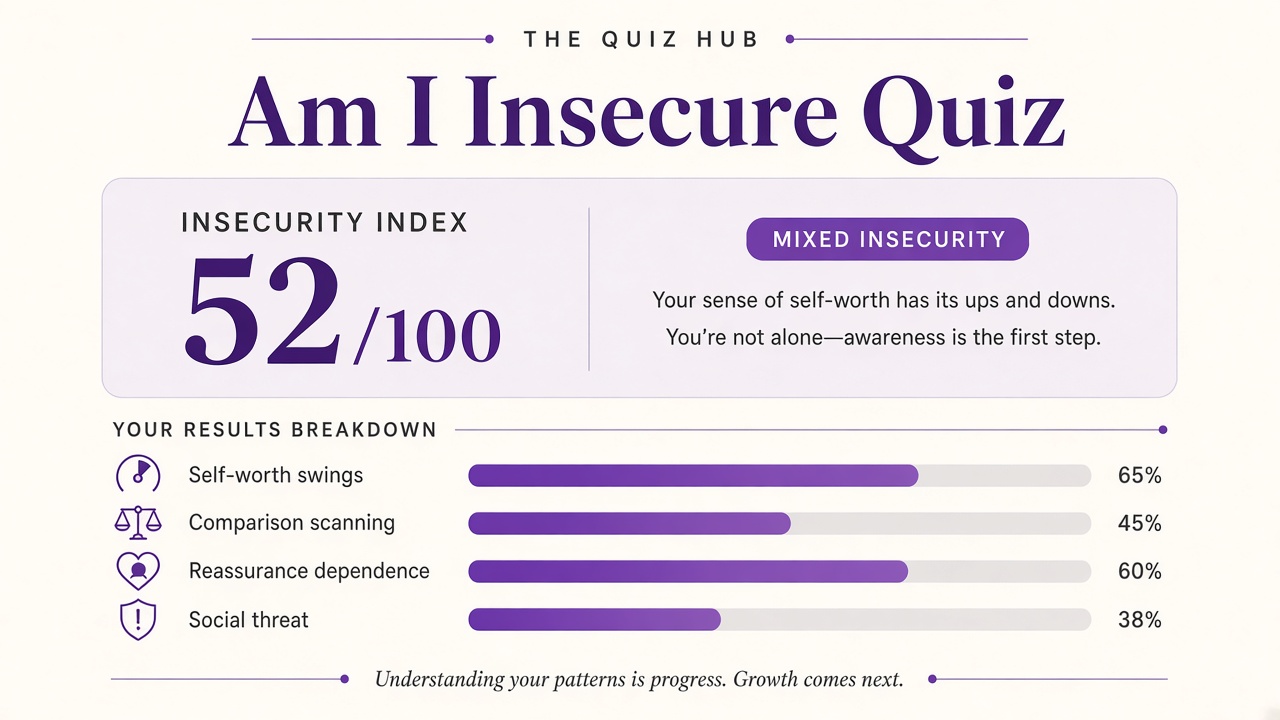
Your insecurity index is the normalized total across all 24 items on a 0 to 100 scale, with reverse scoring on steadier self-worth items so higher scores mean more insecurity overall. Domain bars show endorsement rates so you can see whether self-worth swings, comparison loops, reassurance dependence, or social threat scanning drives your result most.
| Band | Index range | Typical reading |
|---|---|---|
| Lower Insecurity | 0 to 35 | Fewer insecurity habits on this screener; normal self-doubt during stress may still appear |
| Mixed Insecurity | 36 to 65 | Blend of steady moments and doubt loops; worth tracking if persistent |
| Higher Insecurity | 66 to 100 | Frequent comparison, reassurance chasing, or threat scanning; professional support may help |
What your insecurity report looks like
After all 24 items, you get an insecurity index from 0 to 100, a band label, and four domain bars for self-worth swings, comparison scanning, reassurance dependence, and social threat. Percentages reflect how often insecurity habits showed up, not a clinical verdict about your personality.
What this quiz can and cannot tell you
Can tell you
- How often insecurity patterns showed up for you over the past two weeks
- An insecurity index and four domain bars for worth swings, comparison, reassurance, and threat
- Which domain pattern feels strongest in your current confidence habits
- A starting point for therapy conversation or retaking after a confidence shift
Cannot tell you
- Whether you have social anxiety, body dysmorphia, or any clinical diagnosis
- Whether others are judging you without your own observation and support
- Whether insecurity will block your goals without effort and honest dialogue
- What treatment you need without a licensed clinician's evaluation
Self-worth swings, comparison, and social threat
Psychologist Morris Rosenberg published the Rosenberg Self-Esteem Scale in 1965, measuring global self-worth with agree-disagree items still used in research today. Social psychologist Leon Festinger described social comparison theory in 1954: people evaluate themselves partly by measuring against others. In everyday language, insecurity often maps to those patterns: mood tied to achievement, scrolling until you feel behind, needing repeated reassurance, and assuming strangers are judging you.
The Quiz Hub built this am I insecure quiz as an original self-report screener inspired by those themes, not a reproduction of any published instrument. Readers often compare it to sibling tools on this site. Our self esteem test screens global worth with agree-disagree items. The confidence test maps situational self-belief across social and performance domains. The social anxiety test measures fear in evaluative situations rather than comparison and reassurance loops alone.
| The Quiz Hub test | What it adds |
|---|---|
| Self esteem test | Global self-worth and acceptance domains, not two-week insecurity frequency |
| Confidence test | Situational self-efficacy bars, not comparison scanning or reassurance dependence |
| Social anxiety test | Fear in performance and scrutiny settings, not self-worth swing frequency |
| Abandonment issues quiz | Fear of being left and clingy patterns, not general comparison loops |
| Do I hate myself quiz | Self-directed hostility and shame, not social threat scanning alone |
| This am I insecure quiz | Four-domain insecurity index for worth swings, comparison, reassurance, and threat |
Sample item types include frequency ratings such as whether you scroll social media and feel worse about your looks, or whether you ask partners "Are we okay?" when nothing obvious went wrong. High comparison scanning with high reassurance dependence often lands in Mixed or Higher Insecurity. Sleep loss, dating apps, and critical work environments can spike scores temporarily. Read how we review quizzes in our editorial policy or browse more tools on our mental health and clinical hub.
Am I insecure quiz FAQ
What does feeling insecure mean?
Insecurity refers to patterns that undermine steady self-worth: mood swings tied to achievement, comparing yourself to others, needing repeated reassurance, or assuming people are judging you. It is common during stress but can become a habit. This am I insecure quiz measures how often those patterns showed up over the past two weeks. It is not a clinical diagnosis.
What does this insecurity quiz measure?
Twenty-four original frequency items ask how often you experience self-worth swings, comparison scanning, reassurance dependence, and social threat over the past two weeks. Scores map to four domains inspired by self-esteem and social comparison research (Rosenberg, 1965; Festinger, 1954). You receive an insecurity index from 0 to 100 and a band from Lower through Higher Insecurity.
How is this different from the self esteem test?
The self esteem test screens global self-worth, competence, and acceptance with agree-disagree items. This am I insecure quiz focuses on insecurity habits: comparison loops, reassurance chasing, and threat scanning in social life. It uses a two-week frequency frame rather than broad trait agreement statements.
Can this quiz diagnose social anxiety?
No. The insecurity index describes self-reported doubt patterns on this abbreviated screener. Only a licensed clinician can evaluate social anxiety disorder or related conditions through structured interviews. Online quizzes cannot confirm or deny a diagnosis.
What should I do if I get a higher insecurity band?
Consider scheduling an evaluation with a licensed therapist who treats self-esteem, anxiety, or mood concerns. Bring your result summary and describe which domain feels hardest. If you feel unsafe or in crisis, call or text 988 (US) or your local crisis line.
Who reviewed this content?
Dr. Elena Vasquez, PhD, reviewed the test framing and result explanations. See our editorial policy for review standards.
Reviewed by