What this independence strength quiz measures
This am I independent quiz estimates how much self-directed functioning shows up in how you report handling choices, logistics, emotions, and closeness. Twenty original agree-disagree items group into four domains inspired by self-determination research from Richard Ryan and Edward Deci on autonomy need and Murray need theory on independence, plus Bowen family systems ideas about differentiation of self in close ties: decision autonomy, self-reliance, emotional self-sufficiency, and boundary independence. Each item also maps to a fear-of-intimacy stack layer so you can see whether vulnerability pull-back, trust hesitation, self-disclosure limits, or closeness anxiety pairs with solo-oriented habits. Your independence strength index averages these patterns into a 0 to 100 score where higher numbers mean more self-directed endorsement on this screener.
Decision autonomy
Solo timelines, second-guessing when others might disagree, trusting final calls on money or career, and tension before unilateral commits.
Self-reliance
Deferring practical tasks, researching fixes yourself, leaning on others for logistics, and persisting through frustrating problems.
Emotional self-sufficiency
Needing talk-down after setbacks, reassurance when alone, sitting with feelings before seeking input, and holding back until others signal safety.
Boundary independence
Skipping solo hobbies for togetherness, hiding clashing tastes, outside friendships under planning cost, and protecting private time without guilt.
How it works
Three steps from first question to your independence strength report with fear-of-intimacy stack. Click Start Quiz to open the interactive quiz in a full-screen modal.
Answer 20 agree-disagree items
Rate how much you agree with each statement about autonomy and closeness, from Strongly disagree to Strongly agree. You click Next after each answer; nothing auto-advances.
Items map to independence domains and intimacy stack
Your answers accumulate percentages for decision autonomy, self-reliance, emotional self-sufficiency, and boundary independence, plus four fear-of-intimacy stack layers.
View band and dual charts
Results show Lower, Mixed, or Higher Independence Strength with domain bars and a fear-of-intimacy stack chart. Higher index means more self-directed patterns on this screener.
Take the am I independent quiz
Rate 20 statements about decision autonomy, self-reliance, emotional steadiness, and boundaries. Your answers produce an independence strength index from 0 to 100, a fear-of-intimacy stack index, four domain scores, and a band label for reflection or therapy conversation.
Opens in a focused modal. No account required. Results stay on screen.
What your independence strength result means
Your independence strength index is the normalized total across all 20 items on a 0 to 100 scale, with reverse scoring on self-directed items so higher scores mean more autonomy overall. The fear-of-intimacy stack index uses the same answers mapped to vulnerability, trust, disclosure, and closeness anxiety layers where higher stack scores mean more avoidance patterns. Domain bars show endorsement rates so you can see whether decision autonomy, self-reliance, emotional self-sufficiency, or boundary independence drives your result most.
| Band | Index range | Typical reading |
|---|---|---|
| Lower Independence Strength | 0 to 35 | More reliance on others for decisions, logistics, or reassurance; interdependence can still be healthy |
| Mixed Independence Strength | 36 to 65 | Blend of self-directed and consult-first habits; domain and stack charts show where closeness guarding appears |
| Higher Independence Strength | 66 to 100 | Frequent solo decisions, self-managed logistics, emotional steadiness alone, or protected separate identity on this screener |
What your independence strength report looks like
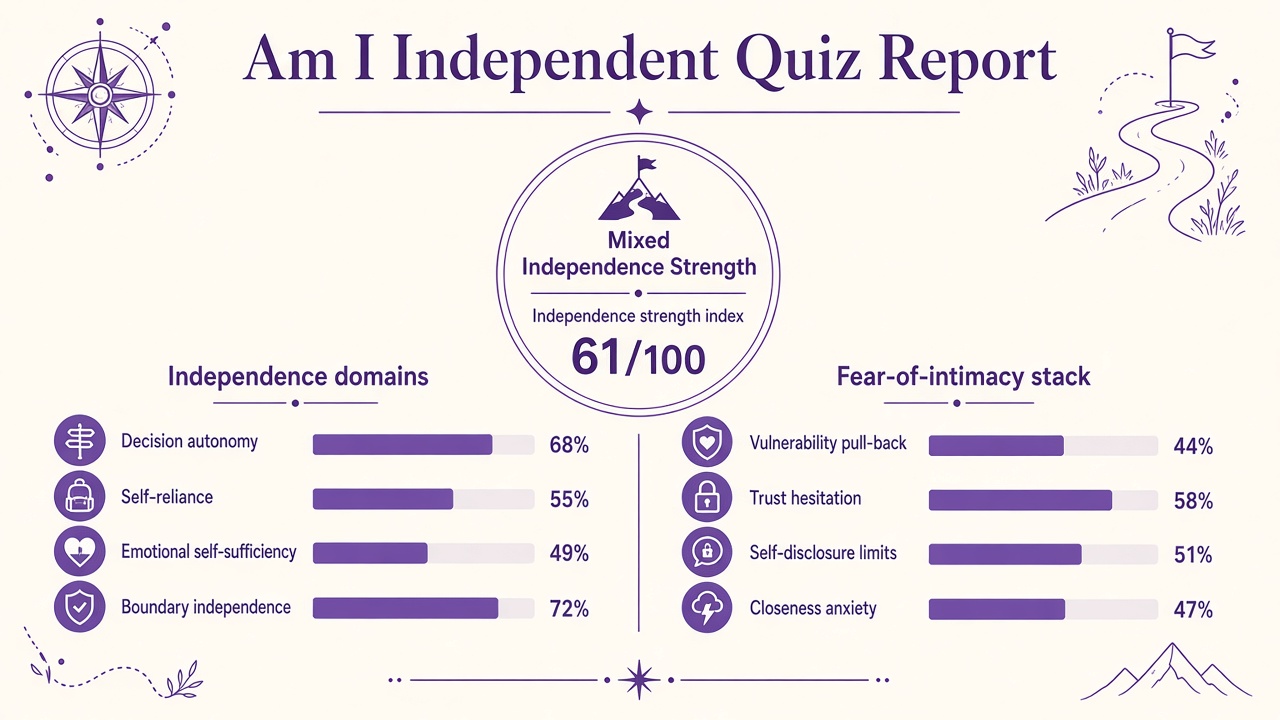
After all 20 items, you get an independence strength index from 0 to 100, a band label, four independence domain bars, and a fear-of-intimacy stack chart with vulnerability pull-back, trust hesitation, self-disclosure limits, and closeness anxiety layers. Percentages reflect how you report handling autonomy, not a fixed personality label.
What this quiz can and cannot tell you
Can tell you
- How much decision autonomy, self-reliance, emotional self-sufficiency, and boundary independence showed up in your self-report
- An independence strength index and fear-of-intimacy stack index with domain bars
- Which independence domain or intimacy stack layer feels strongest in your current patterns
- A starting point for therapy conversation about autonomy, enmeshment, and healthy interdependence
Cannot tell you
- Whether you have an avoidant or anxious attachment style without clinical evaluation
- Whether you are codependent or fully self-sufficient without a professional interview
- Whether cultural family consultation is the same as low independence
- What specific boundary changes others want without honest conversation and trusted guidance
Autonomy, differentiation, and the fear-of-intimacy stack
Psychologists Richard Ryan and Edward Deci describe autonomy as a basic psychological need to feel volitional and self-endorsed in choices, not necessarily isolated from others. Murray need theory treats independence as a recurring motive to act without excessive reliance on others. In family systems work, Murray Bowen wrote about differentiation of self as the capacity to stay connected while maintaining a separate identity under relationship pressure. High independence on this screener can reflect healthy agency, and it can also pair with stack layers that guard against closeness when vulnerability feels risky.
The Quiz Hub built this am I independent quiz as an original self-report screener inspired by those autonomy themes plus FOIS-style intimacy avoidance layers from Descutner and Thelen (1991), not a reproduction of any single published independence scale. Readers often compare it to sibling tools on this site. Our fear of intimacy quiz screens general intimacy avoidance across vulnerability and trust rather than four independence domain bars. The attachment style test maps secure, avoidant, anxious, and disorganized style indices rather than self-reliance and boundary domains. The am I immature quiz covers emotional regulation gaps and responsibility avoidance rather than autonomy framing.
| The Quiz Hub test | What it adds |
|---|---|
| Fear of intimacy quiz | General intimacy avoidance across vulnerability and trust, not decision autonomy or self-reliance domain bars |
| Attachment style test | Primary and secondary attachment style indices, not self-reliance or boundary independence domains |
| Am I immature quiz | Emotional regulation gaps and responsibility avoidance, not autonomy and differentiation framing |
| Am I lazy quiz | Task procrastination and comfort-first deferral, not solo decision comfort or boundary independence |
| Am I a pushover quiz | Boundary weakness and people-pleasing, not self-directed logistics or emotional steadiness alone |
| This independent quiz | Independence strength index plus fear-of-intimacy stack for decision autonomy, self-reliance, emotional self-sufficiency, and boundary independence |
Sample item types include agree-disagree ratings such as whether you feel at ease committing to your own goals without needing someone else to co-sign the plan first, or whether you protect private time for yourself without guilt when a partner wants more togetherness. High boundary independence with high closeness anxiety on the stack often lands in Mixed or Higher Independence Strength bands. Consult-first habits at home with solo leadership at work can split domain scores. Read how we review quizzes in our editorial policy or browse more tools on our personality psychology hub.
Am I independent quiz FAQ
What does the am I independent quiz measure?
Twenty original agree-disagree items ask how much you endorse decision autonomy, self-reliance, emotional self-sufficiency, and boundary independence in close relationships and daily life. Each item also maps to a fear-of-intimacy stack layer: vulnerability pull-back, trust hesitation, self-disclosure limits, and closeness anxiety. You receive an independence strength index from 0 to 100 where higher scores mean more self-directed patterns on this screener, plus a parallel stack index.
Does a higher independence strength index mean I am avoidant?
Not automatically. On this screener, a higher index means you endorsed more solo decision comfort, self-managed logistics, emotional steadiness alone, and protected separate identity items. Healthy autonomy can support resilience. High independence with high fear-of-intimacy stack scores may suggest guarded closeness worth exploring. This quiz cannot prove attachment style or label you avoidant without clinical evaluation.
What is the fear-of-intimacy stack on this quiz?
The fear-of-intimacy stack is a second results chart inspired by FOIS-style intimacy avoidance themes from Descutner and Thelen (1991), adapted to independence framing. Each of the 20 items maps to one of four stack layers showing how closeness guarding may pair with self-directed habits: hiding vulnerability, testing trust, limiting disclosure, or worrying about being too close. Higher stack scores mean more avoidance patterns on these items.
How is this different from the fear of intimacy quiz?
The fear of intimacy quiz uses frequency items about general intimacy avoidance across vulnerability and trust without independence domain bars. This am I independent quiz uses agree-disagree items focused on decision autonomy, self-reliance, emotional self-sufficiency, and boundary independence with a parallel fear-of-intimacy stack chart in one report.
How is this different from the attachment style test?
The attachment style test maps secure, avoidant, anxious, and disorganized style indices from relationship frequency items. This independent quiz focuses on self-directed habits and separate identity with four independence domain bars plus fear-of-intimacy stack layers rather than primary attachment style labels.
Can this quiz tell me if I am codependent?
No. The independence strength index describes self-reported autonomy and boundary patterns on this abbreviated screener. Codependency involves clinical and relational patterns that require professional assessment. Only a licensed clinician can evaluate codependency after a full interview.
Who reviewed this content?
Dr. James Whitfield, PhD, reviewed the test framing and result explanations. See our editorial policy for review standards.
Reviewed by