What this am I having a midlife crisis quiz measures
This am I having a midlife crisis quiz estimates how often midlife transition strain showed up for you in the past three months. Twenty-two original frequency items group into four signal domains drawn from adult development research: time regret, reinvention urges, mood restlessness, and role strain. Your midlife crisis signal index averages these patterns into a 0 to 100 score with plain-language bands. A parallel fear-of-intimacy stack shows how doubt may guard closeness. It reflects your self-report, not a clinician's evaluation.
Time regret
Wasted-years worry, unfavorable comparisons, replaying old decisions, and fear that change may be too late.
Reinvention urges
Fantasies about quitting roles, impulse lifestyle changes, envy of reinvention stories, and restlessness for a new identity.
Mood restlessness
Irritability without clear cause, restless-empty swings, 3 a.m. dread, and fading interest in former hobbies.
Role strain
Questioning marriage fit, feeling trapped by caregiving or breadwinner roles, family conflict, and hiding midlife doubts.
How it works
Three steps from first question to your midlife transition report. Click Start Quiz to open the interactive quiz in a full-screen modal.
Answer 22 frequency items
Rate how often each midlife transition pattern showed up in the past three months, from Never to Very often. You click Next after each answer; nothing auto-advances.
Items map to four signal domains
Your answers accumulate percentages for time regret, reinvention urges, mood restlessness, and role strain, plus a fear-of-intimacy stack index.
View band and domain bars
Results show Lower, Mixed, or Higher Midlife Crisis Signals with signal domain bars and intimacy stack layers. Higher bands include crisis resources.
Take the am I having a midlife crisis quiz
Rate 22 statements about midlife transition patterns from the past three months. Your answers produce a midlife crisis signal index from 0 to 100, four signal domain scores, a fear-of-intimacy stack chart, and a band label for reflection or therapy conversation.
Opens in a focused modal. No account required. Results stay on screen.
What your result means
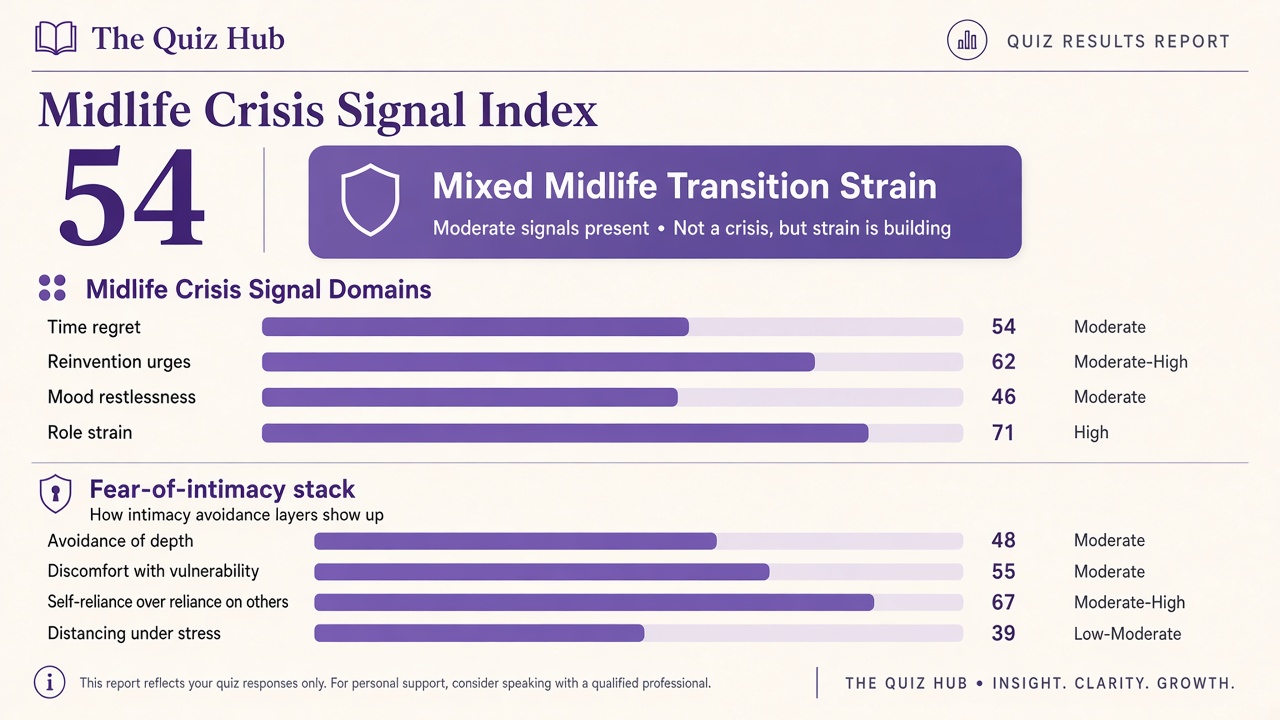
Your midlife crisis signal index is the normalized total across all 22 items on a 0 to 100 scale, with reverse scoring on protective items so higher scores mean more transition strain overall. Domain bars show endorsement rates so you can see whether time regret, reinvention urges, mood restlessness, or role strain drives your result most. The fear-of-intimacy stack chart shows how closeness guarding layers alongside midlife doubt patterns.
| Band | Index range | Typical reading |
|---|---|---|
| Lower Midlife Transition Strain | 0 to 35 | Fewer crisis signals on this screener; normal questioning may still appear |
| Mixed Midlife Transition Strain | 36 to 65 | Blend of doubt and stability; worth tracking before drastic decisions |
| Higher Midlife Crisis Signals | 66 to 100 | Frequent regret, reinvention urges, or role strain; professional support may help |
What your midlife crisis report looks like
After all 22 items, you get a midlife crisis signal index from 0 to 100, a band label, four signal domain bars, and a fear-of-intimacy stack chart with vulnerability pull-back, trust hesitation, self-disclosure limits, and closeness anxiety layers. Percentages reflect how you handle transition doubt, not a clinical verdict about whether you need to reinvent your life.
What this quiz can and cannot tell you
Can tell you
- How often midlife transition strain showed up for you in the past three months
- A midlife crisis signal index and four domain bars for regret, reinvention, mood, and roles
- A fear-of-intimacy stack chart showing how closeness guarding layers with transition doubt
- A starting point for therapy conversation before making irreversible life changes
Cannot tell you
- Whether you must quit your job, divorce, or reinvent yourself to feel better
- Whether you have depression, adjustment disorder, or any clinical diagnosis
- Whether your marriage or career is doomed without honest dialogue and support
- What treatment you need without a licensed clinician's evaluation
Midlife transitions, regret, and reinvention urges
Psychologist Elliott Jaques introduced the phrase midlife crisis in 1965 while studying how executives confronted aging and mortality at work. Daniel Levinson later described midlife as one season in adult development where people reassess marriage, career, and identity. In everyday language, am I having a midlife crisis searches often map to those patterns: regret about time, fantasies about starting over, restless mood swings, and feeling trapped in roles that no longer fit.
The Quiz Hub built this am I having a midlife crisis quiz as an original self-report screener inspired by adult development themes plus FOIS-style intimacy avoidance layers from Descutner and Thelen (1991), not a reproduction of any published clinical instrument. Readers often compare it to sibling tools on this site. Our am I burnt out quiz measures exhaustion and cynicism inspired by Maslach burnout inventory themes. The depression test screens low mood and anhedonia frequency without midlife transition framing. The am I dead inside quiz maps emotional numbness and flat affect rather than regret about life direction.
| The Quiz Hub test | What it adds |
|---|---|
| Am I burnt out quiz | Exhaustion, cynicism, and efficacy loss, not wasted-years regret or reinvention fantasies |
| Depression test | PHQ-style mood and anhedonia items, not role strain or midlife reinvention urges |
| Am I dead inside quiz | Hollow emptiness and autopilot numbness, not time regret or marriage fit questions |
| Fear of intimacy quiz | FOIS-inspired intimacy avoidance only, without midlife signal domain bars |
| Am I lonely quiz | Social disconnection and scarcity, not reinvention impulse or role strain |
| This am I having a midlife crisis quiz | Four-domain midlife signal index plus fear-of-intimacy stack for transition strain frequency |
Sample item types include frequency ratings such as whether you wondered whether you wasted the best years on the wrong path, or whether you fantasized about quitting your job or marriage without a clear plan. High time regret with high reinvention urges often lands in Mixed or Higher Midlife Crisis Signals. Empty nest shifts, caregiving overload, and career plateaus can spike scores temporarily without meaning you must make drastic changes. Read how we review quizzes in our editorial policy or browse more tools on our mental health and clinical hub.
Am I having a midlife crisis quiz FAQ
What is a midlife crisis?
Midlife crisis is informal language for a cluster of doubts that often appear between roughly ages 40 and 60: regret about time, urges to reinvent everything, restless mood swings, and strain in marriage or career roles. Psychologist Elliott Jaques introduced the term in 1965 while studying executive transitions. Later adult development researchers such as Daniel Levinson described similar questioning during midlife passages. This am I having a midlife crisis quiz measures how often those patterns showed up for you in the past three months. It is not a clinical diagnosis.
What does this midlife crisis quiz measure?
Twenty-two original frequency items ask how often you notice time regret, reinvention urges, mood restlessness, and role strain. Each item also maps to a fear-of-intimacy stack layer inspired by FOIS-style intimacy avoidance themes from Descutner and Thelen (1991). You receive a midlife crisis signal index from 0 to 100 and a band from Lower through Higher Midlife Crisis Signals.
What is the fear-of-intimacy stack on this quiz?
The fear-of-intimacy stack is a second results chart showing how midlife doubt may connect to guarded closeness: vulnerability pull-back, trust hesitation, self-disclosure limits, and closeness anxiety. Each of the 22 items maps to one stack layer alongside a midlife signal domain. The stack index summarizes those layers alongside the midlife crisis signal index.
How is this different from the depression test?
The depression test screens low mood and anhedonia frequency over two weeks with PHQ-inspired items. This am I having a midlife crisis quiz focuses on transition-specific signals: wasted-years regret, impulse to reinvent roles, restless mood swings, and feeling trapped in major life roles. Both include honest limits and crisis resources on elevated bands, but they measure different question frames.
Can this quiz diagnose depression or adjustment disorder?
No. The midlife crisis signal index describes self-reported pattern frequency on this abbreviated screener. Only a licensed mental health professional can evaluate depression, adjustment disorder, or any clinical condition through structured interviews. Online quizzes cannot confirm or rule out psychiatric conditions.
Who reviewed this content?
Dr. Elena Vasquez, PhD, reviewed the test framing and result explanations. See our editorial policy for review standards.
Reviewed by